
The Piriformis muscle (piriformis; “pear shaped“) is a tiny muscle located deep in the buttocks, underneath the gluteal muscles. This little muscle is the most well-known of a group of muscles known as the “Hip Rotator Cuff” and is frequently the source of the pain in the butt and leg pain.
Piriformis Syndrome is a miserable condition in which the Piriformis Muscle becomes overly tight. Although there are almost always underlying biomechanical issues to deal with (valgus / varus knees, high / low arches, etc) this pathological tightness of the Piriformis is 0ften the result of FASCIAL ADHESIONS, TENDINOSIS, or a nasty COMBINATION OF BOTH.
Piriformis Syndrome can be aggravated by bending, lifting, sitting, sports, and even driving (foot on the gas pedal). Contrary to what your M.D. might tell you, there are no drugs or surgeries that are effective for treating Piriformis Syndrome. I will warn you, in 20 plus years of practice I have never one time seen a person whose Piriformis Release Surgery actually worked.
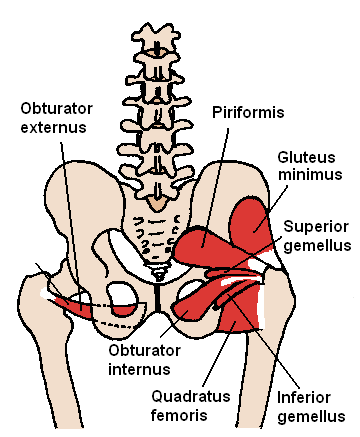
Photo by Beth Ohara
Piriformis Syndrome is an extremely common condition, and is far more likely to be found in women than men (about 6-15 times more often, depending on whose studies you are looking at). Although I can only speculate on the reason for this, I suspect that it is a child-bearing issue. It probably also has to do with the naturally wider shape of a woman’s pelvis. This is the most likely explanation for my finding it much more frequently in women than men —- even in women who have not had children.
As I stated earlier, Piriformis Syndrome is a major cause of sciatica (leg pain, numbness, tingling, or weakness, in any combination), hip pain, and buttock pain. Because sciatica is so often involved, Piriformis Syndrome is usually misdiagnosed as a slipped disc, herniated disc, or a chronic low back or sacroilliac problem (Hint: HERE is a simple test to help determine the difference).
The sciatic nerve is both the largest and longest nerve in the body, and at its largest point is about the thickness of one’s thumb. The SCIATIC NERVE originates in the low back (lumbar spine region) and angles toward the middle of the buttock. It then extends down through the leg, passing underneath the piriformis muscle. Be aware that in as much as half the population, the sciatic nerve travels through the Piriformis Muscle, passes over the Piriformis Muscle, or splits in two and passes directly around the Piriformis Muscle.
f
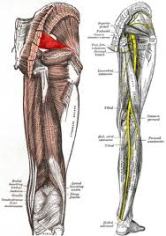
Piriformis Syndrome causes sciatica. The sciatic nerve runs all the way to the foot
f

Note the biggest part of the sciatic nerve near the top of the picture. The muscle that runs across the page just above the sciatic nerve is the Piriformis Muscle.
The symptoms of Piriformis Syndrome usually begin as a deep aching in what women like to refer to as their “hip” area. This pain will be found along an imaginary line that runs from the very tip top of the butt crack, to the greater trochanter of the hip bone (the bony knob on the upper and portion of the outer or lateral thigh).
A significant predisposing factor to chronic contracture and microscopic scarring of the piriformis muscle is wearing cruddy or improper footwear for your foot type (high-arched people wearing a “stability” or “dual-density” shoe). Other people predisposed to Piriformis Syndrome includes those with faulty spinal or lower limb mechanics, being overweight, having poor posture, spending too much time sitting, spending too much time on concrete, not partaking in enough physical activity (or occasionally too much exercise — over-training). And of course, the biggie — just being female.
Due to mechanical stresses causing chronic tightness / contracture, the Piriformis Muscle can actually become shortened over time. This often results in microscopic scarring of the fascial sheaths that tightly surround the muscle itself. Piriformis Syndrome is most commonly worse at rest (sitting or lying down) and is often (but not always) relieved temporarily, by moderate activity (particularly walking or stretching).
For years, I did not really understand why I had such good clinical results with so many cases of buttock / hip pain and sciatica, while other seemingly identical cases were largely unresponsive to chiropractic adjustments. Frequently these “problem” cases would get fantastic short-term results from their adjustment, but these results never seemed to last more than a few days at the most (and often no more than a few hours). It was not until I started doing “TISSUE REMODELING” in 2001, that I truly began to understand what was going on in many of these cases.
Over the past decade I have come to realize that Piriformis Syndrome is literally “epidemic” in the female portion of our society. Although I had no intention for it to happen this way, our Piriformis Syndrome Page is Destroy Chronic Pain’s #1 webpage by far. And despite all of the new research on the subject, the medical community remains largely mystified about what it really is, or how to treat it effectively. Again, drugs do not constitute “effective treatment” for most cases of Piriformis Syndrome (and surgery is such a crap-shoot….). Never assume that a “Piriformis Release Surgery” will solve your problems!
SCAR TISSUE AND ITS RELATIONSHIP TO PIRIFORMIS SYNDROME
As you have read, scar tissue is normal, elastic tissue (think nicely combed hair here) that has been disrupted from its organized structure, into a balled-up and tangled wad of inflexible and hyper-sensitive, micro-gristle (think of a hair tangle that cannot be combed out — HERE). When it comes to Piriformis Syndrome, this kind of microscopic scar tissue is not typically in the muscle belly itself, but in the Fascia. Fascia is the thin, but very tough, yellowish white membranes that cover muscles. In my neck of the Ozarks, deer hunters call these membranes, “Striffin“.
Fascia is arguably the single most pain-sensitive tissue in the body! Fascial Adhesions will cause pain and dysfunction. Destroy Fascial Adhesions and you can oftentimes Destroy Chronic Pain!
Because most of these scar tissues are in the fascia as opposed to the muscle itself, they do not image on MRI (HERE). It is my opinion that microscopic scarring of the Piriformis Muscle is the single most common cause of chronic, long-standing, SACROILLIAC OR BUTTOCK PAIN (the Sacroilliac Joints are the bony bumps that lie just up and lateral to the top of the butt crack). It is also the most common cause of what I was calling a “butt-based” sciatica twenty years ago.
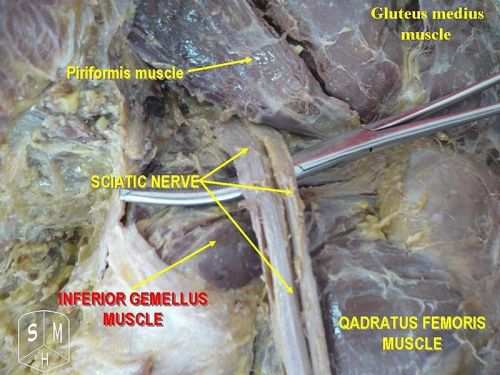
Photo by Anatomist90
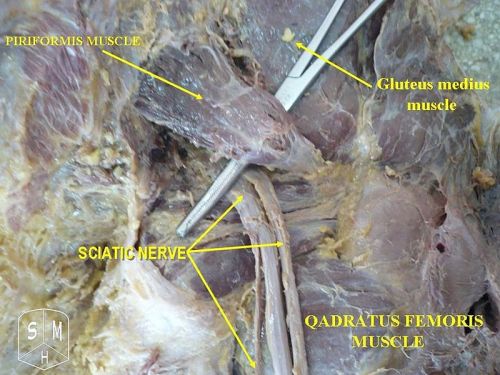
Photo by Anatomist90
If you found this page beneficial, please help us reach others by liking us or sharing on FACEBOOK. Thank you, Dr. Russ Schierling.

 Destroy Chronic Pain
Dr. Russ my dad had tailbone injury 30 yrs ago. Since, he has had many surgeries, pain management, etc. 3 yrs ago doctors told him they could not pinpoint where the pain was coming from and his last option was a an. Implant box from Boston scientific. He had that surgery. For 3 years when he goes to have an “adjustment” for pain where they move the leads around to try and block his pain it only works for 3 or 4 days and the pain is back. I’m looking as usual for answers. This man has lived with this and tried to get help for 30 years. Any advise?
Hello Cindy, Electric pain blocks are wonderful — as long as the leads are situated perfectly; something that’s extremely difficult to do. I wish I had simple answers but after attending a 12 hour seminar 15 or so years ago on chronic tailbone pain (not to mention nearly 30 years of clinical experience) I can say that there are a cases of coccyx pain that are virtually impossible to figure out. Someone out there has the solution, I don’t and am not sure who that person would be.
Sincerely, Dr. Russ
I fell 5 years ago from jumping up to hit a volley ball and landed on the side of my left foot. Bruising and swelling and sore for a short period. I have had many problems with my back, leg and foot pain, I have what feels like a constant current in my foot all day sometime shooting up my leg. I stand at my work all day. my back started bothering me along with hip pain. Started seeing an Ortho Dr. just getting steroid shots in the places I told them hurt. Shots worked for 2 weeks. I solved my back problem by removing the mats I stand on at work, I felt like the height of the mats were making me lean, and no more back pain. I have lost over 40 lbs in the past few months and sitting has become unbearable, I can not sit for even 10 minutes and I am almost in tears. My hip bone aches and the electric current in my let and foot increase. I get on the floor and get on my knees then my leg and foot become worse. I was told by my Chiropractor that I have Weavers Bottom. Reading this sounds like what I may have. Also reading this makes me feel I have no hope of getting better. I have a scheduled appointment for a steroid shot that is supposed to be done with a ultrasound to pin point where to place the injection. If this doesn’t work I don’t know what to do. I have tried all exercises and a cushion that has a gel to freeze. Nothing works. Any suggestions are appreciated.
This is probably PS and not Ischial Tuberosity Bursitis (Weaver’s Bottom) Anna. There are more doctors dealing effectively with this problem now if the piriformis muscle is truly gouging the sciatic nerve.
Sincerely,
Dr. Russ
Thank you so much.
HI Dr Russell,
I have just read your blog after another sleepless night in pain. I have had this for 4 years, which started with lower left back pain, was thought to be sacroiliac and after Cortisone in my sacroiliac joint 3 times which didn’t work, numerous MRIs my consultant said 2 years ago he thinks it is my piriformis. After some treatment at physio it settled but never went away. Came and went and saw Osteopaths as I thought it was my back more than piriformis. Anyway fast forward to now I have just had my ligaments replaced in my right knee, this was an old skiing injury which had been causing me lots of pain in recent years. It has always been painful but moreso of late. It turns out that my medial and acl were like bits of chewing gum. I am now back in the gym this week but still ‘sat’ more than I usually am as walking is still difficult. 2 months ago I couldn’t lay on my back and open my legs (like a gyny exam position) but the pain came and went, 3 weeks ago pain in my lower back flared up, I did some stretches for my glutes and piriformis early this week and YOWSA, I have been up all night with buttock and groin pain all week. Liftin up my leg for e.g. putting on socks. CAn you help? I am in the UK
Hello Joanne,
Very hard to say. If you ever happen to be in the States (Midwest) look me up — you’ll know within an hour.
Im just the opposite. I can sit for long periods without pain. Mine come early in the morning when getting out of bed. I lasts a couple hours until take a pain pill. During the day at work I am up and down with small children, not lifting but moving . After sitting, my legs tingle. It use to be just my left side tingling on the back of my leg but now my right side is affected. I don’t feel the need to see a doctor. The worse pain is in the morning and the rest of the day is tolerable. Im 68 but active. I also do the stretches and that helps for a short time.
Hello Diane,
Sounds like Spinal Stenosis.
Sincerely, Dr. Russ
I was finding that I was having pains in my buttocks and lower hip area, mainly when I will wake up in the mornings or if I had to get up during the night to go to the bathroom. The pain is excruciating. At first I thought it was my mattress and I noticed that after I’m up for maybe an hour, moving around it goes away. Then I decided to look up “pain in the butt”. I am so glad I did. After reading your article completely I realized what my problem was. You hit the nail on the head. (Sounds painful), … Believe me, it is… Horrible.
My doctor called me the very next day to give me my blood work results (everything was fine with that), but that gave me the opportunity to tell him about the pains that I was having in my butt when I wake up in the mornings (thinking it was because of my mattress). I’ll let him know what I read in your article, and I told him I basically understood what it meant and everything in the article as far as symptoms, I was having. I was just laid up for a couple of months because of nerve pain in my right leg from my ankle all the way up to my hip bone area. I was on Prednisone for a month. I told my doctor that I believed, from reading the article about “pain in the butt”, I realized I needed to start being more active and getting a for real exercise routine down. I asked my doctor’s opinion on what I thought about the article and if I was right considering my symptoms and the article, he agreed with me. He also told me to work on getting myself in a routine and doing more exercises and being more active and let him know how it was working for me.
At least now I know why I was having all this pain mainly when I wake up from a real good sleep. Thank you so much. Now I have something to work with.
This was incredibly helpful.
Thank you for all of youknowledge and skill I this
Area. I believe that no radiologist nor physican would
Be able to identify with anything close to these true results & findings. Too often things of importance are over looked.
I’m exhausted with trying to explain my circumstance. The two episodes of excruciating pain (pain that makes me pass out) have got me scared to death for when another could occur. I can’t see how I’ll cope. I was a happy runner 5 months ago. I don’t know what to do to get the drs to listen. Help😢
Hi
I have been suffering with what I now believe to be the condition you speak about. The pain in my left bum cheek and hip is awful when lying down and also the right as well. I have been to the docs and she thought I had bursitis and rest would help. Unfortunately it hasn’t gone away. It is worse at night lying down and have little sleep, the pain travels down my leg and my knee and top of my foot hurts. I started Pilates and I had to stop because of the pain in my hip when lying down doing exercises, walking sometimes is bad, plus the worse is when I carry shopping the pain it puts in my hip is awful. Iam at my wits end with it.The only relief is standing up ..Ive had sciatica before. So really fed up with sleep deprivation. Want my life back. HELP
Had laminectomy for L5-S1 herniated disc in 1999 when I was 33 years old. Then in 2002 had microdiscectomy (same level) in February. By October, same year, L3 – L4 had herniated. Diagnosis was obviously degenerative disc disease and I had to be fused at those levels. Since then I’ve had chronic pain that I’ve refused to allow to ruin/run my life. I’ve tried to stay active by exercising daily, (walking, yoga, Tai Chi, Tae Kwon Do) and gardening. However, a few days ago, I forgot/disregarded the fact that I’m a soon to be 52 year old woman with a surgically altered spine and pushed myself a little too far physically. I’m experiencing ,”paraformis syndrome” type pain that is accompanied with slight swelling, extreme tenderness that feels like a bruise, and, it feels as though I’m laying on a tennis ball when lying down. I can feel a knot on my butt. Has anyone else ever had these kind of symptoms? And if so, did it turn out to be hardware breakage? I’ve scheduled an appointment with my GP. But in the meantime I’m freaking out because I am terrified of the prospect of more surgery and all the crap that comes before and after.
This is my symptoms exactly. Cannot sit for more than 5 minutes without pain in my buttocks and down my leg. Can lie on my back with no problems. Cannot drive without terrible pain. Pain down sides of my legs when bending. Had mri which showed bulging discs in L4 and 5 but this not really related. This all started 11 yrs ago when i had my twins. I walk every day as this is no problems. My only relief is to stand. Cannot go on in pain forever. HELP. Lynn
Very comprehensive information & explanatory. Thank u
Yes this is it. Chiro isn’t working. It is an awful deep pain in my left buttocks and when pushed on fee like something is going to break. Just kills. How do I get this fixed? Bedtime sucks can lay on my left. Than laying on my right makes it hurt to if I don’t use pillows etc. Help what do I do about this???
Omg , I’ve been trying to figure this out for a long time. I think I just did ! I hope my Dr will listen because I’m miserable!!!
Too much pain in my left hip and both of my buttocks. I can not stand or walk for long periods of time. I had an MRI a week ago. My doctor told me that my MRI was normal. He is referring me to a pain management doctor, to see if they can help me.
I’m tired of the pain the numerologist also said it could be my pelvis. I feel horrible as though I’m falling apart someone help me out with this please.
Have you done the self-test yet Yoldanda?
Sincerely,
Dr. Russ
I am a 43 year old female. I went to an orthopedic doctor about 3 weeks ago. He gave me a steriod shot in both hips, which did NOT help at all. I set alot at work which is not good on my butt. My husband did the test above. He barely pressed on my left buttock and I came off the bed crying in pain. Please let me know what I can do to get relief from the pain. I take 800mg of ibuprofen twice a day.
Hello Christel,
Not knowing how long you have had this problem is tough, but I would assume not long since you only went to see someone about it three weeks ago. That’s a good thing. Be sure to read my articles because I have things to do and things not to do to help you help yourself get better.
Sincerely,
Dr. Russ
Can this be caused by injury?
Yes
This as explained more about my pain really good to read thank you.
Hello,
My name is hali, im 26 and i was diagnosed with PS a little over a month ago. I am active in working a in a pharmacy and chasing 2 kids under 3. I have had my pain for 3 months. 1 year ago I had a lumbar sprain while pregnant with my daughter, which such pain I went into labor and my daughter was born 6 weeks early. I have gone to physical therapy, lidocaine patches, naproxen/Tylenol therapy(which is killing my body), bath soaks, icy hot, and a 7 days steroid pack, but nothing seems to relieve this pain! I had an spinal scan 3 weeks ago and they found nothing wrong. What am I doing wrong and why am I not getting any relief. They gave me a pamphlet of PS workouts to do at home. I have not had a solid 3 hours of sleep in months. I think my body may be going into shock.
You may not be doing anything wrong Hali. Sometimes these things happen for no good reason.
Sincerely,
Dr. Russ
Hello Doctor, I am in dire need of help. My lower left buutock hurts a lot while sleeping and walking. Its worse when i move around too much. I fall down from a moving bike(accident) in January 2012 and till now i am experiencing the pain. I was diagnosed minor slipped disc and given Rejuneuron medicine. I cannot function daily without Ibuprofen.What could be the real cause of this pain and can it be healed permanently. I work as a waitress currently.
Tough to say what is causing it. Make sure to do the test I talk about in the comments repeatedly.
Sincerely,
Dr. Russ
This is spot on accurate to my condition. I went to my chiropractor about 2 months ago and told him I felt like there was a Charlie horse right in the middle of my left buttock. Of course the adjustments left my back feeling nice and limber, but my problem has not been solved. This all started when I was trying to improve my running time and distance. Now I’m not running at all because I’m afraid of making things worse. I wish you did not live 5 hours away! It is impossible to sleep more than a couple of hours and driving is like straight torture.
I received a rocephin shot a little over 9 years ago. The pain was excruciating. Since then I have had MRIs and x rays. I have done physical therapy which helped a lot. The pain is worse when standing still too long. There was a point when I could not stand for more than 5 minutes without pain. I don’t think what I read above is the problem, but do you have any ideas of what it might be. No one believes me that it was from that shot, but they can’t tell me what it is either. Please help me.
Hello Amber,
Although I see it with all kinds of antibiotics, the most common for this to happen are FLUROQINOLONES. Doctors are very aware that this is happening and choose to ignore peer-review and keep their heads in the sand — it’s easier that way than to have to explain that the treatment caused the problem.
Sincerely,
Dr. Russ
Thank you for this information. eIven though I’m discouraged, I believe I just figured out why and what I’ve been suffering for two years with NO ONE to be able to tell me. It all makes perfect sense.
I too am so happy!!! After driving for hours, I get butt cramp or pain in my right buttock due to foot being perched over gas pedal for hours. I hate driving now, but have to for travel baseball. I knew it was due to poor driving posture and couldn’t figure out how to solve it. Women suffer more than men for similar reasons that more women also drive with seat in 90 degree posture. I also sit most of the day at a computer, so I sometimes also have bad hip pain at night sleeping on side (although that is partially due to weight gain). I am hoping to try the new car seat position. I may even take my vehicle to an OT and see if they can help me position my car’s seat properly.
hello doctor! im 32 years old and been on birth control for 5 years (depo) shot..i work in a office and i been having the glute pain that i also feel in my left leg hip area. what can i do to help the pain i feel so miserable and i anxiety hitting me now..im unconfortable most of the time sitting,laying down .and better when i stand please help me
Hello Monique. Anytime you have butt pain that will not allow you to sit. PS is certainly on the table as a potential diagnosis.
Sincerely,
Dr. Russ
Dr. Russ I had coccyx pain when sitting for several months. It cleared up for awhile and has been back for over a year now. I have burning in right buttock and it also can radiate to themy calf and foot when sitting and lying. Sitting is better on a hard surface. An xray only shows mild degenerative disc disease. I have had injections and internal physical therapy with no improvement. Can you please provide your thoughts?
I actually went to a 12 hour seminar on this topic a lot of years ago. Tough to say Lin as tailbone pain of an unknown origin is not terribly uncommon.
Sincerely,
Dr. Russ
This is a God send. I’ve dealt with these text book issues for years. They improve and then reappear. The symptoms are much worse at bed time after a leg/glute work out. I also find that when I’m not consistently in the gym, it’s worse as well. I’m familiar with myofascial release and the benefits there in. How can I be evaluated? Please help
Hello Karie,
The fact that the gym makes it better and not worse means that it is almost surely a myofascial issue and not true PS. Anyone good at myofascial release should be able to help you.
sincerely,
Dr. Russ
Hi,
Just came accross your blog accidently.
It wa like you were talking about me.
Im 56yrs with Fibromyalgia and CRPS.
I have had MRIs done, pulse therapy nothing helps. Then I read your article and boom all was clear. I have severe pain in both buttocks,with pain in left leg, trocanter region both sides and left groin and anterior pubic region.All tests NAD.
Cant sit for more then 10mins. Standing also a problem and walking easiest thing to do.Pain increases going up an incline and declining.
Sleeping also difficult especially on left side.
On Zanaflex, Palexia and Ketamine all of which only dull the pain.
What do you think?
Yvonne.
Hello Yvonne,
As much as I would love to tell you I have the solution, CRPS throws a wrench in the machine and at the very least, muddies the waters. Bad stuff and I truly wish I had a simple solution for you. Maybe read my stuff on CENTRAL SENSITIZATION.
Sincerely,
Dr. Russ
Interesting. I was diagnosed with ankylosing spondylitis due to my sacrioiliac pain about 15 or so years ago as I have hlab27 gene, then undiagnosed by a rheumatologist because I didn’t have inflammatory markers nor did inflammation show on x ray. ( my son has AS with all the markers and the gene) Then diagnosed with depression. The pain was depressing. I tried all sorts of therapies and none worked. I continued to do yoga and to be active and just got on with it. The pain has alleviated somewhat post menopause and now I can do a lot more yoga. ( it was awful during my first pregnancy, disappeared after, no sign in second pregnancy, came back after with a vengeance)
Tried running recently it got worse and then included heel pain which made it hard to do yoga so I stopped running and worked to get rid of the heel pain with yoga and exercises for plantar fasciitis which worked.
I had never heard of piriformis but now realise this is what it must be. Pain first started about 18 years old and now I’m 54.
It sounds like even if piriformis syndrome was known about all those years ago there would be the same problems treating it.
I’m glad I understand it more now and if I’m kinder to myself ( have to listen to it) it is less cruel
Hello Jane,
Answering this is sort of uncharted territory simply because even though I have treated a number of people with ANKYLOSING SPONDYLITIS, I have never treated someone with AS and Piriformis Syndrome. Make sure to look at the link as I have all sorts of info about AS and other Autoimmune Diseases.
Sincerely,
Dr. Russ
Hi I’m 20 years old and this is quite a new thing, don’t know what to do… I’ve got this dull ache in my buttocks, my bowel movements aren’t good it’s been two weeks please help.
Very unlikely Megan, that this is PS. Sounds like it could be subluxation or possibly even a disc. I would have this checked out by someone qualified.
Sincerely,
Dr. Russ
Reading this article it seems it is beyond Orthopedic doctors to pin point exact diagnosis for Gluteal pain having “Various different diagnosis” When clinical and radiological diagnosis is a dilemma, how patient can be treated?
Hello Dr. Parmar,
You are correct on all counts. However, both EMG and Diagnostic Ultrasound are getting better, and the MRN technology will probably someday be more readily available and covered by insurance. As far as treating PS non-surgically, I have found that many cases respond quite nicely to Tissue Remodeling or various other forms of bodywork.
Sincerely,
Dr. Russ
Dr.
I have been going to the chiropractor and a myofacial guy for lower back pain for over a year. It has recently turned into a constant piriformis/sciatic nerve area pain. Much worse when I sit or lay down then stand back up, but always there. Chiropractor mentioned injections, but what is the best option long term?
Kevin
Very tough to say Kevin, but what I can tell you for sure is that I rarely see injections solve anything, although it might relieve you for awhile. The big problem is that the corticosteroid-based injections are massively degenerative.
Sincerely,
Dr. Russ
Good morning I also suffer from this bum hip leg pain…it is only sore when I put pressure on it. I am a runner and I suffer a lot.
I will go for physio….messages …. chiroptactor. Ijections….and then one day it will be gone….I will go for so many treatments that I don’ t know what helped..every year I waist mony on all things…..
I don’t know how to deal with this anymore.
Hello Dr.
I am a 52 year old overweight female with many health issues.I just had foot surgery, but what is pressing me at the moment is constant nagging dull aching pain right on and around my tailbone. I do have Degenerative disc disease, and I think a bulging disc in my lower back. I also am type 2 diabetic, have Fibromyalgia, Rheumatoid Arthritis, and Interstitial Cystitis. I also have Asthma, and Chronic obstructive pulmonary disease. When I am able to walk I felt better but didn’t lose more than 5 pounds. I eat well also.
I am answering this with a post via my blog. Look for it tomorrow or the next day.
Sincerely,
Dr. Russ
Hi. I happened upon your blog by accident. I have been dealing with some hip/buttock pain over the last 9 months. I am a 56-year-old female runner. I continue to be active with walking and cycling, but I have been unable to run for months. I have researched the gamut of PS, tendonitis, bursitis, sciatica, etc. I began seeing a neurologist a few weeks ago and underwent an MRI. I was diagnosed with “Lumbar degenerative disc disease most pronounced at L4-L5. Severe narrowing of the central spinal canal at L4-L5. Moderate to severe narrowing of bilateral L2-L3, L3-L4, and L4-L5 neural foramina.” However, I have significant pain in the left hip/buttock that does not feel nerve-related; it feels muscular and I occasionally experience muscle spasms in my butt. My physician is performing an injection in a couple of weeks. I’m hopeful I will find some relief but have a sense it won’t work. My husband attempted your “test”, but neither triggered the pain. I’m trying to figure out if I have the correct diagnosis. Any feedback would be appreciated.
Hello Carolyn
When you’ve got stenosis, it’s tough to say as it can cause all sorts of nerve irritation stuff. Inversion, when done correctly, or Spinal Decompression Therapy can often be effective for helping this problem. Make sure to read my post on the topic (HERE).
Sincerely,
Dr. Russ
Ive had pelvic hip pains for years im 29. Ive had 4 c sections cut hip to hip because the first one was emergency. I recently had an mri after thinking i had impignment where arthritis was found on my spine. Mri showed soft tissue edema slight disc prominence and moderate facet arthropathy. I can hardly move after getting out of a chair. I now have burning tingling pain at the top of my but crack. I was also told i have trochanter bursitis. Could this be something i may have?
Hello Krystina,
the hip-to-hip scar tissue could potentially pose a problem (make sure to read my stuff on post-surgical scar tissue). The MRI finding don’t seem pronounced enough to be causing the pain you are dealing with. You could have bursitis on your trochanter, but if so it would be very point tender. Best guess is that you have a fibrosis issue, probably in both the Thoracolumbar Fascia and the scar itself. All of this would put you in line for something called “Lower Crossed Syndrome”. I am getting ready to do a post on the topic so watch for it.
Sincerely,
Dr. Russ
I actually just had a abdominal hysterectomy and they removed some scar tissue. I had adenomyosis. Thank you! Its been miserable feeling drained and exhausted everyday. Although my hysterectomy made a huge difference with my engery unfortunately my pain in my hips/legs didnt go away. My back never bothered me until i had injections into my hip joint which on the second round he had an extremely hard time getting in my cartilage. Thank you for your response i will be looking!
I think I am suffering from this it is killing me. Could it be something else? It is taking away my quality of life to do anything. I am a 38 year old female, I had my spleen removed last year. Please help me.
Hello Mystery Girl,
I have seen a lot of weird stuff (some of it severe) from the gas they pump you up with for these types of surgeries. It could be a disc problem. Realize that this could be a disc problem. Make sure to browse comments and see the test for determining the difference.
Sincerely,
Dr. Russ
Hello Dr. Schierling. I’m an Irish dancer who has been having pain in my buttocks and upper hamstring when lifting my leg (high knee or straight), when sprinting/running, when flexing my buttocks (turning out my leg for dance) and when sitting. It’s a dull ache, but it really hurts my butt and my upper hamstring when I lift my leg and when I try to run. I have not been dancing or exercising and have been resting it, however it has not improved and quickly flares up when I try to do minor exercise. Physical therapy has helped, but the pain has remained consistent. The therapist was able to pin point the painful area by pushing on the right side of my buttocks, in the middle but rotated outward slightly. When pushed on it is extremely painful. I also visited a spine specialist to make sure it wasn’t a back issue, and lucky for me my spine is in great shape. Could this issue possibly be Piriformis Syndrome? I am really frustrated with the pain not going away and I’m having a hard time not being able to exercise.
Any advice is helpful! Thank you for your time. 🙂
Hello Hallkal,
Probably not PS, but almost undoubtedly some sort of FASCIAL ISSUE.
Sincerely,
Dr. Russ
Hi I am 71 and
I have had this pain in my left butt cheek with tingling in butt cheek going around to my groin but no pain going down my leg. Gone to spin doctor had three CT scans showing arthritis, scoliosis with narrowing around the nerve at disc 1 and 2. And other disc’s bone on bone. I have had three injections in specific places of trouble and no relief. Now going to physical therapy to be evaluated. After reading your articles and the comments I am sure this is my pain. My question to you is can I have piriformis syndrome without the pain down my leg? It hurts exactly how you described it in sitting standing and bad when I’m sleeping.
Yes you can Virginia, even though it may not actually fill the official definition of the “syndrome” part. Make sure to check out our videos as I have at least six individuals who had PS over 25 years, gaining full or nearly so resolution of their problem.
Sincerely,
Dr. Russ
Hi
Im 24 years old and recently noticed a depression (which corresponds to the location of piriformis) on my right buttock, which is more prominent when I flex the hip. There is also some tightness experienced when i squat. So far there is no pain or tenderness over the area nor any radiating pain going down to leg.
Could it be piriformis syndrome? And please guide me in how to treat this.
Thank you
Hi I’m 22yrs old and I am in so much pain! Only my butt though ! The pain is so deep now I don’t know what will help anymore. I have an extremely flat butt and won’t grow lol but is there anything I can do? Anything that will make it ease up? Any meds? Anything?I’ve tired everything !!! Please help!!
Hi I am a 37 active female and have been dealing with left mid buttock pain for 4 years. I use to run a lot and can’t do it anymore because it hurts so bad when I run. I have been to chiropractor and even had injections right into the buttock and spinal injections. None of it helped so had some deep tissue massages which did let some pressure off but still not 100% better. Over the last year I have been getting worse. Now hurts to walk, sit, and stretch. Kills me to sit on bleachers! I went back to Dr in fall with tremendous pain and sent me back to therapy. Been going for 3 months and still no relief and since therapy now having back issues along with back spasms that I never had before. Doing stretches and using a stimulator and they don’t seem to be doing anything. They started doing A stem and I am wanting them to do dry needling. I am a MR technologisit so I know my anatomy and it feels just like my priformis tendon is inflammed. I don’t know what else to do. I can’t live in pain like this for ever.
Hello Melissa,
Wish I were able to help you more, but you might find something helpful in THESE POSTS.
Sincerely,
Dr. Russ
This gave me a better understanding of what was causing my pain, after treatment on my disc in L 4/5, with epidural the discomfort/pain. In left buttock hip and going down my leg, due to heavy lifting at work, this treatment was amazing, how ever pain continued intermittently. It was good to hear others in the same predicament and it’s not in my head. Was interesting reading.
This article explains everything that been going on with me for over two years and none of the doctors I have seen can explain what is going on with me. They all pretty much gave up on me and no I see others has actually gone through this. Especially women. I have scarred tissue and pain on my mid buttocks all the way down the back of my leg. First it was was my left leg and sometimes in both legs. It is very painful and alot of times I can’t walk at all. It is frustrating seeing several doctors and no one understands the pain. To know that what I am going throw may not show up on MRI’S or e-rays explains alot. I am not sure where to go from here but at least I know that someone can at le as the describe it
I am 34, female, 4 kids and I just recently started getting tender pain in my right buttock (hip joint area) when I lean on that side when sitting or turning sides while laying. Coincidentally that is where I would have pain during my pregnancies. It was more of an annoying discomfort pain while this is tenderness. I hope it will suddenly go as it suddenly came.
Finding this has shed some light on my current situation. Besides normal back pain due to c-sections and a torn muscle while playing baseball 2 years ago I haven’t experienced any injuries. For the past 2 months I’ve had an intense deep ache which is at times, unbearable. The pain runs from my tailbone area to my calf muscle and is constant. It feels as though my leg is in a consistent cramp though there is a lack of tightness as you’d normally have with a cramp. The pain I normally (normal to me over the past 17 years) have with my back due to my c-sections is gone, though I believe the pain in my backside and leg (right buttocks and leg) simply masks that pain.. I no longer notice it. My doctor first prescribed my Tylenol 3, ketorlac (sp – was a high dose ibuprofen/anti-inflammatory) and Baclofen. None of these helped with the pain at all. I’ve gone back in after massage and a cycle of these medications with no results to which I have now been appointed to have an x-ray. My doctor has also prescribed Oxycodone and Pregabalin. So far these medications have provided a small rest for the pain though not much. I take the Pregabalin before bed which allows me to sleep but I wake with pain and extreme stiffness. At this point I am desperate for any advice or questions I can bring back to my doctor. I am waiting for an MRI which takes time due to waiting lists. He is convinced it is Sciatica but I do not believe so as there is absolutely no back involvement at all. Calve muscle and buttock area are also sensitive to touch and becomes very painful with pressure as well.
Today I went to therapist in reference to back pain and she touch me that area where the piriformis muscle I am literally almost shot off the table because it’s so painful but for a long time. I have be in pain. I had total knee replacement on both knees and soon after knee replacement I start thinking that I need a hip replacement because the pain was so unbearable in the hip area at this moment I will be continuing to going to therapy but I think I have found an answer thank you so much for the information it has been very helpful to me.
Good day
I am a 33 year old female and i think i suffer from what you explain. Doctors just give me pain killers. I have pain from my hip down into my feet. The pain is down my back into my bum cheek and then down my carves into my feet. Sometimes pain get so much that my whole area becomes so sensitive i cannot touch it and when i lay and stand up i cannot stretch my legs or trap on my feet. Please is there anything i can do to help my condition?
Hello Chevonne,
Make sure to read my posts on Piriformis Syndrome over at DoctorSchierling dot com.
Sincerely,
Dr. Russ
Amazing! Found answer to my pain and the doctors never did. SMDH!!!
Hello Dr. Schierling,
I got a problem through extensive cycling what I believed to be high hamstring tendonitis, because of the saddle digging in my thighs. I also get a dull pain, when sitting for longer times in soft chairs or car seats. Sitting on hard chairs is much better and triggers almost no pain.
The problem with my theory is, that I am able to run a lot without this pain (recently a marathon). As web search showed, high hamstring tendonitis is also a problem for runners, so I am considering that it is not a high hamstring tendonitis.
Can a piriformis syndrome only show when sitting and cycling but not when running?
Sincerly
Chris
Yes it could Chris, but from what history you have provided me, best guess is that it is neither.
Sincerely, Dr. Russ
I have this issue and have found the only thing that helps is myotherapy
Hi, I am a 39 yr old woman with previous spinal surgery fusing C-5, C-6, C-7 with a donor bone from my hip. I had recurrent pain about 3yrs later, had a rhysotomy (sp?) With great success for 4yrs now. I’m not super active, due to terrible fibromyalgia, but i do as much as i can. 4mos ago i began battling with some of the worst pain I’ve ever had, worse than my neck which I never thought possible. It came out of the blue really and starts in my very low back, my hip, the underside of my groin, runs down my legs into my heel. The pain and burning is pretty hard to describe really unless you’ve experienced it. occasionally I get a bit of relief that’s manageable, and I can function more which is why I can post this now. It was an ok day yesterday, and has lasted thru the night, but doesn’t typically last long and happens occasionally. I’m trying hard not to focus on it but it’s hard to focus on anything else. It’s affecting my life negatively at a fast rate. I had to quit my job, and I’ve pretty much lost the ability to care for my family. I can’t stand at The sink to do dishes, or even get in and out of the shower by myself. Its devastating.
The symptom that concerns me the most is the hip, butt, groin pain and burning in the underside of my groin as well. I’ve had an MRI, and they found nothing…thats happened before and I’m just not convinced, there has to be a possible explanation. I’m not getting anywhere. Muscle relaxants don’t work, prednisone was a false hope. It worked well to take the edge off for a couple days so i could eat some, and sleep some as well. As soon as I went off of it, I got worse. I’m eating little and sleeping less. Im up for 2 days at a time. The pain is exhausting, but I still can’t sleep because it’s so bad and no sleep doesn’t exactly promote healing. PT made it worse so I stopped, I couldn’t handle it. Chiropractic methods also failed and make it worse. I’m at a loss and with no health insurance, it’s pretty hard to get the care you really need so, I need financially feasible options and maybe a suggestion on what it could be. I could really use some advice, and help. Thanks
Very tough to say what this might be Tahnya, however I would suggest you head over to my Doctor Schierling dot com site and learn everything you can about inflammation, fibrosis, central sensitization, and fibro — lots of great self-help sort of material.
Sincerely,
Dr. Russ
I am in my mid 40’s and am an avid weightlifter. Sadly I haven’t done any lifting for almost 2 months because of my butt pain. If I stand too long or go shopping (10 min or more) my mid butt hurts and my leg goes numb. I love to exercise…it makes me sane and I’m going crazy with this pain. I’ve gone to a chiropractor but it persists. Wondering if I should go to a different doctor and maybe get some sort of muscle relaxant? My symptoms do differ from others….It only hurts when I am standing to long or walking and it isn’t all the time but at least once a day and it’s bad when it comes on. Only thing to relieve it is to sit down. Can’t live my life on my butt. :0) Any advice would be great.
Here’s the thing Angie,
There are any number of myofascial issues that mimic PS. So can disc problems. Make sure to do the test I mention several times in the comment section as well as in the article itself.
Sincerely,
Dr. Russ
My chiropractor did diagnose me as having this problem.
I have about thirty articles on PS over at my Doctor Schierling dot com site. Make sure to at least thumb titles as you might glean something beneficial.
Sincerely,
Dr. Russ
I have been in pain for 15 years now, after giving birth, I have been to different Dr and no one could tell me what I have. I have pain in butt but most of time by touching it and pain in the leg and sort of burning sessions. I tried everything I did echografie and radiography and nothing to see… I really don’t know what to do.
Wow! I wonder. I am 31 had hyperthyroid and with radiation treatment and now hypothyroid. I’ve been having bad often times excrutiating pain in my lower bac, hips and legs. I recently noticed a big dimple in my upper right rear cheek, min you I’m only 100lbs but because that’s where alot of times it seems the pain is radiating from, I noticed if any kind of pressure is applied there it send horrible deep sharp pain through my back and legs. Sitting in the car, restoom or anywhere becomes painful and I toss and turn at night it also affects things in the bedroom. I’ve had all kinds of tests done but will definitely be talking to my Dr. About this. I wonder if it is liked to autoimmune as well?
First Jess, make sure to read my stuff on both thyroid and autoimmunity in general as most thyroid issues, low or high, are autoimmune, and most autoimmunity can be addressed in the same general manner (HERE). Second, make sure to do the test I talk about in this post and mention in many responses.
Sincerely,
Dr. Russ
I’m in agony. Every night i get extreme pain in my hips, butt and legs. I can’t even turn over in bed. I had a spinal fusion two years ago – L4, L5, S1. MRIs are clear. However I have burning feet and I can feel two strips of fire down my legs during the day. Im on Pregabalin, Carbamezapine, Tramadol and Baclofen. The pain is so bad at night I just want to get out of bed and stand but I cant move. I also have intermittent pain in my left groin. Physio does not help. I’ve tried all the stretches given to me by physical therapists but no luck. Any idea what I can do? Please help.
Very doubtful Wendy that this is Piriformis Syndrome (rare bilaterally). Not sure what it is, but the most likely culprit if it is not a disc is some sort of inflammatory or autoimmune attack. Tons of info on my Dr Schierling site about dealing with this sort of thing.
Sincerely,
Dr. Russ
Hey Wendy. I am having the same problem. I went from trying to sleep in my bed to sleeping in a recliner or an expensive computer chair that reclines. It helps soo much you don’t even know. I tried sleeping in bed but it left me in tears and I’m a Marine and consider myself to have a high tolerance to pain. I feel ya tho. I hope this helps. I know it sucks. I dream of sleeping in bed once they can figure out how to clear this up, but until then, at least I can get some sort of sleep. If you don’t mind me asking however, what do you take pregabalin and carbamezapine for? The doc has me on baclofen and pain meds and thats it. If the other two help with it let me know please!!! Lol
Wish you well
Valuable information. Lucky me I found your website by accident, and I am shocked why this accident didn’t happened earlier! I bookmarked it.
I’ve had pain and been unable to run for 6 weeks now. Went doctor and he said Piriformis. I don’t have the shooting pain down my leg, I don’t have numbness nor do I have tingling. My buttocks hurt and felt tight in the center for about 4 days then that disappeared. Since then I’ve had pain at the very tip top of my hamstrings on the backside of my legs in further toward the inside of my legs. I’ve begun exercising, glute bridges, clam shells, front planks, one legged glute bridge. At what point will this pain cease and I can at least jog again?? Is this even Piriformis? I’m not certain the symptoms are indicative of that. Have another appt next week for 2nd opinion, but am curious as to your thoughts. Anxious to run. It’s been waaay too long.
Does not sound like PS Barrie, but not sure what it really is.
Sincerely,
Russ S
FYI had plantar fasciitis bilaterally. Dr. said I had to live with it. Started walking 6 miles a day and have not had a pain in 20+ years! I think if I do this again, I can resolve this the same way. Will let you know.
Thanks. I had already self Dx and this confirms it.
I’ve been in so much pain and have had no answers from the doctors I’ve been going to I think they think I’m lying when i tell them I’ve had this for more then 6months but i have and outs pinky gotten worse. I googled my pain and that’s how i found out about Piriformis syndrome I’ve never heard about it before. They are sending me for an MRI which honestly I don’t want to go to because of the pain i will have to go threw just to lay on that bed and then to have to get up and to no they won’t even see anything if this is what i have. Thank you so much for posting this information now i have something to take to the orthopedic they’re sending me to in two weeks if i can last that long.
Thank you ,
Liz
Hello Dr. , this article seems like it’s about my current situation. I had this exact pain during my first pregnancy 7 years ago and nothing helped. I’m currently pregnant and the pain is too much to handle. What can I do to relive it? Thank you!
Hello Aleks,
Bear in mind that pregnancy is not a contraindication to tissue remodeling.
Sincerely,
Dr. Russ
I didn’t stretch good back in Sept 2016. I did split it literally said “pop” it brought tears to my eyes…every since that muscle in that spot hurts, Is swollen, can’t rely extend leg, lift leg,or nothing without pain…seems to be getting worse as time goes on..I don’t know what to do about it… I feel like if they cut leg off from butt cheek down That it wound feel better
Hello Dana,
Obviously something tore or avulsed. You need to see someone for an exact diagnosis, then you can start to solve this.
Sincerely,
Dr. Russ
To the young gal , I had a cortisone shot into myb” ” spot ” which had hurt me on and off for 2 years. 85 took the inflammation away , which is why I was having so much aggregation , including hip pain . /9 now I just guard that spot , I guard my back , in careful not to pull and cause any strain on my butt muscles . I’m also 45 so I have that going again St me but I’m a nurse assistant and that is why it happened .
hi, I don’t know if this is related but anytime of the day, anywhere, I feel sudden pain simultaneously in my left side vagina(near the bone), buttocks, and my left ankle. It last around 1-2 seconds only. Can anybody advise or diagnose and what I am experiencing. I’ve been researching about this and still got no idea.
Hi
I have had chronic and constant pain in both buttocks for approximately 18 years. I’ve had physio, chiropractic treatment, massage, tried strengthening the muscles and been to my doctor and had X Rays yet still nothing seems to improve my condition. Have you any advice on what I can do? I’m in agony every single day, whether standing, lying down or sitting. As I’m only 35 I would like to ideally get rid of the pain, but I fear the best I can do is manage the pain. I would appreciate any advice at all.
Thank you
Martin
Other than what you find in my site, not really Martin. Wish I could do more for you.
Sincerely,
Dr. Russ
Hi
Around two months ago I started to get pain in my right butt cheek while sleeping – very painful when rolling over and excruciating when getting up. It started about a week after a holiday when I exercised with a sore back, went running and did HIIT barefoot and abs on a hard surface… Dr has given me anti-inflammatory tables and co-codamol for sleeping but it doesn’t help. I have seen a physio who found a very tight piriformis muscle and have had two sessions of acupuncture so far. The only result seems to be that I have developed a more typical sciatic nerve pain (down my leg, behind by kneee and my calves, sitting down is painful etc). I am also sore on the other side now although it feels more like an adjustment to my sleeping position than a tight muscle. Any advice? I need to sleep 😦
Hello Chiara,
I don’t really have anything that’s not already out there on my site.
Dr. Russ
I have had tingling in my left leg since February followed by numbness again just the left leg, i have had sciatica in the past too…. most recently i had a hysterectomy and 6 week post op i started get pains in my knees and hips and buttocks, traveling up from the knee up the thighs right round in a horseshoe shape, i can walk briskly with no pain but sitting, stairs, and laying down and sleeping are all sheer agony….. i have been referred to a Muscular skeletal doctor so he can see what it might be. pain killers do nothing so i don’t bother taking them. could i possibly have this too? also is there anything i can do to relieve the pain?
Because this problem is bilateral Sally, it’s almost certainly coming from your back. As long as there is not something like a tumor in there pressing on the nerve, some of the hints on my Solve Your Own Back Pain posts over at Doctor Schierling dot com could possibly prove helpful.
Sincerely,
Dr. Russ
I am a seventeen year old female who doesn’t get enough exercise and has high arches and foot pronation issues. I began to have pain in my left butt cheek five months ago. I haven’t been able to sleep on my right side, I can barely sleep on my back, and my right hip started hurting too in the past month or so so sleeping on my right side is also painful. I need to go to the doctor to figure out what is going on, but this is the closest thing I’ve found that matches my symptoms w/o any mention of swelling (as I do not have that). I just read this article and started crying cause I’m scared that I might be in pain for the rest of my life. Should I be scared of that or are there things doctors can do? And is it normal for this sort of pain to be happening in someone so young? Also, my pain initially started with sudden and acute pain in my lower back radiating up from my left buttock, and after it disappeared the pain in my left buttock started with the squeezing/sore/fullness feeling I have there now.
Hello Aidan,
You are young to have a PS issue, although I have seen it before. From what you say, it sounds like it may be a back issue. Besides a doctor that may or may not be able to do anything for you, I created a cool DIY post called HOW TO ADDRESS YOUR OWN BACK PAIN.
Sincerely,
Dr. Russ
For years I had major sore calve muscles from doing nothing but normal day to day stuff. That went away when I started taking creatine supplements. Recently the soreness came back in one calf muscle and the other popped. Plus for years I would get tingling in my toes. Since the injury the tingling has been constant and only a little bit of soreness. I have also been experiencing a small buring sensation in both of my hamstrings. I got a eng test and it came back fine, no issues. Just started some physical therapy and done a few new stretches to add to my normal stretching I do for small amounts of running and Taekwondo. Today I got a major pain right in the buttock area, where the pforisis muscle may be and it hurts to move, sit, squat, stretch. Any ideas why it may be super sore? Thanks!
Hello Erik,
Tough to say exactly what this is because there are so many things that can cause similar symptoms, but I doubt that it’s PS.
Sincerely,
Dr. Russ
Wow this is so interesting and fits all my symptoms
Yes i think you hit the nail on the head.it seems to be getting worse,i cant seem to get it to stop.im going to the doctor in the morning. THANKYOU..
Wow! I have been dealing with butt/hip/groin pain for years. I am a runner.
I am a woman.
My concern is that I have been running for years but cannot run anymore without pain in my hip/groin/butt. I have had injections, PT, acupuncture and now I am scheduled for hip surgery. I do have significant osteoarthritis in this hip.
BUT – I do wonder if some of my pain is attributed to the piriformis. And, dang if I want to have surgery if its a performs issue.
Thoughts?
Hi I have bursitis in my hips which I’ve had a huge flare-up for the first time that has not gone away. As a result I’m having cortisone injections in the hups. I’ve never had a problem. They take about 7 days to completely take away the pain and u can walk again. I’ve been getting them for a year and a half now usually by the same doctor. Recently I had a doctor do the injections who has hurt me before by taking too long to do them and pushing hard on the areas trying to find the worst area and I always ask for someone else because of this. I didn’t have a choice and he did them and I was fine except for the usual amount of aggravation from his poor technique when all of a sudden I got excruciating stabbing, radiating pain in the midle of my left butt cheek and down the outside and some of the front of my left thigh. It comes in waves. I’ve had it for 15 days now. Every time I think it’s getting better it starts again. He didn’t bother calling me back to let me know what he thought was going on. Could this be gapping because of the injections somehow? It’s not like my usual bursitis pain, it’s a sharper pain and comes and goes like lasting 10 min then stopping for an hour or 2 or 5. Does this sound like piriform? Nerve damage maybe? I don’t know what to do. I’ve been pretty much stuck in bed for 2 weeks. Scared to drive to the doctor. Ot hurts so bad I cry and yell so can’t go anywhere. Please help. Thank you
Hello April,
First, you sound relatively young to me. Secondly, if you are having bilateral hip bursitis on a regular basis, this is a significant problem. Third, if you read the material I have on my doctor schierling dot com site on corticosteroid injections, you’ll see how dangerous and degenerative these really are (it sounds to me like your doctor is not following standards of care). Not sure if this is PS, but you really need to get to the bottom of this issue or you will soon have artificial hips.
Sincerely,
Dr. Russ
So maybe I am gradually developing Piriformis Syndrome. I am over 73 yrs and quite healthy. I like to exercise and go for walking. In May I got cute pain, after X-ray and ultrasound which were ok, I diagnosed my self as having shin splint. I rested for about 7 weeks and wearing bandages etc. pain disappeared. Last week I started getting slight but tuck and thigh pain when I wake up or if I sit. When I move, it disappeared. Pain has increase and subsides at lower rate when I move. I feel at my best when I do my normal stretching exercises or after my 1hr walks.
How can I help myself to reduce this pain? I am traveling tomorrow for 16 days
There are a wide variety of PS stretches (I have a number of them on my DoctorSchierling dot com site). I would start by trying some stretching and maybe some massage.
Sincerely,
Dr. Russ
In 2013 at 59 years, I experienced sharp right butt pain and was diagnosed sciatica. The next morning i was sitting in a chair and leaned over to pick my grandson up and felt incredible pain down my right leg. I went to lay down and only got up to eat. My daughter noticed my right leg was discolored. I had an extensive Blood clot from lower leg into abdomen. I recovered fairly well and wear custom comprehension stockings. The clot never completely dissolved and if I sit too long I get pain in right leg or groin and rarely butt. I am a psych provider so sit a lot but pain not usually an issue unless too many days in a row. I have had scans many times since and no new clot (old clot never completely dissolved). Recently I have been having right side butt pain and it is worse if I lay on my back. I am afraid of course it is a new clot but at the same time wonder if it could be nerve irritation or something else. I don’t stay on my back long but have a sensation with the pain of tightening. The pain does not immediately go away and I don’t push the issue testing things because don’t want to make things worse. There is a condition also found in women called May thurner syndrome and is a cause of the same type of dvt I had. I am going to see my doctor and get my pain in the butt looked at. I was misdiagnosed originally and understand no one including me considered a dvt until my leg was involved.
No idea Cindy,
The whole DVT thing throws a significant wrench in the machine as far as knowing what is actually causing your pain.
Sincerely,
Dr. Russ
I am a 53 year old active female. I am the perfect weight for my body build and very healthy in all areas other than my hip/butt. I fell in May of 2016 and hit on my right hip and didn’t think it hurt anything as I was able to get up and go about the day without pain. The next day my left butt muscles felt extremely sore like they had been overworked. The right side didn’t hurt at all. The following day I started experiencing pain in my hip and going into my left leg. It felt broken but the xray did not show a break. The doctor said I tore a muscle and triggered sciatica. He put me on muscle relaxers. They do help but the pain is still there and it gets worse the longer I am on my leg. Some days I can only be up a couple hours before it starts. My relief is when I sit or lay down. Standing and walking feels like my leg is trying to come off. I have all the normal sciatica issues in that leg
also. Cramping numbness and tingling all the way down the back of my leg and into my foot. Any suggestions??? I do not want to stay on muscle relaxers.
Hello Tammy,
Could be disc or even myofascial. Not PS though. Lots of self-help stuff on my blog.
Sincerely,
Dr. Russ
….Tammy, I read your comment and I have also always been an active woman. I danced, skated, walked all the time , etc. I fell in 2012 , really hard, right on my behind, hitting the right side much harder. I am the kind of person that just sees if I’m ” OK” ,gets up and dusts myself off, rest a bit and go on. lol. I didnt start getting pain till a YEAR later. .; I had a childhood injury to the right side of entire body but had fully recovered from it, it took three and a half years…but I was fine. This fall aggravated that injury and I believe it tilted my hip EVER SO SLIGHTLY. Which is a big deal….and it was always this dull ache in my butt and noticed it would worsen with the weather turning bad. I could tell when it was going to rain, snow, etc, Crazy, lol. But them it started to go from there to my hip and I’ ve been battling it ever since. I have been using Baby Aspirin, Epsom salts baths and Tiger Balm. AND elevating my leg seems to help a great deal. I can skate and it is actually BETTER with doing this. I have no interest in meds, shots, etc, so I approached it from a standpoint of making sure I drink lots of water ( which I have always done anyway) , real food ( smoothies/ lots of veggies/ lean protein, and little carbs of the ” bad kind’. All veggies are carbs , but are the better carb, lol. ) Like you, I could only function a couple of hours at a time until I decided to not let this get the better of me. …and get myself back to a place of being active and getting on with life. I also had/ and sometimes still have the cramping, etc, as you described. I know that my Vitamin Supplements have helped, ( Take one magnesium tablet at night , with an Omega 3, it helps A LOT ) as well as eating avocados ( which I love ) , they have THREE times the potassium of a banana, can even be used in smoothies..
I am 63 years young and I want to encourage you , that it CAN be better and I already have felt it improving some. ..and it is so much improved from even a year ago. I wish you blessings , may you find healing that works for you.
Ok….good article that makes a lot of sense….My question is what kinds of stretching exercises do you recommend…..I thought I was going to need a hip replacement, was so happy to hear otherwise however, I’m still in the dark as to what to do….
I had one cortizone shot to relieve the pain , it helped tremendously, now what??
Be aware Judy that corticosteroids are massively degenerative and eat collagen-based tissue, which is basically everything in the joint. Using these drugs is essentially trading tomorrow for today. Tons of self help things, including stretches on my Doctor Schierling dot com site.
Sincerely,
Dr. Russ
Interesting you should say that! First I’ve heard of this. I had two cortisone shots in my shoulder (which now feels better) but funny thing now I have problems in lower back (degenerative disks) and extreme pain in buttocks. Could the shots have cause the disk problem? I’m 63 and play sports three time a week.
The medical guidelines for using corticosteroids are rarely followed (HERE).
Sincerely,
Dr. Russ
Thanks for this page I was just diagnosed with Piriformis syndrome. I am so happy someone finally listen to me. my problem is my regular doctor keeps tell me to work out and stretch o and my favorite one loss weight, how I am in so much pain after I can’t move. any suggestion?
Lots of them over at my Doctor Schierling dot com site Kim.
Sincerely,
Dr. Russ
I have been in pain for many years complaining to my doctor about my butt sore to move certain positions to try and get comfortable and my legs.The pain is horrible ii had to stop doing aerobics and Pilates and even yoga cant get into positions any more stiff and so much pain
Just found this sight 2 days ago and it describes my pain .one part i couldn’t walk at all .my doctor found a doctor who gave me cortisone in my butt to help me walk .which took 3 days .
I cry with pain turning over in bed sitting still at times
Walking getting in and out of my car
My back is no good .but my.muscles hurt more than.my back i cant sleep for days which makes my pain more .
I.am now in a different town.i will go to the doctor show him what i wrote down and try to get medication to help with pain and urgent help with sleeping
Thank you for this very informative article. I am suffering too much pain from this piriformis syndrome and I am already getting frustrated on how to ease the pain.I tried going to chiropractic treatment and did stretching every now and then,but to no avail.I am now having this small like ball lump in my butt cheek area which when pressed makes it painful and causes tingling in my left foot area.I am looking to your best medical advise to ease my pain.Thank you.
Tons of info on my Doctor Schierling dot com site Florence,
Sincerely,
Dr. Russ
This exactly what is happening to me. I had a ligament wear issue after which i experience this more as and when i use my left leg more ..or specifically while driving. I have consulted so many doctors and physiotherapists but they are not able to detect the actual cause and says it will heal with time. Can it be because of the knee ligament issue i had? Can it be healed? The pain sustains for 2/3days and subsides. Can you tell me some exercises?
Hello Gargii,
The answer to all your questions is on my site.
Sincerely,
Dr. Russ
Hi there,
This was really informative, and I definitely have this, but my question is what to do? I work with a PT, and things are pretty bad. It’s hard to sit and I have pain in the legs, butt, groin, hips. I had a cortisone shot in the muscles which I regretted, as it just irritated things and I got worse. I’ve been stretching and doing what I can, but I guess I’m wondering what course of action you would recommend. I am not currently seeing a chiropractor. I have a history of pelvic muscle problems, and I found it interesting that the piriformis is a pelvic muscle. Thank you so much!
Hello Sophie,
a chiro is great but you need to make sure you are getting some good bodywork as well.
Sincerely,
Dr. Russ
HI
I read your article and I am convinced that this is what I am experiencing. Also I’ve had the mesh inserted in me since 2001 in the vaginia. So I was thinking all this pain was from the anchors they inserted one dr even said he would remove them But I don’t want more surgery. what’s your opinionn on this?
Hello Marie,
When I see “mesh” all bets are off. It is almost impossible to know whether or not removing the anchors would provide any benefit.
Sincerely,
Dr. Russ
Hello Dr Russ
Fantastic article. It sums up my problems. I am male 72 years. I can’t sit or lay down without awful pain. I have been up all night with a throbbing stinging pain in my right ankle. Tried chiro. Was improving after 5 sessions and then he did something and I am back to where I started. Hoping for some relief soon. I need a sleep.
Hi Dr Russ.
I am Asif from Pakistan ,I am 32 over all in good shape I have been struggling with low back pain since 2009
I use to work as a loader in a factory heavy lifting was routine task after 3 years I developed a sore constant pain in my lower back near
the dimple on lower back right side I believe it’s called SI joint gradually the pain got wore & I had to quit that job .
but the pain never went away now I have a desk job but I can’t sit for more than 25 or 30 min . standing , going up stairs & driving makes pain worse
I also feel a deep pain in the right glute & right hamstring also hurts pain also goes to my right foot sometimes & the entire leg feels week all the time
My MRI showed L5 S1 Disk degeration / nerve root compression . SI joints didn’t show anything remarkable
I have had 6 injections in my back with temporary relief , acupuncture & oral pain killers dnt really help me much .
Prergablin reduces pain but it make me very dizzy & sleepy its also addictive
I do some stretches for PS I saw on you tube but the next day pain gets worse , heating the area also make it bad
There no qualified chiropractor available here .
Please advise me .
Thanks
Hello Asif,
The problem with your situation is without a chiro (or DO or PT or someone similar) in the area, you are left with a drugs-only approach. Make sure to read my article called “CHRONIC LOW BACK PAIN AND THE THORACOLUMBAR FASCIA“.
sincerely,
Dr. Russ
I am experiencing a great deal of pain. I was recently discharged from the hospital after a couple of days with an diagnosis which doesnt explain what is wrong with me. I had surgery last year the end of April, to remove 4 bone from my lower spine. I had narrowing of the lower spine which constricted the spinal cords, and cause my legs, hips and feet, swelling, pins and needles and sometimes numbness.
I’m beginning to get the same pain and muscle cramps in my left hip, buttocks and leg. None of the medications they are giving me seem to relieve this pain entirely.
I goggles my symptom’s and this Piriformis syndrome is exactly what I’m going through. Tired of taking medications and don’t know where to turn.
Wow!! After reading your whole page/article, I was amazed with what I read. This whole article narrows it down to me and definitely all of the pain and discomfort that I feel and yes I am a female. The “Pain in the Butt” is not a good feeling at all & I don’t wish it on anyone!! Male or female!! The pain does radiate to both of my hips and legs and the back of my thighs. It hurts like you know what. It does hurt especially to sit. I do stand on my feet for long hours at a time at work. I do seek chiropractic care and it does not help. Thanks so much for this article. The information was very helpful. And yes….”Pain in the Butt” is a good name for it and yes it t truly is a Pain in the Butt!!!
Dr Russ,
I am a 49 year old male and have had a pain in my right upper butt and I have pain that runs down my leg and ends at my ankle the top if my foot is numb. I can’t lay flat in bed and only lay about at a 45 degree angle. I did have a blown disk at the L4 L5 and had surgery to fix that. Still have the symptoms of piriformis syndrom. When I walk my feet room from the outside to the inside. I use shoes with rollbars to correct this. I have had this issue for about a year. Additionally I am a motorcycle rider and am retired from the military. I have been on gabapenten for about 6 months and do have some relief but am always in pain. Sitting increases pain walking and standing gives some relief but I can only stand or walk for short periods. Any thoughts. Thanks
Rusty
Hello Rusty,
Make sure to do the “Self Test” I mention in the article. It should help you differentiate.
Sincerely,
Dr. Russ
Dr i need your help!! Im 27 i have had this pain for 2 months and it is very very painful!! Ive payed out over 200 quid in the last few months on physio and its not going i feel like ill have this forever!! What is the solution!? Thankyou
Hello Kieran,
About the best I can tell you, not knowing any more about the situation, is to pour over my blog and learn everything you can — not just about PS but about inflammation as well.
Sincerely,
Dr. Russ
ThankYou for your reply I have looked through this and have identified some possible solutions. I have impingement or femoro acetabular impingement (FAI) on my left leg due to playing so much sport so i thought this might be thw cause of this new pain on my left. I cant play anything anymore just cycling. Anyway thanks again.
I’m a 40 year old male and every time I lay down for a period of time my buttocks hurts into my hip down my leg.It just happens on my right side! When I stand up it’s hard to start walking but once I get going it makes the pain go away? Do you think that I have PS please help I don’t get enough sleep at night!! Thanks Bradley
Very doubtful this is PS.
Sincerely,
Dr. Russ
hi, i suffer with 3 lower disc bulges at around L1. I suffer with pain in my back hip butt and leg. If its cold or i sit i get a bad paid in what seems deep in my butt and hip. I have to use a stick to walk.
I love everything you said exactly right
Hello Dr Russ,
I have been having pain in the right outside part of my glute just behind the pelvic bone, this pain radiates down the back and outside of my right leg and stops at my knee. It feels like it’s jammed or needs to be popped. I try to stretch it out but that doesn’t seem to be working. I recently found out I am pregnant and I drive a truck so I am sitting for long periods at a time. I do walk, climb stairs and walk my dog throughout the day… Any suggestions?
Ashley
Hello Ashley,
Driving anything for a living is hard on a spine. I would suggest that when you get a chance, see your chiro — a great starting point for an issue like this,
Sincerely,
Dr. Russ
Could domestic violence non cohabital cause this.A client went postal.He thru me around like a rag doll. Wrapped me around a pedestal table and legs wrapped around the pedestal..had a huge bruise in inside both thighs and right lung..They did an mri right then but it may been too soon.I can’t stretch with out spasming.Its my clutch foot I can’t use without spasming.People ask me to sit I say if you don’t mind I’ll stand.I can’t lay flat..my left leg will collapse on me. how can I know.?
Absolutely. However, because tests don’t show PS well, proving it will be a challenge.
Sincerely,
Dr. Russ
I put my back out weight training some 7 yrs ago. I couldn’t move for a week button better and didn’t think about it, being young and all.
Since then I’ve put my back out several times and started getting this pain which I think is p’s.
I was diagnosed with a slipped disc and told to stretch and strengthen core. Currently off work as I got Intense p’s, no back issue as such just this pain along with really tight hamstring, left buttock and leg.
Actually get depressed thinking will I ever solve this problem!!!
Hello Greg,
I believe there’s a solution for every problem short of rigor mortis. It’s just a matter of finding the person with the solution. Usually it’s fairly simple and straight forward.
Sincerely,
Dr. Russ
It literally is a pain in the butt!!! Happy to know I’m not totally crazy but I wish I was alone. I am totally obsessed with that nagging pain…& constantly messaging that area… Folks will begin to talk if they haven’t already!!!
Hello,
I am wondering If it is possible to aquire piriformis syndrome after spinal fusion on l4 l5? My back no longer hurts but my my butt, hip, and right leg are so bad I don’t know what to do. I’ve had a MRI and CTscan and they show the surgery hardware is in place.
I’ve seen it many times Delise.
Sincerely,
Dr. Russ
Hello,
Hit by a truck in ’98. Broke my hip and pelvis, it fused back together, just had second knee surgery and l5 s1 disc fusion, now am due for a hip surgery. Not one dr has mentioned the pf?? Kinda worried I have all the symptoms my left buttcheek kills and goes around to my hip. The Drs say it’s a ligament tear that needs to be fixed but I can feel some tendon or something in my buttcheek. What do you think? Thank you in advance.
Hello Mitchell,
The problem you get into in this situation is that most doctors don’t know much about PS because it does not show up with standardized testing.
Sincerely,
Dr. Russ
I think have both, PS and disc issue. So an inversion table can help with my compressed disc but at the same time can make PS worse? PS mostly on left side, but occasionally on right side. Also frequnt SI dislocation on left. Years ago it was SI on right until I stopped carrying wallet in back right pocket.
Hello Roykni,
Inversion might help you. If you decide to do it, do it very gently and gradually. When it comes to inversion, in most cases less is more.
Sincerely,
Dr. Russ
Hello Dr. Russ,
Many thanks for a great rich article.
I’m 34 years old male, 190 cm tall and weight is 88 kg. I’m a right handed.
I have maintained an active life style until 4 years ago when I got a bit lazy.
18 months ago sometimes -and randomly- when I wake up I notice lite pain in the upper left side of my glute, nothing serious but it’s annoying, it fades away through out the day. I’ve noticed this is more likely to occur when I over sleep.
4 months ago I got back to training including squatting -since 1 month ago I started high repetition bodyweight squatting-, rope jumping, and weight lifting. I’ve noticed the same pain comes back after cooling down of squatting repetitively.
The pain is lite it’s more visible for a second when I bend forward and in other positions it comes for a second then goes away or fades.
It always felt more reliefing to put the effected left leg over the right “left foot over right knee while laying on my back” the pain goes away.
Some information that might help:
Being right handed I’ve always felt that my squat form gets compromised specially in the last repetitions “I do alot of body weight squats, around 100 aday”, in which the right side does more work and the left is shaky.
In general I’ve a weak lower body.
I always blamed the bed thing on the mattresses specially that it I had to move alot at that time.
Your help will be much appreciated.
Thanks again,
Abdullah
Hello Abdullah,
Firstly, you might be overtraining. Secondly, watch my blog as I am writing an article on this topic in the next month or so.
sincerely,
Dr. Russ
Help! I’m so desperate for any kind of release in my right hip and leg. I’ve been suffering with hip/leg pain for four years. I have always been a runner but 6 years ago I started to increase my mileage and started running marathons. I was always training with high mileage and also working 12 hour shifts on concrete floors. After two years of running marathons I noticed during my races my leg would feel fatigue especially running up hill. I went to the doctor and was diagnosed with bursitis and piriformitis and also my psoas is really tight. I also get clicking around my tailbone and my lower back feels tight. I was given an oral steroid to help with the inflammation which seemed to help but for only a short few months. I also started noticing a sharp pain running down my leg while I’d be standing at work for a long time. I knew from having been pregnant before that it was my sciatica. I began doing yoga and using a topical antiinflammatorie and seemed to help a little. Fast forward about a year I was running a race and I felt great but all of the sudden my right leg felt fatigue more than it ever has. I tried to run through it and my leg started to feel like I had bricks tied to it but my leg felt like jello. I almost fell so had to begin walking. If that makes sense. I didn’t know if I could finish. But after walk/ running for two miles I was able to continue but with a slower pace. It has been so frustrating to see how this has effected my running. I have not been enjoying it like I us to. Ever since that race I have experienced this, going on the fourth year. I became pregnant and took a long break from running thinking that this is good for my body to rest. Once I began running after I delivered my son three weeks later it was STILL there! My right leg froze up and it radiates all down my leg, from my hip down my butt, both my quad, hamstrings and calf. I have noticed the faster I try to run the harder it is to keep running and the worse my leg freezes up. So say I’m running a 5k, I will try and race it as fast as I can but I end up walking alot of it, but if I’m running a marathon I can keep running but my leg will feel fatigued. This all usually happens in the first few miles than it will subside until later in in the Marathon. I’ve tried massage therapy, cryotherapy, yoga, foam roller, foot zoning antiinflammatories and it will help a little but nothing will fix it. Any thoughts or suggestions? My next resort is an MRI but as a single mother that expense has kept me from getting one, but I think it’s about time.
Hello Leslie,
Runners always hate to hear this, but were I you I would change sports. Try weightlifting, crossfit, whatever, but give your butt a break from the concrete and see what happens. I have seen way too many people who continue running until they are essentially debilitated.
Sincerely,
Dr. Russ
I need HELP! This is exactly what I am going through for the last 4 years, I can’t sit for more than 30 minutes, can’t stand, and now I can’t sleep or lay on on my back, I can only sleep on my left side. I do get some relief working. I work 12 hour shifts but after 6-7 hours I start hurting, it also makes my knees hurt like a lot of pressure around both of them , the nerve pain gets so bad That I cant stand it. I have been to 3 doctors had 3 MRI and nothing shows up. Had a nerve branch block on my si joint and steroid injection on si joint and L4 L5
Can someone please give me some advise on this.
Hello Sharon,
A couple of things stick out to me in your comment. Firstly, while not impossible (I’ve seen it), bilateral PS is very rare —- especially bilateral PS that develops simultaneously on both sides. This tells me the problem is probably disc related. Also, if you are exercising the way you are, but are still overweight, I would guess there are issues with your diet. Important to understand that inflammation is driven mostly by diet, and is intimately related to disc problems as well a host of others.
Sincerely,
Dr. Russ
Hi , I want to clarify that I am not over weight I weigh 133, bmi is 24 , I had an injury 4 years ago and it all started then, I also have pain and pressue on my butt, when I start hurting it starts in my butt then my knees feel like they are gonna blow up and the burn on down to my feet, I worked 12 hours today and I had to immediately lay down on my Right side , I laid down around 8;15 and its 10:00 now and the pain is so bad , especially in my knees and feet , my feet feel like they’re on fire along with being cold.I take 2400 mg of neurotin, 750mg metrocarbinate x4, and 100 mg tramado x 2 a day. I dont know what to do or where to go , the doctors Ive seen says I have no problems with my spine.
Tough to say Sharon, but my best guess is that both sides problems have a common source. This tells me that it’s probably something in your spine or thereabouts. Wish I could do more for you.
Sincerely,
Dr. Russ
Dr Russ,
Thank you so much for the information! Knowing that diet can affect inflammation is empowering. I will have to look up more information on that and what foods to increase and what foods to avoid.
In your last comment, are you saying that if the pain on touch is bilateral it likely is NOT piriformis? Sounds kind of sad to say, but I was hoping I would be able to finally put a label on my discomfort. Look forward to your reply.
Barb
Hello again Barb,
That is exactly what I am saying. Not totally impossible as I have seen it. But quite rare. As for the inflammation / scar tissue connection, I have at least half a dozen blog posts on the topic (all filed under “inflammation” or found by doing a search on the word “Fibrosis”). It is a critical link that the medical community does not even mention to people.
Sincerely,
Dr. Russ
Hello, I have just started getting burning sensation in both buttucks near the top of my legs, I admit I was sitting too long it started as a numb feeling then burning came after.
It went when I sand up but after two weeks its still here and now find even sitting 25 mins can kick it off and also last night was first time it happened while in bed sleeping I awoke with the pain from a deep sleep
Is this getting worse for me? Should I go tje doctors?
Im over weight but I excercise everyday I swim 80 lengths front crawl of a 25 metre pool and walk 4 miles once a week. Help! Thank you
Hi doctor , I’m a nursing assistant in a physical medicine rehab ( go figure ) and a few years ago I injured my ” butt “. It took me a long time to put it all together , but the pain went from my butt to my hip – and I feel they were connected . The butt pain was a like a nagging toothache and the only thing that ever brought or brings relief is when someone pushes on it with nearly all their weight. It hurts then but the pressure is then relieved. Sometimes that keeps me good for a few days . I also play softball and had been lifting heavier then I should of have been weights . The pain is now on my right butt and it does down my leg.
Today I sat all day at work with a patient and I could barley stand it . My PT at work says it pirformis . What do you think ?
Hello Kelli,
Sounds like PS to me. If you find the right person, this should be solveable.
sincerely,
Dr. Russ
Hi Dr.
It all started a month ago I think. I used to keep my keys in my right back pocket.My right butt used to pain while driving, I knew that keeping anything in right back pocket is not good for sciatic nerve and would immeditaly remove that when it used to hurt.
After a few days it would hurt without the key in the back pocket,I would then try to sit more erect and pain would subside. This went on for a month.
And last week, I had tremendous mental stress because of my wife’s health issue. Next day, pain my butt increased badly and I could feel that while driving. My right leg would not feel happy and I had ache around my butt and mild ache down my leg.
And since then I have not been able to sleep on my back. In 5 seconds, the pain starts.
I cant even sleep right side way.
If I have to sit on a chair or car, I have to keep something below my butts so there’s some sort of gap between the chair and area in my right butt that pains.
Is this PS?
Regards,
Sach
Hello Sachin,
It could be PS but usually people get relief by laying down. However, every case is different.
Sincerely,
Dr. Russ
my lower back always hurts, it’s been hurting for a few years. i went to a physical therapist and he said there was nothing wrong with me. Now fast forward 2 years later, I’m still having back pain and now I’m having sharp shooting pains in my right upper buttock area. it feels like i’m being electrocuted. I went to the ER and they said it was nerve pain/Siatica and said I may need to see a physical therapist or a neurologist. All they gave me was 800mg of motrin for pain and that’s not helping. so now I have to make an appointment with my primary doctor just to get a referral to see a physical therapist or the neurologist. Who should I see first? And in the meantime what can I do to ease this pain? Please help me.
I would suggest you see a chiro first,
Dr. Russ
I have searched the net and can’t find anything that even resembles what I am experiencing. In looking at pictures of muscles and whatnot, that are in the area of my pain, I have found that the piriformis muscle, and the sciatic nerve are exactly where my pain is. However, my symptoms do not seem to match either. I’m always the odd duck like that.
I do not have any pain at all, anywhere, unless I lie flat on my back, or lean too far back while resting in a chair/on a couch where my lower back is resting on the seat. After about 5 seconds, the pain starts. But when I try to get up, I have such severe pain from the top of my butt cheek, that runs over to my hip, that I seriously can not move. I can’t move my legs, I can’t raise my back up, I can’t roll over, and I can not sit up. I have a very high pain tolerance, and this pain makes me want to die. I gave birth without drugs and would rather do that again than try to get up.
Unfortunately, I am a back sleeper. I keep 2 big pillows under my knees, and I have no pain that way. It only happens if I lie flat, or lean back too far. No pain during the day, never have any pain that runs down my leg, in my foot, or anywhere else. I asked my chiropractor about it, he didn’t have a real answer. This problem has been going on for many years. Never gets better, never gets worse. If I knew what the problem was, I could maybe do something to help it, but I have no idea what I’m dealing with. I try really hard to remember not to do things that make it hurt like that, but occasionally I forget, like last night when I slid down and leaned back on the couch, then wanted to scream and die. That’s what led me to your page. Do you have any idea what might be causing this issue?
Hello Cathy,
In 25 years of practice, I have never seen anything quite like this. Definitely a nerve involvement. Not sure what’s firing it up — could be Scar Tissue but I have no real idea.
Sincerely,
Dr. Russ
Hi there…I had to reply
I have exactly what you are describing. Any luck finding out what it is? Regards Lilian
I have similar symptoms – haven’t been able to sit down for 6 years because of intense pain. I can’t lay on my back, and recently (last six months) both of my hips are really painful when I lay in bed on either side. The pain goes through the whole of my pelvis (front and back), but starts in the tailbone / buttock area. It is an absolute nightmare – the pain is very wearing, and can be excruciating. I don’t sit down. I have been diagnosed by several ‘specialists’ with coccydinia – but some said my symptoms aren’t ‘typical’. I am on here as no treatment, so far, has helped me. I am wondering if I have Piriformis syndrome. It yours isn’t PS, maybe it would be worth you looking up coccydinia? There is a really good website on this at coccyx dot org. Good luck to everybody reading – hopefully we will find relief one day.
The only time that I have pain in my right hip is when I am lying flat on my back, I get this intense pain in my “hip” area. Moving my right leg or torso is not a possibility at that point. The only way that I am able to relieve the pain is by using my left leg to roll myself over onto my right side. I have been going to the chiropractor for 3 years (ever since it started) and although he adjusts my hips every time the pain always comes back. It makes me very curious if it might be this, some areas on the right side of my sacrum are really quite sensitive to the touch and incredibly tight. This is a great article and very informative, I will definitely have to bring up this topic next time I see the chiropractor!
Hello Kennedy,
Let me know how it goes.
Dr. Russ
How’s it going just wondering can anyone help me I’m only 21 years of age and I’m a male I used to be a very active person I played every sport you could think of about 6 years ago out of no were I got a slight pain on my right leg by my buttocks and as the years went on they got worst I can’t really describe it but it was like I lost power in my leg because of the pain in my buttocks at first I thought it was a muscle but it wasn’t I was diagnosed with ankylosis rheumatoid arthritis about 3 years ago and then started taking acroxia tablets but to this day I still haven’t been able to play sport I do my exercise still to this day but for some reason I just do not think Its ankylosing. The pain is always there it’s feels like it’s a trap nerve but o paid so much money of physio and massages I just sick of it I would kindly appreciate if some body could please help or suggest help for me I would kindly appreciate it
Hello Scott,
The real question here is whether or not they have your diagnosis right. If they do, you need to read my article on Doctor Schierling dot com called “Exit Strategy”. If not, you’ll have to figure out a way to solve the nerve issue with the Piriformis Muscle.
Sincerely,
Dr. Russ
Hi im Casey Im 14 and ive been researching buttock pain it hurts right in the middle of my upper but … But when i check it theres nothing there… I dont want to be disgusting or anything i touch it and i feel a bone right in the middle where it hurts i think thats whats causing it cause when i touch it it feels bruised and sore and yes i play sports and im a very athletic person please help!!
Hello Casey,
Sounds like the pain is at your Sacroilliac (SI) Joint. I would see a chiro, as this can probably be resolved fairly easily.
sincerely,
Dr. Russ
I’ve Googled my symptoms and read different articles but yours is exactly what I’m feeling. The middle upper part of my butt hurts and across my lower back hurts hips ache when I stand to long and as I go to sit down I feel pain in my lower back and my knees ache on off through out the day. I could be laying in bed and everything hurts after awhile I also get sharp pains up and down my spine area they are so sharp at times I can’t move I’m only 38 and scared it’s going to get worse and I’m not going to be able to work. I’m a very active person I been nursing for 10 years I’m not over weight, I just changed my diet to vegan this year I know I need to see my doctor she knows I have back pain but all these other symptoms are getting worst I don’t want to seem like all I do is complain to her can you give me any suggestions.
Hello Crecy,
The best advice I can give is to read the numerous articles on PS included on the blog over at my DoctorSchierling dot com site.
sincerely,
Dr. Russ
Hello. I know what you feel. Chiropractic and acupuncture helped me a lot. You need to find only very professional
My spouse suffers from piriformis pain and diabetic neuropathy and was given Gabapenten to help. Is this Tissue Remodeling something that would help?
Maybe,
PN is an animal all unto itself and can definitely throw a wrench in the machine. Make sure to check out my posts on both topics over at my Doctor Schierling dot com site.
Sincerely,
Dr. Russ
Dr. Schierling – Three weeks ago I packed up my condo, hired movers and drove to cross country with my brother. I sat in the passenger seat and found that I continued to have discomfort in my left lower buttock during the drive. I had no pain other than while sitting in the car. I tried sitting on a pillow but it didn’t help. Once I arrived at my destination I found that the pain returned while sitting but was worse when I laid down in bed. I am usually able to find a position to minimize or stop the pain but I don’t see anything changing.
I am a 69 year old woman, in good health if you don’t count that about four months prior to my departure my physicians discovered that I had brain damage at the back of my brain due to shallow breathing while sleeping and a lack of air getting to the back of my brain. This effects layered thought and while it seems to be a minimal problem retired, it was the reason I retired from my position as a paralegal. The consequence/solution for this sleep deprivation diagnosis was a CPAP machine and a good nights sleep. I don’t believe the brain/CPAP issue is relative to the discomfort described above, but it seemed appropriate to add my most recent medical history. The truth is, other than this darn buttock discomfort, I feel healthy and younger than my age. I am not quite settled in my new location and have not yet found a physician. Any insights you may have would be greatly appreciated. Susan
Tough to say what it is Susan, but does not sound like Piriformis Syndrome.
Sincerely,
Dr. Russ
Dr. may it be an inflammation in gluteus muscles ? It feels like all the muscles in the area got crazy and they jump and hurt but no test shows anything wrong. I am frustrated
It could be Taly, but impossible for me to say not being able to examine you.
Dr. Russ
Dr Schierling,
It is been almost a year since i have pain and inflammation in the butt area. All my MRI’s and ultrasounds are great but i suffer a lot. I have pain in 2 buttocks and hips and it is hard for me to sit and to stand for a lot time. Terrible feeling. 4 months ago a doctor gave me steroids in pills and i really worked good. I took them for 1 month and everything got better for about 3 months and now the problem cane back and noone knows what it is. I make hot baths and Voltaren and Advil but it almost has no change. What would you recommend to try ?
Hello Taly,
Because your problem is bilateral, you need to look for a common source. While possible, very doubtful you developed PS bilaterally.
Sincerely,
Dr. Russ
I have pain in my butt, lower back,and hip that ran down to my knees. Sometimes it feels like my whole leg is starting to go numb. This is both sides. I was diagnosed bursitis in my hips and giving cortisone in each hip one month apart, July and August 2015. I have just recently had a 2nd injection in my right hip and have another on left hip next week. They seem to stop the pain in my legs but not my butt. After sitting for awhile I find it quiet pain when I get up to walk. I am a bar tender and have been for 40 years. So always on my feet. The pain can quite often wake me at night. Living on Panadine Forte.
Hello Wendy,
In my experience, bursitis typically does not lead to Sciatica. With bilateral leg and butt pain, you have to look to a common source. Although there are any number of potential causes of this, disc is the most logical and common.
sincerely,
Dr. Russ
Hello Wendy,
I actually replied to you via a blog post I created on this topic (HERE).
Enjoy, and thanks for sharing,
Dr. Russ
Hello doctor. ….
You are my new hero (and doctor Tent)! I admire your logical thinking though one thing I don’t hear anyone mention is the medications everyone is/ was on. For my father’s situation, I found that his ED Medication actually started his pain in his legs, buttocks, shoulders, wrists, etc….no doctor or test came up with this one. Luckily I ran into a similar website where people talked about their common side effects that were supposed to be so rare. ……people need to know to stop these medications and their mysterious pains in some cases could actually have a chance to get better as happened for my father. …..thank God for the Internet because doctors and safety inserts are inadequate.
I have been dealing with piriformis muscle, sciatic nerve pain and hip pain July will be a year now. I have been to a doctor which she took x-rays and didn’t see any broke bones because I have fell on stairs last year. She gave me a steroid shot which didn’t help. I have been to 2 different chiropractors. The last chiropractor I went to, took an xray and said one of my hips is turned out (this is the one where I have pain the most) and the other one is turned in. I never got relief from the chiropractors. I’m in pain all the time, every day. Is it possible that since my right hip is turned out it has my piriformis muscle tight and pinches or puts pressure on the sciatic nerve? What can be done to get my hip back to its normal position?
Hello Rhonda,
The answer totally depends on what is causing your pelvis to torque. Often times, simply adjusting more is not the answer because if there is Scar Tissue present it will pull it back out.
Sincerely,
R. Russ
Thank u I have been suffering
Badly. I have PN I pulled a groin muscle
6 was ago still looking for relief. . Help. I’ve tried tape the whole nine yards no, relief. I’m 61 yrs old. It’s making very mean. Marilyn.
The first thing you need to do Marylin is take a look at my blog over at Doctor Schierling dot com and read my articles on neuropathy.
Sincerely,
Dr. Russ
HI Dr. Schierling,
No I haven’t tried a chiropractor – but I will call around and look for one now. I almost hope that is what it is because this daily excruciating pain behind my left thigh and butt bone area cause almost my entire back to stiffen up now making it very difficult to walk and stand up straight. For now I have been taking Advil and Tylenol to relieve the pain and loosen things up. Thanks for taking the time to reply to my question.
Excellent,Thank u.
You are quite welcome Linette.
Dr. Russ
I had very bad sciatica where I couldn’t sleep through the night for three months. I am now 99% better. My chiropractor and physio helped but key to my recovery was the use of the reformer in Pilates which allowed me to strengthen my core. It’s a lot of hard work but worth it.
Excellent
Dr. Russ,
I am happy to read your informative article. I have had piriformis syndrome for two years. A year ago I had a MRI and was told it was because I was a female and old at age 54. I was told to live with it. I had been a runner for 35 years. I started biking, stretching, walking and yoga, It felt some better for awhile, but now it’s very painful again. I have had ten acupuncture and adjustment sessions. I am slightly better. But if I walk too much or sit too much the pain is incredible. I have had to change my lifestyle and avoid many things. I can relate to the other sufferers. Now what do I do?
Thanks,
Hello Ellen,
My entire article is about Tissue Remodeling. I would suggest you try some.
Sincerely,
Dr. Russ
Are you familiar with the nerve (complications) damage associated with surgical pelvic mesh placement? *Such as obturator, pudendal, cluneal, etc…
Slightly Rose, but I don’t treat them.
Sincerely,
Dr. Russ
Dr. Schierling ,
I was recently diagnosed with this and was given stretching exercises and meloxicam (to take daily for two weeks – and then as needed). I feel like nothing has changed and it is very difficult when I can’t even stand up straight in the morning to walk cause of the pain in the back of my thigh and buttocks AND I am scared to sneeze or cough because of the sharp pain it causes. Should I go back to the doctor? Should I request an x-ray or MRI?
Hello Natalie,
I would guess that this is disc. Hopefully you have tried a chiropractor before going for advanced imaging.
Sincerely,
Dr. Russ
Hi! I am a 24 yrs old and a week ago started having pain in my ankles, legs, bones by groin area and buttocks. Also feels sore. Most painful in the morning, and when I sit or lay down for any amount of time. Gets better when I stand or walk. I have high arches and do some Pilates. Can it be PS?
Thank you for your time!
I’m interested in have tissue remodeling. I was shot in the buttock 10 years ago and I have all the symptoms of piriformis. Can you refer anyone in my area??
Hello Carmen,
I have treated bullet wounds, but never one in the buttocks. Doubtful I could help you out with your question even if I knew where you lived.
Sincerely,
Dr. Russ
All that you’ve said here is the problems I am having. Are you sure that there is nothing that can be done to give me some relief. I work in a day care and I’m not use to not being able to move around like I need to. Please help!!:)
Hello Sandra,
Not sure how you could read my article and come to the conclusion that there is no potential solution for PS.
Sincerely,
Dr. Russ
Hi, I’ve been having constant stomach aches and diarrhea. My diarrhea smells like crazy bad, constant pain in my right Bum cheek like aching. Can’t get comfy and when pressing my bum cheek and there’s pain in a certain part. Tired all time out of breath feel sick add it all nearly five months stomachache worse when eating. Sometimes goes away a few days and sometimes sharp stabbing pain lower right side stomach thank u so much very worried.
Hello Laura,
Make sure you check out today’s blog post over at Doctor Schierling dot com as it is right up your alley with this.
Sincerely,
Dr. Russ
Very informative….I think I have this painful syndrome..thanks to this article I am self diagnosing my self as not having actual hip/joint issues and will certainly tell the orthopedic doctor when I make appointment of this article. However I am unsure which is worse Piriformis syndrome or a hip issue…sounds like no cure/relief for the syndrome
Hello L,
Make sure to check out the testimonials. Lots of people find solutions to “The Syndrome”.
Dr. Russ
I would just like to say that I have had this for over 3 years now. I started feeling the pain after starting a desk job. I have always had jobs on my feet. I started with chiropractic treatment and was going about 3 times a week for 2 years! It would temporarily relieve the pain. I then decided to see a doctor who had an MRI ordered for me! Told her my hips hurt with shooting pain. She looked at the MRI of my back and told me there was nothing wrong and that I should work out? I was in tears! I decided to get a 2nd opinion and was told I had bursitis on my hip. So I did the injections! Made the pain way worse and now I have the pain on both hips! Went to a 3rd doctor and he sent me to physical therapy, which is where they told me about this piriformis muscle! The did some great things there. I went for about 3 months, 3 times per week with temporary pain relief. I am now done with PT for about 2 weeks and I am back at square one. The doctor decided to prescribe tramadol and Mobic. I took the Mobic with no relief and I feel like taking the tramadol will just end in addiction so I decided to wait on that. I have been referred to an orthopedic doctor but am waiting for an appointment! At my whits end with this! I have a hard time working and I miss a lot due to the pain. My current primary doctor does not fill out paperwork for short term disability so I am stuck with the pain until I see the orthopedic who is out on vacation right now. I don’t know what is next!!
Jordan
Hello Jordan,
Either way you slice it, you have been though a lot of treatment. The problem is, this is the norm for huge numbers of people.
Sincerely,
Dr. Russ
Just got a call back from the orthopedic specialist… He doesn’t handle back problems and will not see me for this! Great! I didn’t realize this was a back problem? I had an MRI done that shows I have a very healthy spine!
Hello Jordan,
Because PS in its variations is usually a soft tissue problem, it does not image will with standard tests and technology. Very frustrating for those suffering.
Sincerely,
Dr. Russ
I have had piriformis syndrome for over ten years now, I had one piriformis muscle bigger than the other detected on an MRI scan of the pelvic area. Spinal scan will not detect it.
I’m in agony everyday and I have it bilaterally, I’ve had one muscle released, the sciatic nerve branched off through the muscle and was squashed completely and it stings inside loads at present, I think I have scar tissue forming, I’m so uncomfortable 8 mths on. the other is still squashing the nerve. I’m in so much pain in awful. I find sleeping very hard, it’s agonising.
Sadly mine was ignored by Dr’s when it first started, no one listened me, if they had at the beginning I would not be like this now. Physio may of helped me during early days. I’m angry as it’s ruined my life. Luckily now I have the best GP who is doing all he can for me.
Dr Shierling
I have been dealing with pain in my left buttock going down my leg for 2 1/2 months now I’ve seen the chiropractor five times he couldn’t help get rid of the pain and recommended a neurologist who tested my leg with the nerve test and found it to be normal he sent me to a pain management I have had two epidural injections which have done nothing anti-inflammatories work but have upset my stomach I have lost 15 pounds in two months is there a few stretches that I should be doing the can help stretch this muscle I am starting physical therapy next week. I’ve had two MRIs the one in the back shows no herniated disc just a slight bulge and two small posterior tears the MRI in the pelvic area done with dye was normal I don’t know what to do anymore. When this all started I also started vaginal spotting I’m a 63-year-old female went to the OB she performed a D&C for Polyps that came back normal but said that I have fibroids do you think that could be related to the pain nobody else think so. I’m was an active in shape person, now I feel like I’m withering away.
Hello Cindie,
Doubtful the two are related. Make sure to read my posts on this subject over at my Doctor Schierling dot com site.
Sincerely,
Dr. Russ
Candy I read your story and omg it was me , I can not believe the facts that you have put to paper. I have been to ,gynos,neuro’s, gastro’ s. Even rheumatoid specialists still no answer. If I find one I will surely pass it on
Best wishes Bec xoxo
Ps hopefully we find relief sooner than later xo
I came across another thread from a different site in which women who received steriod injections had fluctuations in their menstrual cycle, even post menopausal women. It’s a side effect of steriod injections.
Corticosteroids have a side effect profile as deep and wide as the Mississippi River. Lots of info on my DoctorSchierling dot com site pertaining to Corticosteroids.
Sincerely,
Dr. Russ
Dear Dr. Schierling.
I’ve been a registered nurse for 8 years. 6 out of these years i’ve struggled with left hip pain. I’ve seen several GPs and physios and they all say it is muscular. It is a constant dull pain, becomes unabareble with repetitive movements such as cycling or work out on a rowing machine. I then immediately have to stretch, and any stretch at any time is painful and only give a short window of relief.
How do you diagnose Piriformis syndrome and considering my symptoms is it likely that this is what I suffer from? What is the best treatment?
Thank you in advanced.
Kind regards,
Hege
Hello Hege,
Diagnosing true PS is tough, as there are all sorts of myofasical issues that can mimic. The biggest difference is probably that true PS will have Sciatica, and the myofascial stuff probably won’t. But don’t kid yourself — the myofascial problems and Fascial Adhesions have the potential to be miserable.
Sincerely,
Dr. Russ
Hello Dr. Russ,
I lived with chronic pain in my right “hip” for a couple of years, putting it down to the hard building/ landscaping work I was doing; but when that stopped and the pain didn’t go away I started looking for other causes, and more importantly, solutions. I eventually hit gold last December with a physiotherapist who identified ‘piriformis syndrome’, gave me stretches to do and massages. Life got a lot better: i can go for hours without pain. I can sleep! BUT if I skip a day of “self-care”, the pain comes back. Which brought me to your web site this morning and perhaps the missing part of my ‘treatment’.
I have strong/high arches; I walk at least one hour a day, often more, wearing Salomon walking shoes which i replace regularly… but you say:
“A significant predisposing factor to chronic contracture and microscopic scarring of the piriformis muscle is wearing cruddy or improper footwear for your foot type (high-arched people wearing a “stability” or “dual-density” shoe)”
Could you please, please expand/ explain? What should I be looking for in a walking shoe? How can I tell if they are ‘stability’ or ‘dual-density’? The shoes I have say “EVA midsoles” and “OrthoLite advanced formula insoles” which may be just proprietary jargon… but should it be avoided?
I am determined to live without pain – and I thank you for all the information on your website that aims for the same goal. THANK YOU so much.
Hello Dominique,
I don’t claim to be any sort of expert on feet. I can tell you what I’ve learned from having high arches with both foot issues and hip / buttock problems (not constant and nothing like it used to be). If you have high arches, you cannot buy a shoe that has a high enough arch to compensate for your high, rigid, foot. You will get the best information on the shoe you want by reading about it online. If you are in or near CO, go see Shawn at Xtreme Footwerks in Idaho Springs — he’s the guru.
sincerely,
Dr. Russ
Hi, Dr. Schierling…I, too, was so grateful to find your page. Six weeks ago, I had a terrible sinus infection and received two antibiotic injections–one in each hip (but administered by different people on different days). Both hurt a lot and were sore for a couple of days. But three weeks after receiving them, I was at the gym and attempted a single squat with very light weights. I felt searing pain in both injection sites and immediately stopped. For a few days, I couldn’t bend or lift my legs enough to tie my shoes (though I could walk OK). It’s now been three weeks, and one side in particular keeps getting worse. I have pain from the injection site down the back of my left butt cheek. Can’t cross my legs while sitting or do several other very ordinary things (not to mention yoga, Zumba, and PiYo, which I love). Could injections in those locations cause PS? And on both sides? And it is strange that the worst of the pain came several weeks after the injections were given? Trying to figure out what’s going on with me–and what to do about it. Thank you for any insight you can provide!
Hello Karri,
Let me first say that according to current peer-review, antibiotics are mostly not considered the standard of care for sinus infections any longer because the huge majority of all URI are known to be viral. Besides that, they set you up for future problems. As for your symptoms as related to antibiotics, I have a slew of articles on my blog filed under the category “Antibiotics”. Many, including a recent one, are about the degenerative nature of certain of this class of drug. Skim the titles and you will see how often antibiotics are related to chronic pain. The worst offenders, by far, are antibiotics from the Fluoroquinolone family (cipro, levo, etc).
Sincerely,
Dr. Russ
Love this site!!! You got the piriformis scar tissue pain problem right on the mark. I need you to go with me to the many doctors I have seen am still going to. LOL
Hello Dr. Russ
PLEASE DO READ THIS. PLEASE.
Firstly i really would like to thank you for writing this article.
Secondly i’d like to ask you what might my problem be. When I first started MMA training back in august ’15 my trainer used to make us stretch our legs 180°. Which indeed was a painful thing to do. But one day he came behind me and suddenly pressed my glutes downwards in order to spread my legs more. I felt a lightning pain and heard a sound. But the pain doesn’t followed after that. But after a couple minutes while doing chest level jumps I felt the intense pain in my lower back. For almost a month I felt the pain in my lower back. Although it wasn’t that much severe back than. I felt like I could recover. But than after 3-4 months it vanished completely. And started again a couple weeks later. In January ’16 I joined the Gym. And it was after that I realised that my pain was getting down to my left buttock. I thought it might vanish in a month or so. I did leg press abductor/addctor leg curls and extensions etc. And within a week i felt that the pain was increasing. So whenever i used to walk it used to get a lot worse. It made it impossible for me to walk. Then after 1.5 months some tingling in my feet started. It was then that i consulted a physiotherapist. He used some IFT machine to provide some electrical impulses to my left buttock. It reduced my buttock’s pain by 50% as he was also engaging me into stretching. But the pain didn’t go away even after a month of therapy. And even worse. The tingling which was very little in the beginning started to radiate upto my knee. Please help me identify this problem and let me know if there is any way to cure it. The symptoms are the following :
1. Unbearable pain in left buttock while walking.(although 20-25% while not walking)
2. Tingling / Numbness in the area under the knee.(which started from the feet and travelled upto the knee. Also the Numbness is mostly felt in the left-back side of my left leg and all 4 fingers of the feet except the big toe. It only gets numb when I get’s up from bed or sitting position.)
3. In the beginning pain felt while walking was only in buttock than it radiated to the right and now to the back side of the knee.
4. Pain gets better if I stops walking and do some stretching or rests for a while.
5. I cannot jump, run, jog, cycle. Or it gets unbearable for me.
6. I cannot lift my leg while standing without bending the knee.
7. Numbness started when the pain finally radiated to the knee.
Please help me sir. I would be forever grateful for your help. Please do help me. My life has became hell due to this pain.
Hello Himanshu,
Your trainer needs to be beat for his stupidity. Not sure where the tear might be. If you were in my office, I would start working and see what I could do with this, but the problem might be too deep to access. Hard to say. I would pay to have this pain relieved for you if I could do so. It’s just too hard to say exactly what is going on.
Sincerely,
Dr. Russ
PS; please let me know if you find a solution to this.
I found this helpful. I started with knee pain in the back of my knee then pain and tightness in my hamstrings. I had physio and massage and deep heat treatment on my thigh. But all my symptoms are back im fed up. I will go to dr and tell him this us what I think it is. Will massage help over the area to release adhesions. I am very sensitive n tense in my mid buttock area and hip pain
Hello Kathryn,
Massage often times helps with these symptoms and is a great starting point most of the time.
Sincerely,
Dr. Russ
it’s possible in guys as well correct?
im embarrassed if its only a lady thing. but im feeling those kinda things also
You are correct Ruben,
It is certainly possible in males. It’s just that it is much more common in females.
Sincerely,
Dr. Russ
how can i figure out for sure if it is this or something else?? everyone i talk to thinks it might be early signs of diabetes or nerve damage. how do i narrow it down and eliminate false suspects?
i feel it around the knees, from my right knee up to the hip, shins, calves, bottom and tops of feet, hamstrings – my lower half basically sucks right now. and because of that – every single day sucks because i dont feel normal. like you said in your description sitting is what affects it the most – in fact sitting for too long is probably what caused it i think. along with years of poor posture, lack of exercise, like traditional exercise (i always thought going to work and working hard was exercise enough) now i cant even go to work.
any help you could provide would be very much appreciated – i thank you for your time
The whole Diabetes / Inflammation thing is why I am such a stickler for Paleo. Have you seen a doctor to be evaluated for Peripheral Neuropathy? I just put up an article on it on my blog last week or the week before. Also make sure to look at the “test” I link to numerous times on this page (it is also in the body of the article).
Sincerely,
Dr. Russ
So how do I treat piriformis syndrome now?
Make sure to read the many articles I have on this topic on my Doctor Schierling dot com site.
Sincerely,
Dr. Russ
Thank you so much for the amazing article! For almost a year this pain is driving me crazy no metter what I do. It gets way worse when I lay down. You described my symptoms and it feels good to finally find out what is bothering me since my doctor and chiropractor could not help. I’ll do more researches to find out what could i do to get better. Thank you!!!
You are welcome Danny.
Dr. Russ
Is there anything I can do to help it. I only have the problem if on a long trip in car or sit to long on couch. I do streching it helps. Get up and walk helps. Just tired of it it’s been 2 years.
Lots of self-help stuff on my DoctorSchierling dot com site.
Sincerely,
Dr. Russ
Have had constant hip and back pain issues for years on my outer right hip and tailbone area of back. Had an mri done of spine 12 years ago and had a hymangioma and swelling at l4/l5. Have had my ribs dislocate at c2/c3 with no obvious cause. Have had pelvic/pubic separation during last pregnancy making walking nearly impossible. I also have Instertitial Cystitis with severe detrusors every 3 minutes or so and Pelvic Floor Dysfunction. Now my sacroilliac joint keeps popping out of place on my right side. I have had bad bouts of sciatica in the past as well. I now have small fiber neuropathy for which I take gabapentin. I have bouts of cramps in my feet that nearly cripple me as it shoots up from the arch into my pelvis area. Now my left side butt cheek has a deep aching pressure that hurts worse if I lean forward or sit. I also get extremely bad cramps in my calve hip and pubic area that radiate down my leg to my knee. My right knee locks and pops. I also get symptoms of raynauds when exposed to cold and by cold I mean anything below 80 degrees causes my hands feet face and butt to go ice cold and white and then when I warm back up they get bright red and flushed like I was playing in the snow. something as simple as walking in the refrigerated isle at grocery store induces this. I am starting to worry that there is something really wrong.Is this all related to a pinched sciatia?
The fact that you have at least two Autoimmune Diseases (Raynaud’s & Interstitial Cystitis) not to mention the PN (a hallmark of both Fibromyalgia and blood sugar dysregulation) tells me that you have Inflammation running rampant in your body. This is the first thing you need to deal with. Fortunately for you, today’s blog post is on Peripheral Neuropathy. Take a look at it because I will show you some tricks to help you potentially deal with all of these problems.
Sincerely,
Dr. Russ
Thank you so very much, I can’t believe that this hits the nail on the head perfectly this is exactly what is wrong with me and I had no idea I thought I had bone cancer or something! Thank you very much!
Glad I could be of help Anita.
Sincerely,
Dr. Russ
I’m a 57yr. old female with no children. My job involves labor as I am a product merchandiser. This pain started about 3months ago and doesn’t usually bother me at work. Yes, concrete floors. Right side, stops at knee from the right butt cheek. Hard to walk at times at home. Some creams help….thought it was arthritis or old hamstring pull from 30yrs. back. Try diabetic shoes?
No idea where you live, but if I saw you in my clinic with this, I would automatically think of Scar Tissue / Fibrosis in the buttock / hamstring area. I would treat you, and probably not even make a follow up appointment. Best guess, it would dramatically improve almost instantly.
Sincerely,
Dr. Russ
hi dr. Russ,
back in january i fell directly on my buttocks onto a stoop stool. Could this have triggered the pain in my piriformis? i have never had this pain before. My masseuse told me it is possible. Can this be true?
Thank you
Brenda
Absolutely Brenda,
PS is frequently the result of a fall or impact type injury.
Sincerely,
Dr. Russ
I have previously had a slipped disc removed on left side .for the last week I have pain on right side buttock area that goes to my hip and groin area worse when walking or sitting .thebpajn is constant I feel like when I am walking I’m walking strange as if my body is pushing to one side .please help
Hello Marie,
What exactly do you want me to do?
Sincerely,
Dr. Russ
I have been having this problem for about a year and it is getting worst. I haven’t seen a doctor and I don’t know what it is that’s giving me unbearable pain. You actually described every problem my leg hurts my upper but area and my hip. It’s so hard for me to work let alone drive I am only 21 is this common for younger females?
21 is quite young, although I see this sometimes.
Sincerely,
Dr. Russ
I have been having a battle with this for over 25 years now. Sometimes does cause sciatica pain down my leg but most the time DOES NOT! I had a pain specialist tell me that the chance of it being in that tiny muscle was so rare…well, he laughed at me! Sometimes, the pain is to the point my leg gives out and I’m down in an instant. I’ve had problems with my back for years. Two years ago I had a steel rod put in my cervical neck and I do have some bulging discs in lumbar and sacral sprine. Have lots of arthritis in lower back too which dr. tells me is causing all the pain and not to worry but I’m sick of this!
Hello Kim,
I have seen many cases of debilitating long-term piriformis issues that do not involve sciatica. Most of the time, it involves hardcore Fascial Adhesions.
Sincerely,
Dr. Russ
I am a 27 year old male. My back issue comes and goes. Have been good for 2 years but the last 3 months it’s been back and as bad as ever. I am told I have a pinched nerve in my lower spine. My pain initially was right in my tail bone. I have been doing physio twice a week, being put on a traction table. Feel like that pain has gotten better but now have sever pain from my butt to the back of my knee. What can I do to fix this?
Hello Derek,
Be sure to read my post called, “Chronic Low Back Pain and the Thoracolumbar Fascia”.
Wish you well,
Dr. Russ
On January 17th, I developed a sore back from taking down decorations (this is nothing new and I thought very little of it) On the 20th, I experienced extreme pain, tingling, and weakness in both legs. Within an hour, I was incapable of walking and my husband and to carry me just to get me into a wheelchair. MRI was done ASAP to r/o Cauda Equina. I had also developed difficulty voiding. MRI shows some degeneration at L4-5, DJD, and mild to moderate cord compression, lumbar stenosis. I was treated with anti-inflammatories and sent home with a walker. When I was discharged I was unable to bear any weight on my right foot and minimally on my left foot. I strained with all my might to void because straight cath was something I was desperately trying to avoid. I remained out of work until the 23rd, use a cane, and still go to PT 2/wk. I’ve gained back much of feeling in my right foot. However numbness and tingling persist across the buttocks and I have pressure at the bottom of my spine. I have strained to pee SO much, I feel as though my urethra opening has stretched as well. I’ve been told nerve damage can take a very long time to heal, but i am getting frustrated and do hope and pray that the “tennis ball” I feel I’m sitting on goes away sooner rather than later. I’m still uncertain as to whether or not to use ice and/or heat. ANY advice would be so appreciated.
Hello Christina,
I have actually had a case of Cauda Equina Syndrome in my clinic that the ER had sent home with Tylenol (we sent him to a different ER with a hand-written note explaining what his problem was). This would have definitely been at the top of my list concerning you. However, cord compression can do very similar things. This is not PS. I have a post on my Doctor Schierling site called CHRONIC LOW BACK PAIN AND THE THORACOLUMBAR FASCIA that has a ‘Top Ten’ list of DIY for your back. I would probably at least talk to someone in your area about Spinal Decompression Therapy. “Moderate Cord Compression” will sooner rather than later lead to some sort of surgery.
I wish you well,
Dr. Russ
So what does a person do to release the fascia? I have had butt pain and lower back pain for about 5 months. Lately I find the most relief from the tightness by massaging with a lacrosse ball. It seems when my butt hurts then it causes my lower back to hurt.
Hopefully, you read my article on Foam Rollers over at Doctor Schierling dot com.
Sincerely,
Dr. Russ
Hello Dr. ! I am 33 years old , mom of 2 kids. I am suffering from buttocks pain two sided already 6 months. All my MRI’s are ok. I feel a preassure pain when lying on sides. When sitting i feel like sit bones pain. My pain was worse and i also had hips pain and feeling of instability. Anti inflammation drugs didnt help and my doc gave me the prednisone for a month. The pain got better in hips but buttocks pain is still there and another strange thing is jumping of muscles in buttocks and hamstring and feeling tightness in hamstrings. I had no injuries . I have seen a lot of doctors and noone can tell me what it can be. Some doctors tell that may be PS . Is there any test i can do to make sure the problem is PS ? Ultrasound maybe ?
Although the newest diagnostic ultrasounds are far better than they used to be, I still don’t believe they do a good job of imaging PS. There are very special sorts of EMG’s that can sometimes tell you something. Be sure to read my article called “Imaging the Piriformis” over at Doctor Schierling dot com.
Sincerely,
Dr. Russ
The content of the article reveal of what happening to my son. I would love to discuss more.This feel like a huge relief for him. Hopefully he will be diagnosed properly
My sincerest desire is that he gets helped.
Sincerely,
Dr. Russ
So you have educated me on the differences of PS and Herniated Disc. I believe I have PS any treatments available
Yes Jeanette,
This is the thrust of my site.
Sincerely,
Dr. Russ
Help!!!! I have had 6 back surgeries. Lumbar spine almost all fused. I am 63. Osteoporosis and numerous autoimmune dx. T10 compression fracture and vertebroplasty and recently RF. Told I have bursitis, bilateral SI joint issues and petiformis… Tried PT numerous times. No relief. 4’10” was 5′. Pain is all the time ! Walking or lying in bed. It awakens me. Is there ANY hope for help? I can hardly stand it!!! I Cannot sleep on my back because of surgeries and can only lie on right side which is my worst side. I NEVER can sleep for more than an hour or two before I have to sit up for awhile. I am DESPERATE!!!! And in tears often. I try to keep active but am told because of back surgeries and the way I walk it compounds the sciatica, bursitis and PI. I cannot have injections or take steroids becsuse of side affects and have numerous medication allergies and side affects. Is there ANY HOPE left for me? Doctors keep saying more back surgety and I refuse!!! No more !!!! Please help me!!! Now I have pain in feet, and lots of chsrlie horse type of spasms all over my body, buttocks, hips, stomach, legs, feet, hands. I have numerous (hundreds) of small and medium size lumps all over my body that are very tender. They come and go. Fibromyalgia? I have that too ! Ct scans shoe numetous calcifications all over my body is this related to my pain?
Hello Gloria,
It certainly sounds bad. And while I do not have an “Easy Button” like they do on TV, if you go to my Doctor Schierling dot com site and type the words “Exit Strategy” into the search bar, there’s something that may help you.
Sincerely,
Dr. Russ
I have a swollen L4L5 that my physician tells me it is cracked and is leaking fluid on my L5 root nerve. Have had 1 sac injection and 2 epidurals in my swollen disc. With not much relief. I only get relief by laying flat. It hurts to walk and to rise from sitting. Most of my pain is in my butt cheeks. But have some in my lower back area. Have been this way since having knee surgery. One leg is an inch longer then the other and one foot stick out 10 degrees to the outside than the other. Exercise doesn’t help. Stretching very little comfort when I sit butt and groin numb up. Any suggestions.
Make sure to read my post on Doctor Schierling dot com called “Chronic Low Back Pain and the Thoracolumbar Fascia”. I do not believe your problem is Fascia-related from what you are telling me, but I have a “Top Ten” list for healing your own back.
Best wishes,
Dr. Russ
This pain is unbareable it is so bad that it wakes me up My pain medication is not helping me at all just wanting to know what else I can do to sibsize my pain in having other obtions
Hello Sharon,
The very first thing you need to do is to head over to my Doctor Schierling site and learn everything you can about PS — including taking the self test.
Sincerely,
Dr. Russ
I believe i have periformis syndrome. Is physical therapy a good way to go for getting rid of it? I have had it now for about five weeks. Stretching seems to help the most. The most constant thing is not having full sensation on the outer bottom of the affected leg, as well as the out part of the calf on the same side.
Stretching is always a good starting point.
Dr. Russ
For about 5 and a half years i have had terrible pain in my upper glut area. It definitely feels like a deep charlie horse in my muscle like it is always tensing and won’t relax. I get spasms in glut muscles and done my leg and my low back. I think it through me out of alignment so I have really bad tightness in my shoulder with the same numbness down my arm. In the last two months I’ve had numbness with no pain on my face. All on the left side of my body. Right side feels fine, normal. This pain is constant and I feel that I’ve tried everything. I stretch and stretch and do yoga. I tried muscle relaxers for a short time, no relief what so ever. I’ve tried electro pulse therapy. I use a heating pad. I was visiting a chiropractor regularly. Massages seem to make it worse. I just started a doctoral program for oriental medicine and I receive acupuncture regularly. It seems like nothing truly brings relief. I have had either no insurance or state insurance, so it’s been hard to get help. No MRI, don’t know if I should. The pain reaches a ten often and sometimes I wonder if I should go to the emergency room. Is there any hope? Can the muscle or nerves die if the pain continues for years? I just turned 24, I had no injury to cause this. Tall and thin, no kids. Always been very active in sports, outdoor stuff, yoga. Desperate for help.
Thank you, Mikayla
Hello Mikayla,
Not completely sure what this could be. Doubtful MRI will show anything. The fact that massages make it worse is interesting. I have several articles about Central Sensitization, but it is impossible for me to even speculate on something like this.
Sincerely,
Dr. Russ
I have been suffering night spasms in my legs for years never really knowing what it was. Always around the time I get a bad bout of sciatica. I wake with both legs in spasms and can hardly stand. I have to struggle out of bed leaning my hands on the wall in front and try to get my feet down as they are contorted. My lower legs then crack and it leaves my legs pulsating…I can never seem to get answers from doctors or osteopaths that I have seen in the past. I have been told I could have surgery to try and help but it is not recommended due to the risks involved.Is this being caused by the piriformis muscle and how can I get a diagnosis
Hello Karen,
The problem with surgery for this problem is that doctors don’t even know what’s going on. Doubtful it’s PS, but I really have no idea what it might be.
Sincerely,
Dr. Russ
I have most of the symptoms you described, but no butt pain. My pain ranges from my hip to my knee to my lower leg to my feet. It started out worse in my hip area and is now worse in my knee area. I have had slight back pain a few times. My pain is at its worst when I sit very long or when I sleep. It is better when I am active. I have lupus and my doctor brushes it off as arthritis. This pain is different though and only when I’m not active. Any thoughts?
Almost impossible to say Sandy. Make sure you take a look at the Autoimmunity Protocols over at DoctorSchierling dot com.
Sincerely,
Dr. Russ
That sounds like my sciatica pain. Don’t look at auto immunity info. See if your doctor can check you out for sciatica.
Hello ND,
The problem with a physician “diagnosing” sciatica is that sciatica is a symptom, not a diagnosis. If, in fact, the doc happened to puncture both Sciatic Nerves with the injections, they will hopefully get better on their own as there is no treatment for this sort of thing that I am aware of. However, if you take a look at my blog, it is replete with letters from people who have had terrible reactions (mostly various forms of autoimmune) to antibiotic injections (mostly but not limited to fluoroquinalones such as Cipro). The web itself is full of sites dedicated to this very thing.
Sincerely,
Dr Russ
Hi. I have this big lump for the past 5 days. It is on my right butt and very painful. It’s getting bigger than it was the first day. First day it had a small portion with puss and I squeezed it out. I’m 35 weeks pregnant and I can’t even lay facing upwards because of the pain on butt. If I touch the lump, its temperature is hot compared to rest of my body. It’s about 4-5cm wide. Now the lump is just hard and no sign of puss. What could it be?
Hello Tatenda,
This is about as far out of my league as something can be. Could be a pilonidal cyst depending on where it is (or even MRSA). Not sure, but whatever it is, you need to see a doctor ASAP as this is not even remotely related to Piriformis Syndrome.
Dr. Russ
Wow!!! I’ve been dealing with this unbelievable pain!!! AND I MEAN PAIN!!! I USED TO BE A PERSONAL TRAINER, I totally understand the importance of having a strong core, and continued to work for 10 yrs. Trying to keep my muscles strong around my back to keep to support my spine. Until, I am no longer able to do so, I continue to move,move ,move!!! As painful as it is,, but I’m afraid I’m only doing more damage at this point
Hello Jim,
I would have to have more information to give you my opinion on your last sentence.
Sincerely,
Dr. Russ
Hi, about 10 yrs ago. I had to hold down a consumer, or better known as a Handycapped Adult. 2 xs. In doing so, I herniated and bulged 7 discs, I used my left leg to hold his core down. I was literally holding him down with every Oz of strenght I had.
It has never gotten better. I’ve had 1 lazer surgery, over the yrs.on my lower back, I’ve also, ripped my pec. (Another surgery) after the pec tear, at a ER they injected me in my left butt, with morfion, hit my siadica! Almost, couldn’t walk.had the pec surgery also, fell on my butt 2 xs at another job. In doing so. Fell on my right hand 2x causeing on going nerve damage. In my right hand. However, my main concern is, the question,,,, did I rip that muscle??? Holding down that consumer 10 yrs ago???? I’ve never been the same since. I exercise, at least try 2. My hip, groin pain, siadica, and left leg giving out without warning. Is too much! I stretch every morning, very lightly exercise, and keep moving, In doing so,, costently fall!! Help,,_plz!
Sounds like you are asking me a legal question. All I have is the information on my site.
Sincerely,
Russ S
Plz… No I am not asking you a legal question, plz is all,,, I want to know is could I possibly have ripped that muscle? Back 10 yrs. Ago? I have worked , continueusly…….. In doing so ………stretching ,, and very light exercise, but trying to keep moving……… Pretty much non stop. The pain is the same, feels like hipps are broken, unbaleavabile groin pain and ofcorse, Siadica down the back of my left leg. It won’t ease up, I can’t drive 4 any distance,, and quite often my leg has no feeling, and I go down unexpectedly,, just value youre opinion.
Again thanks for any input
J Herbert
Hello again Jim,
You certainly could have ripped the muscle. Bear in mind that most of the time, what people refer to as “torn” or “ripped” muscles (or for that matter, “pulled” muscles) are actually injured Fascia, which will not show up with standard advanced imaging.
Sincerely,
Dr. Russ
Dr.
Thanks soooo much,, words can not express my gratitude. And yed, I’ve found out after many yrs. Modern imaging doesn’t pick up my problem. It has been a very miserable to say the least 10 yrs. For myself. My symptoms have not changed, and have exepted the fact, I have to live with this. I’ve tried everything from operations, acupuncture, injections, P.T. and the list goes on. I had continued to work,, threw out the yrs. Only to find, I reinjure my back, again and again. Ppl.watch my left leg give out. And I fall literally on my face! Last dpring, my left leg, touched a hot motorcycle pipe, never even noticed it till 4 days later. At which time it had turned into a spider infection.
My leg goes numb and I never felt it. But the hip, butt, groin, and constant siadica I do notice!!! I can’t begin to express my gratitude for ure help.. I do stretch, everymorning and continue to try and exercise. Adprin, Aleive, and everything gover the counter doesn’t touch the pain!! The only releive I get comes from my pain management Doctor, I ice, I heat, in stsfting to learn self psin control.Our Brains r very powerful !! I’m trying to teach myself, mind over matter. And pray to God for some releif. Stay as stress free as possibile. And keep my mind active.. If u don’t mind, it dont matter. ( Kinda )
God bless
Jim
Good morning,
In reference to our past conversation, I HONESTLY. Beleive. This is my main issue. And with that being said, I am stretching, very light exercise, I move nostop beause of the pain. I woud not allow another surgery! I used to be personal trainer. I know my body better than anyone ! I know what it takes to change my body, no matter what age I am, (54) however, nothinghelps. It feels as though, its hopeless. No one believes me. I’m a Christan and I don’t lie. I take it 1 day @ a time. It excuse the expressionbut it SUCKS. To say the least. Ppl watch my leg give out. I m constently falling hitting myhead, urning my leg, as it is numb most 80% of the time. Pain medicine works, but only 4 a small period of time. I do not, allow myself to become addicted to any medicine. So I purge my self off all medicines before I require a stroger dose. You are a godsent, this form is very helpful ! My heart goes out 2 all, that have 2 deal with this nasty Symdrone. I think I screwed my self in thinking I was invinsabile! ? No 1 person is invinsabile!! We r what we eat, r bodys r like machine, take care of ure body and it will take care of u! Abuse it,,,,,,, and we’ll….. Hear we r. Trying to figure out what’s wrong.. Any feedback is greatly appreciated.
Sincerely Appreciated
Jim
,
Hi, I think I may be a victim of Piriformis Syndrome. I am crushed. I have always live a very active lifestyle. I am now 40 years old and have been in and out of the gym for 23 years. In the past, I would consider myself an athlete and even have had people asked me in the gym, if I am an athlete. I use to Hit the gym 5 days a week. About 2 years ago, I probably took my workout a little too far. I was trying to really focus on my butt and I began to dedicate 2 days per week on legs and glutes. My butt used to be my best asset and now it is a pain in my A** (no pun intended. ok maybe). Seriously. I had no clue. about a year and a half in and I started to feel burning pain on my gluteus muscles, but I ignored it. I then started to notice my butt began to sag. I thought maybe I needed to up my protein and increase my weights. Fast forward, by the time I realized something was wrong, I was too late. I first tried cutting my leg days to 1 day per week, then quit working legs all together for a couple of months. Nothing worked. Now, when I sit down, I feel my butt burning. I am so sad. I don’t know what to do… All of my muscles are gone. Now my butt is flat with no shape to them what so ever. I wished I had done more research earlier when I noticed the pain, I wonder if I could have prevented it. If there is anything I can do to alleviate the pain, please let me know. Thanks so much !
Hello Sophia,
If you start looking at the blog posts on PS on my other site (doctor schierling dot com) you will see I have tons of self-help information. Beyond that, have you tried any sort of body work?
Sincerely,
Dr. Russ
Hi ,, Not exactly sure what u are reffering to by body work? However if You mean Exercise? Yes,, I have exercised most of my life. Since age 18, I have always been active. Diet and exercise have been apart of my life since my wife past 18 yrs ago. However when I was at a job, 10 yrs. ago and was asked to restrain a consumer whom, belonged behind bars, instead of in a home for the slow, or other mental disorders. I herniated and bulged 7 discs. The male weighed in at about 350lbs was 6’3″ and I was 160 lbs, but fit. He Head bucked me, Smashed my head with a fire extinguisher. I performed my job and had to hold him on the ground for 20 min. twice. In doing so, I held both his arms down and used my left leg to hold the rest of his body down. I was honestly fighting for my life!! I had to do so without hurting him. Not easy! Trust me, when someone like this is, told they cant do something they had in the past they get crazy STRONG!! After…. I have had crazy Crazy! Pain. I have had ! laser spine surgery, ( No Relief ) my leg goes numb, ( the leg I used to hold him down,) it feels as if Ive been kicked in the groin, the only way i can explain it is, it feels as if my Hips are broken…Ive gotten out of my truck before to have my leg numb, ( nothing there ) grab a tree to keep from hitting the ground and ripped my pec. from my bicep. While at another job, I was checking the parking lots to see if they needed to be salted, and slipped and had my hand with my clipboard crunched by my rear to brake my fall. which left me with nerve damage in my hand. At any rate have I tried exirecise? Yes ! stretching, massage. injections, aqupuncture. I wonder if while at the ER, for my pec tear, a P.A. shot me in the syadica with some kinda pain killer would do damage, I wasnt able to use that leg for 45 min.?
By “bodywork” I mean any of the myriad of massage-like techniques used to break up adhesed tissue.
Sincerely,
Dr. Russ
Dr. Russ,
I unfortunately did have the Release surgery that promised to cure the pain I’d been having for 20+ years. I was told by the Surgeon that my Sciatic Nerve was wrapped around my Piriformis muscle from birth… Needless to say, I was heart broken when my pain is the same on good days and worse most days. This was after 20 years of tests, Specialists, being called a hypochondriac and a “Pill Seeker”. When they gave my Piriformis Syndrome a name I was so relieved to know I wasn’t crazy! I put all my hope in the surgery being “the answer” and was assured it was. After 5 years and still in pain, the Surgeon tells me that it’s how it’s going to be and I knew that the Surgery had risks. He refuses to see me. SO… I am back to square one… Any thoughts, ideas, or encouraging words? 😉
Lori in Minnesota
Hello Lori,
Not sure who to see for this, but I do believe that there is a solution for everyone out there — it’s just a matter of finding it.
Sincerely,
Dr. Russ
I can’t find anything on what is causing my pain only when I stand up after bending over or squatting down. When I am about to be upright I get these horrible pains in my back upper thigh where my leg and butt meet and what I think is pain in both hips but it all feels like its in the back (not my back) . I don’t have any radiating to my leg pains . It started yesterday out of nowhere when I stood up after bending over. Do you have any idea to what this is?
Hello Anna,
Do not freak out here. You can’t possibly know in 24 hours what is really wrong with you, let alone whether it’s PS (highly doubtful).
Dr. Russ
You are correct, no relief lying down or sitting. The pain initially midway my buttocks and horizontal pain it radiates my back thighs down to the knee. Extreme pain! It wakes me every night Have to get out of bed to walk my heated car seat appears to offer some relief. I fell in a clients home in May 2015., my doctor has ignored my reporting of pain. I stepped into client’s family room one step uncarpet floor.. Fell flat in buttocks! Still in much pain!
Between Piriformis Syndrome and Asymptomatic Disc Herniations, doctors are sort of stuck, as the surgeries for both are historically a crapshoot.
Sincerely,
Dr. Russ
Good morning,
I’m 33, and I’ve had what I believe to be Piriformis Syndrome for 12 years now. Some days it’s worse than others. Lately it’s been worse than usual.
I’ve seen countless doctors, chiropractors, acupuncturists, massage therapists (including ones that do Active Release Therapy), etc. I’ve done months of physical therapy 3 different times. I’ve tried stretching programs, exercising, not exercising, have had MRIs, trigger point injections, dropped thousands of dollars on a nice new bed, new chairs, foam pads, etc and the list goes on. Nothing has been able to give me consistent, long-term relief. I just manage the symptoms day to day the best I can, and try to move forward.
I’m intrigued by your website and the idea that you can make this go away. However, given all of the different things I’ve already tried that have failed, and the distance / cost it would take to fly from New England to Missouri, I’m skeptical that it will just be another addition to my list.
Do you think you can you help me?
Thank you.
Hello Matt,
No idea with a case history like yours as to whether or not I can help (HERE). Wish I could do better than that, but I never really know beforehand. If you ever decide to vacation in the area or are traveling through, be sure to stop by.
Sincerely,
Dr. Russ
Thanks for the info..helped me understand better..I’m going to look into it more..I’m in so much pain and doing pt at the moment but have had it for years..nothing work’s. .I’m hoping to find out more about this when I go to my dr. Appt on thursday. …thanks,again
Do me a favor Diana and just post back about what your doctor tells you as I am curious.
Sincerely,
Dr. Russ
Hello Dr. Russ,
I have had piriformis syndrome for over a year and a half and it has significantly reduced my quality of life at only age 31. I have undergone 3 rounds of PT, had acupuncture, massage, saw two different chiropractors (one who did active release on my piriformis twice per week for months), and had two lidocaine/steroid injections into my piriformis, which did absolutely nothing. I have also had injections in my SI joint, s1 nerve root, and hip joint, all which did nothing as well. All of my MRIs have been clear, and I’ve had 5 (hip and low back). It seems that everything that is supposed to help PS has made it worse. Massage activates the pain for days, I experience no relief. The pain also goes to my lateral hip, and sometimes the front of my hip and low back. Out of desperation, I finally allowed a hip surgeon to go in and take a look. He found a labral tear and repaired it, but said my sciatic nerve looked good. He said I did have a small band near the nerve that he cut (it was very small) just in case it was pressing on the nerve. Needless to say, my hip and butt pain have been even worse after surgery. I’m very interested to research the technique you discuss here regarding the fascist adhesions, I just can’t help but be nervous that it would aggravate my pain in the same way massage and active release did. I can handle a lot of pain, but both of those things caused increased pain for days, and then a return to my normal pain level, never an improvement. Should I still look into the technique? Are there practitioners in various areas that practice it? I’m very committed to feeling better but fear that I will be on prescription pain killers for the rest of my life. Any advice/guidance is appreciated.
Hello Denise,
Not surprised the MRI’s have been clear as it does not show up on this test. As to whether or not what I do would aggravate it, it’s tough to say. If you start reading through my blog posts on PS over at Doctor Schierling dot com, you’ll notice that a couple of patients have stirred their problem by overstretching post-treatment. I have helped lots of people with this problem — some who have had it for as long as 40+ years (see our testimonials). I have also had people who did not respond at all. I’ve even had several people who responded beautifully for a week or so; then their problem came back. The only promise I make people is that you will know in one treatment if it is going to work. Believe me when I say that I wish I could promise better. Unfortunately, I have not yet determined a way to know beforehand.
Sincerely,
Dr. Russ
I have a pain it’s almost like a fatigued muscle pain right UNDER my butt check, right where your leg bends. Right now the left side has been hurting for the last week. It switched from side to side, but isn’t usually on both sides at the same time. I think it’s weak muscle. How do I isolate which muscle it is to try to work on it. I can’t do any kind of lunges they make my knees HURT!!!
Hello Stephanie,
This is not PS. Have you been adjusted? Being out of adjustment subtly affects nerves without necessarily causing full blown sciatica. I will say that anytime someone starts talking about problems like this that are switching sides and moving around, the potential for autoimmunity enters my mind. Most of the time, isolating muscles is the last thing you want to do, as it is better to work on complex movements that involve lots of muscles. One more thing, I am a fan of lunges but if not done exactly right, they can cause knee problems (you were probably already aware of this).
Sincerely,
Dr. Russ
Can the pain travel upwards causing a feeling of severe angina?
Can the effects of piriformis syndrome travel upwards in the body causing a pain in the chest (heart) that seems to be angina?
Although I hesitate to categorically say “no” to almost anything (only because I have seen some very strange symptoms over the years), I would categorically answer this in the negative.
Sincerely,
Dr. Russ
How do I fix it? Every night arround 9ish I am in pain!! I fell on my porch steps last winter and ever since then I am in so much pain…. I don’t know what to do..
There are any number of things you can do — most are over on my Doctor Schierling dot com site.
Sincerely,
Dr. Russ
Out of curiosity, have you had the pain since your fall or were you pain free for awhile? I fell 18 months ago but have only been in pain for 9 months or so. I thought everything was fine for awhile now I’m in pain everyday.
Dear Dr. Russ,
I was told eight years ago by Pain management Dr that there wasn’t too much he could do for my pain, yet I was able to get a referral for a spinal cord implant. That didn’t cover my pain. He did give me two shots in upper buttox that kept me pain free for a month. Also was told if I continue to be so persistent I would get myself fixed. I’ve had a fusion done and been told I need one more surgery. Yet I moved out of state and can’t find any surgeon that agrees.I’m confused. Is it really hopeless?
Hello Bobbie,
I feel for you, but without even knowing what is wrong with you (pain is a symptom, not a diagnosis), I would have no idea what to tell you.
Sincerely,
Dr. Russ
I have had left buttock pain for the past year not been able to sleep on left side at all. Sustained an injury while sitting in a chair something stuck me in my left buttocks went to ER and csplinters were removed, what is my issue?
Hello Anita,
I have experience with people getting hit in the butt and it causing PS.
Sincerely,
Dr. Russ
I appreciate the article and better understand my pain.
Thank you so much Dr. Russ for this informative article. I sustained an injury on my job in 2002; 2005 became permanently disabled (L3-S2) herniated, bulging disc among other things and for 3 years I’ve been given epidural with some relief. However, for the pass two years I have endured this nagging rt. hip pain and the butt pain that’s often not quite sciatica. I also have a severe left foot valgus, which I wear a knee high brace which is somewhat helpful but still often painful. So your article certainly helped put things in perspective for this nurse of 40 years now disabled. Thank- you. There IS power in being informed.
Thanks for the comment Patricia,
I wish you well with your endeavors.
Sincerely,
Dr. Russ
Dear Dr Russ,
I know I have a herniated disc at L5/S1 from an MRI scan that appears in contact with my sciatic nerve. However, I am not convinced that it is the cause of my pain, I have had two spinal injections which have not helped at all.
I have not been able to sit down for 12 weeks. If I don’t sit my pain is minimal or gone, except when I lie on my right side in bed which can also be uncomfortable.
When sitting if I slide my buttocks to the very edge of my chair and lean right back I can sit for an extended period – maybe one hour. However, if I sit in a normal upright position after 5-10 minutes I am in great pain in the right hip region and back of thigh and have to stand, and then the pain eventually eases.
Do you think I could have PS? I have been doing pilates and find that this relieves my symptoms temporarily. I have also been doing some piriformis stretching just recently when I read your site, which feels good.
Osteopathy has not helped.
Any suggestions would be gratefully received. I can’t sit at work, I can’t travel in the car – it’s very disabling.
Many thanks and regards
Catherine
Hello Catherine,
Absolutely impossible to say. Do the “test” I describe frequently in the responses on this page.
Sincerely,
Dr. Russ
Hi Dr.Schierling.
I am a 46 yo woman, w/several autoimmune diseases, who has been living in chronic pain hell for the past 4 yrs. I had a myomectomy in Jan if 2012 & since maybe 4mos after, I have developed chronic, debilitating pain. I hv been diagnosed w/ Hashimoto’s thyroiditis, Hypothyroidism, IBS, Raynaud’s, UC, and RA. And most recently, my pain management dr want me to be tested for Adrenal disease.
And I have sciatica pain EVERY time I walk or stand for more than afew minutes. I try to push thru it but my hips freeze up first , then my legs, and it feels as though I can’t take another step. I am on opioid pain meds, muscle relaxers for spasms (which feel like a spinning, flat sawblade in my low back/butt cheek). I can’t work, I can’t do much of anything, my life has become just trying to remember to take meds, and dealing with the different levels of pain. My life has been robbed from me, I used to go to the gym in the early evening for 2 hours at a shot, 6 days a week and pilates 5 days a week in the am. I was fit and pain free, then suddenly all the above happened. I want my life back….do you have any suggestions on wht doctors to see, tests to ask for, anything?
I thank you in advance for any help or guidance you can provide.
Hello Staci,
Although I have specific information on my site concerning every single one of the problems you have mentioned, my suggestion is that you start HERE.
Hi Doctor
Great article. I have been experience pain in left buttock which travels down to my calf muscles. The Pain is worsen in the mornings and while sitting and standing as I am unable to put any pressure on my butt muscles. It’s seems to go away once I have been in a sitting position for good time i.e. driving. I do do a lot of running. Could you please advise what steps I need to take for the pain to go away and for me to exercise again. I am 27 and fairly fit. Is this piriformis and do I need to concerned about my lower back?
Thanks again 🙂
Nick
Scan this page for the word, “test” and click on the link.
sincerely,
Dr. Russ
I have been to so many doctors….then when I decide to Google why my back and bottom still hurts…..these are answers! I am going to your blog/page to read more! Doctors don’t take the time to care. Thank you for taking that time to help.
We need more doctors like you.
Thanks,
Penny Vann
Thanks for the kind words Penny
I’ve had 2 failed fusions L5-S1 then L4-S1. I get what can only be described as a hot ice pick in the area where my right sacroilliac joint is with nerve pain down my but to my calf….or so I’ve been told by 3 specialists. Could this be piriformis misdiagnosed???
Hello Michele,
Once you understand “Asymptomatic Disc Herniations” (title of a post I wrote for my Doctor Schierling site) you can begin to understand how this could be true.
Sincerely,
Dr. Russ
Dr. Russ,
I’m a 23 year old female and have been experiencing sharp constant pain in the inner of my right buttock going down to my knee for the past month. I am a long distance runner and have been training for a 50k over the past 6 months (thus increasing my normal distance training) I’ve now reached the point that the standing, sitting, and even laying down the pain will still exist. It has gotten so bad that I’m having trouble sleeping at night and get constantly woken up from it. The only time I have some relief is after I’ve done some stretching and muscle massaging. Before any of my runs I do a short warm up jog and lightly stretch. After that I do my long run followed up with 20 minutes of stretching. I also notice that my hips/lower back pops/grinds whenever I do any kind of leg lifts. Is PS a possibility? And should I see a specialist and what kind of doctor? I afraid if I go in, they’ll just prescribe me pain killers and muscle relaxers instead of really treating the problem. Running is my passion and I would hate for this injury to stop me from doing that. Any advice would be great. Thanks!
Hello Jenn,
Not sure I have any earth-shattering solutions for you, but I would suggest that you get this figured out before you continue to train so hard. You could potentially end up causing yourself irreversible damage. Don’t ask me how I know about this (the story can be found on my blog).
Sincerely,
Dr. Russ
Hi Dr. Russell,
I have been experiencing occasional pain in my lower back and right buttock and i was having difficulty picking things up and even looking down without it hurting. My doctor believes it is sciatica and she gave e flexiril, which has helped. I haven’t taken it often because, as I said, it’s intermittent.
This week, the pain has worsened immensely. I don’t know if it’s even a related issue or the same one, but I have been having pain when walking in my buttock. It sometimes causes discomfort on my hip and my thigh. Sometimes, it feels “dead” or numb. Other times, it actually hurts and i find myself limping and overcompensating for the painful side (right) without realizing it.
Just this weekend, the pain hit a 10. It was horrendous and I found myself in tears and on my knees unable to move because any movement only caused more pain. The pain seems to cover the entire right buttock area (middle part up to the top) and it feels like my muscle is locking up or cramping up. i can’t tell. I just know i can’t make a small move with causing it to hurt and feeling like I can’t move because I’d make it worse. Hoping you can please help.
Hello Amy,
Firstly, Because there are so many different causes, sciatica is not so much a diagnosis as a symptom. So ‘diagnosing’ you with Sciatica is really not a diagnosis at all. Secondly, I would suggest that you go to my Doctor Schierling site and look up the “Piriformis Test,” which will help you differentiate between two very forms of sciatica — from a disc or from Piriformis Syndrome.
Sincerely,
Dr. Russ
I had a laminectomy at L5S1 in the mid 80’s. Several months after that surgery I developed agonizing pain and was forced to walk with a very bad limp and totally “lop-sided” due to scar tissue formation. I went into a chronic pain clinic at a local hospital for 8 weeks and several types of treatment were tried until I was able to loosen things up so that I could walk correctly again. In the intervening years I have had some troubles with my lower back and more than one doctor has done tests and told me that I have other disks that are narrowing.
Last March I flew from Florida to Illinois for a program for one of my grandchildren. Before I left I experienced this pain in my bottom and by the time I navigated through the airport, flew for 2.5 hours I was in so much pain I couldn’t do anything but cry. My chiropractor was able to help me get through the weekend and attend the program by using electrical stimulation and deep massage. When I returned to Florida I was fine for several months.
In August I experienced the same thing and when my Ortho Doctor did some tests and examined me he said it was bursitis and gave me a steroid shot. The shot hurt like 60 but it seemed to take care of the issue. He did inform me that it was not a cure and the condition could indeed come back.
Last week on Wednesday the situation came back with a vengeance. I again went to my chiropractor this time because I had the wedding of a very close family member on Saturday and was willing to try whatever might get me the best and quickest results. She used the same techniques but as we spoke and she did her examination, she said she thought I could have PS, which I had never heard of. I did make it to the wedding but only by taking pain meds.
So on Wednesday when I had had no sleep to speak of for 2 nights, I contacted my ortho and he is doing an MRI on Monday and then I will see the specialist in the practice who deals with backs. He said it sounded much more like I was experiencing disk issues again.
I’m still not convinced it is not PS and I plan to ask this new doctor about it when I see him after the MRI on Tuesday. I have been managing these last few days only by staying filled up with pain meds and steroids and I hate feeling so out of it on these drugs.
Any advice on how to address this to get the best conclusion would be greatly appreciated.
Linda
Hello Linda,
Do the test I spoke of in the previous (or nearby) comment. It will help differentiate these problems for you.
Sincerely,
Dr. Russ
I had a pretty traumatic fall about 3 years ago, the pain was excruciating…… Anytime I moved it felt like my right back and leg was being shocked, at one point I passed out from pain. An MRI showed 2 herniated discs. I quit working out for about 3 months and returned as normal with minimal pain. Over the past year the pain has gradually grown, and is bothering me on a daily basis. It hurts when I use the restroom, it hurts when I sit in the bath, it hurt when I drive, it throbs sometimes for no reason. I’ve noticed my left leg is also slightly longer than my right, which is the side my pain is on. I’m wondering if maybe my hip is broke, fractured??? It is starting to affect my daily life. Just standing still will hurt me. The main form of exercise I do is running….when I run it doesn’t hurt. Recently I’ve began feeling the pain in the front side of my hip as well, actually it’s slightly above my hip, but in the front. What would you think this sounds like? Thank you so much for the informative article.
Stephanie
Hello Stephanie,
When people get severe pain they often think that they must have a broken, cancer, or something of the like. A disc problem could certainly cause your symptoms.
Sincerely,
Dr. Russ
Dr. Russ,
I’m 52 and have been at a desk job for 22 years. Several months ago, I began to have deep left buttocks pain ONLY when sitting at work. Sitting anywhere else caused no pain, and the pain was immediately relieved by standing. I tried different chairs and using various types of cushions. (Also, I have had left hip pain, back pain, and radiating leg pain for many years – don’t know if there is a correlation.) Recently, the pain in my buttock (still just the one side) happens no matter where I sit, and is still immediately relieved by standing. Do you think this is PS?
Thank you!
Hello Cheryl,
Tough to say, but it certainly has the classic trappings.
Dr. Russ
Hi
Can the irritation cause twitching of the muscle in your experience? I have had ongoing twitching for a week or so. But had the pain first. I do a mixture of a lot of sitting and then very hard cycling!
Thanks
Hello Steve,
Yes, I have seen this on occasion.
Hi,
I am 24 years old and 15 weeks pregnant. I’ve had chronic lower back pain for roughly 10 years now, however, over this past 2-3 weeks, now and again, when I wake up I can barely sit up and standing is worse! My whole lower back area and both sides of my bum are in excruciating pain. I stand up to stretch it out and it is relieved maybe 5-10 minutes after. I can barely walk in that space of time. I’ve never felt anything like it. Do you think it could be Piriformis Syndrome?
Kind regards,
Leah
Hello Leah,
Doubtful you have bilateral PS, but it could certainly be some sort of myofascial / Scar Tissue thing. Make sure to read my posts on Thoracolumbar Fascia.
Sincerely,
Dr Russ
Hi. I got my right knee injected with kenolog and lidocaine s/p meniscus repair. I developed by his right buttock tingling and pain. If I have weight on my right leg it catches. Painful. I walk and it is better. I can lie down on the right side and it feels better with pressure on it. Sounds crazy huh? It does run down my leg but the pain is butt cheek and calf mostly. Is this PS. Do all chiropractors know how to remodel?? Thanks
Hello Mary,
I have seen occasions where injections fire off PS-like symptoms. However, not sure if I have ever seen a knee injection cause this in the pelvis area. As to the remodeling, some do and some don’t. You’ll just have to ask.
Sincerely,
Dr. Russ
Hi Dr. Shierling~
Wow! Great article. After reading it, I too am convinced this is what has been driving me batty for about 26 years. I remember when it started. While I was pregnant with my first child laying on my back an annoying aching pain in my lower back, deep in my hip came on me and ever since then I have had this pain that radiates into my buttocks left side and only a few times has that radiated down in my leg so I don’t believe it’s actually sciatica I do however believe it is the Piriformis syndrome.
There is one thing though that I’ve noticed that wasn’t mentioned. For me, I have a very strange way of relieving the pressure temporarily and it has become a habit if you will. The pain is in my left hip and butt muscle. Deep in there, so I lean over bearing weight on my left leg. I raise my right leg as high as I can and then POP goes that whatever it is. It feels like my hip is popping back into alignment, but I could be wrong. Maybe you can comment on that. Like I said it seems to relieve things for a while. I have to perform this weird ritual at least 5 times a day.
Feels like there might be arthritis in my hips too. I also am AMAZED at the stiffness in the muscle. It’s seems as though deep stretching would be just what the dr ordered but no. The muscle refuses to give. Not sure what that is about. Ex ballet, gymnastics, dance so stretching is huge and now that I am older (45) it is no longer relieving to stretch.
But, I was recently diagnosed with Fibromialgia which has been a living nightmare in itself so stretching my muscles creates more intense pain.
It would be wonderful to have some relief. Thank you for your research and sharing your knowledge with us.
Regards,
Kelly😀
Hello Kelly,
Thank you for the kind words. Best guess is that this is not actually PS, but some sort of Fascial Adhesion causing a bony restriction and subsequent crepitus that is relieved by you “popping” it. Figure out where that adhesion is, and you’ve gone a long way toward solving your problem. By the way, make sure you check out my posts on FIBROMYALGIA as well.
Sincerely,
Dr. Russ
Hi Doctor,
I have a 18year old sister who experience a pain in her waist,and it extends to her leg and sometimes vertebrae column.It started 9years ago when she was given an injection on her buttock.
Later on,she fell down and the pain has been excruciating anytime she feels it.
Visit to several doctors indicate there is nothing wrong with her.
Please can i know what is wrong and some remedies?
Hello Asherrozil,
Tough to say exactly what is going on, but I have seen similar problems before. This is not PS, but likely some sort of nerve injury from hitting the sciatic nerve. As to whether or not Tissue Remodeling or anything else for that matter would help her, I really don’t know.
Sincerely,
Dr. Russ
Dr Schierling,
I’m in my Junior year of college and I’ve been dealing with pelvic problems since the summer after senior year football. I was working out and I dont remember ever getting injured, but I slowly got this nagging pain in my left glute and it got worse and worse until I saw a doctor. He sent me to a chiropractor who said i had sciatica and who I went to several times for adjustments and electrical stimulation, and I would leave feeling slightly better but the pain would come back soon after. This was about a year or two ago, now I dont have as much consistent pain, but anytime I bend over or try to stretch I get this terrible pain in my glute and cant stretch. I have essentially no flexibility now in my left side only because of this, and when I squat or try to stretch my hips tilt really badly to accommodate that side. Do you think it’s piriformis syndrome? I try to roll on it with a lacrosse ball sometimes and it helps a little but stretching just seems like a lost cause because I’ve tried a lot and I can’t really do it and it doesnt help when I try. Is there anything I can do?
Joseph
Hello Joseph,
When simple stretching and exercises don’t work, I usually suggest trying Tissue Remodeling — something that sounds like it might help you. I do have tons of self-help stuff on my DoctorSchierling site.
Sincerely,
Dr. Russ
Great Article!
My life has been taken away (I will get it back) by a literal pain in the but. I had ongoing pain in my back for the last 5yrs. In the beginning I would only experience pain every so often. This pain would last for a week and than it would be gone. Over time (a few accidents, being sedentary in office environments) the issue has developed into a serious problem that has effected almost every facet of my life.
For the past year I am experiencing pain in my piriformis (have you noticed spell check doesn’t even recognize the word) that causes sciatica like conditions down my leg into my foot. When I awake in the morning I look like the Leaning Tower of Pisa. My entire body is slanted and I have to adjust most of my weight to the “good side” of my body in order to make it to the bathroom. Once there everything is done in a slanted position. It is hard to walk and very painful. I force myself to get up and make it downstairs to the kitchen. I eat, take some anti inflammatory medication and try to walk around as best as possible. After a few hours I start to come around. The periformis stays painful but somewhat bearable (funny how you get used to pain and treat it like normal) but I am not as much on a slant. I can not sit down for long periods of time. Driving in the car is a whole new experience and usually takes me some time to get moving after getting out of the car which is a task in itself. I am in some kind of pain all the time.
I have been scheduled for an MRI and I hope this will show more. No one has been able to tell me what is wrong and its bad to say but I feel that due to the lack of knowledge in these areas it is easy to give a person the run around. I just want to know what is wrong so I can work to heal it. It is essential that I find a solution. I am 36 years old and have a family to take care of. Why is it so hard to find out what is wrong with you? Can you offer a better strategy to determine the root of this problem?
Dwayne
Thanks for the kudos Dwayne,
Sounds like it is PS. Make sure to check out my article on Doctor Schierling dot com about “Imaging the Pirifomris”. If that is in fact what this is, MRI will prove worthless. I have about 20-25 articles on PS over on that site.
Sincerely,
Dr. Russ
Dr. Schierling, I have been dealing with a radiating pain that starts at the left side of my lower back and radiates through my left buttocks and thigh. It started out as something that would flare up every so often. It is now something that happens whenever I sit down for more than 10 min. I will literally get up from a sitting position and be limping. I cannot sleep at all at night because my left side will radiate with pain no matter what side or position I try to get in. Pain relief medicine does absolutely nothing for it now. It takes about a good hour of moving around in the morning before the pain finally subsides. I am a makeup artist so I am on my feet all day. Oddly it is the only time I am not feeling the pain. Suggestions????
Hello Francisca,
Make sure to check out the second half of my post on Doctor Schierling dot com called “CHRONIC LOW BACK PAIN AND THE THORACOLUMBAR FASCIA“.
Sincerely,
Dr. Russ
My buttock aches also going around top of leg feels achy burning foot aches so does knee at times what is this dr says hip joint xray showed cartilage worn down i’m tired of aching
Hello Olene,
The answer to this question totally depends on how much deterioration you have in your hip.
Sincerely,
Dr. Russ
Good Evening
Interested to see this article . 15 years ago shortly after giving birth to my daughter i was laying down when i started getting pain that would radiate from my mid lower back into my buttock and down my leg only while lying or sitting for long periods of time. Im still suffering to this day. Everytime i lay down ,without fail, i get radiating pain that goes from my buttock/hip area down my leg and draws my leg up every 30-40 seconds and leaves me without sleep. The nerves in my hip and leg are so sensative that ( if i am not taking medication) i can get something as simple as a itch on my arm ( or anywhere) and it sends that nerve/muscle into drawing up and reacting. I’ve recently also started getting a hot tingling burning feeling deep in my hip area (where the leg joint connects to the hip) on both sides..worse in the right. If pressed it burns and radiates pain in that area as well as the upper part of my leg and upper butt area..my right hip is always sore. Also it tends to be more irratated when im ovulating or on my menstral cycle.
Hello Tanya,
Although this certainly could be PS, it sounds more like something brain-based or neurological to me.
Sincerely,
Dr. Russ
Dr. Schierling…
I was so thrilled to find your webpage…. I am a 65 year old female and have been having lower back problems for several years putting me on disability. I have seen several doctors with diagnoses such as sciatica, sacrolilliac, bulging disks, disk degeneration, etc. and have undergone pain management, physical therapy, cortisone / epidural injections, and RFA’s for nerve burnings. I’ve had 2 MRI’s (the last one being 2 yrs ago) and they both showed the things mentioned above plus more.
My LATEST problem is a scale of 10 for “butt pain”… It’s intense and I ice it about 5-6 times a day which gives me a little relief but not long lasting… I just went through another 6 weeksof Phys. Ther. and the PT said she didn’t know what else she could do…I take plavix (due to a stroke a few yrs back) so I can’t take anti-inflammatory drugs… i am at my wit’s end. I haven’t slept in the bed but probably 4 times in 2 months. Most nights consist of 2 hrs sleep…pain & up for hours… then maybe another 2 hrs sleep (if I’m lucky).
The dr. is ordering something called a tens unit to see if that helps. He has also suggested pain management again….
I noticed in an above post that ayoung lady said her pain travelled from one side of her butt and then would hurt on the other side (but never at the same time). That’s exactly what I’m going through. I have to sit completely straight (and not for a long period)…am having trouble walking and last night I fell down…
Can you offer ANYTHING to get me going in a direction where I can have a decent life? Surgery was suggested a few years back…but it scares me since I’ve had so many “different” diagnoses ….they don’t really know what they are treating… One dr wanted to place some kind of pain control unit inside my body where I can control the pain (He never even went over any of my history …just spent 7 minutes with me and determined I needed this “implant”… needless to say.. I didn’t go back to him.
HELP ME…. Please…. Once again it is 2 am and I am still up….
Diane
Hello Diane,
Honestly, when the pain bounces back and forth (not to mention the rest of your history) I would say this is likely disc-related and not PS.
Sincerely,
Dr. Russ
Dear Dr. Schierling,
I am 27 yrs old and have been experiencing these painful electric sting in the upper part of my right butt for almost 3 yrs. The pain does not radiate anywhere. It usually comes with prolonged bending or if I lift or work with heavy things for longtime(more than 20 min). Then I cant sit, walk or sleep in certain positions coz it triggers the sting which is extremely painful to bear and I can feel the muscles sore at that area. It usually used to diminish on application of hot water bag on my back but it doesn’t seem to work these days.
I would like to make a point that in other days I am extremely fine and long hours of walking, sitting and standing does NOT trigger the pain. it only comes back when I do bending or lifting jobs for more than 20min.
Do u think it could be PS? would it get any worse?
It could certainly be a piriformis issue (myofascial) but sounds like there is no sciatic nerve issues — at least not yet. Have you been to a competent chiro yet? That is one thing I would consider trying first, along with the piriformis and gluteal stretches.
Sincerely,
Dr. Russ
I was recently told I have a slipped disc, L5, S1 and could barely move the pain was so bad. Some lower back but more the entire length of my left leg. I have been going for acupuncture for a week and a half and my acupuncturist told me my piriformis was pressing down on my static nerve causing the pain in my leg. Acupuncture has greatly increased my mobility in just a week and a half and would recommend it to anyone with a similar problem. It will take several visits and they will be painful but you’ll heal quicker then doing nothing in my opinion. Best if luck.
Glad to hear about your good results Dana.
Sincerely,
Dr. Russ
Hello!
I’m a 35 year old female carrying my second child. Just got the pain in the butt that is so sharp and awkward, I can’t stand on that leg or put pressure on it. Unfortunately I also struggle with Pubic Symphisis, both issues I developed with my first pregnancy. The public symphysis never went away 16 months post partum and I’ve seen many people and done many exercises and nothing helped. I am wondering if the two could be related? I use to be a runner and much more active before these issues arose and I would do anything to get there again. Will massage help the sciatic issue in the butt?
Hello Sara,
They certainly could be related.
A competent chiro should be able to help you with the Pubic Symphisis issue, which may help the butt pain.
Dr. Russ
In April, I discussed my aching glute muscle with a yoga instructor as she also does deep tissue massage. I thought, perhaps, that would help with my problem.
After probing the area, she felt it was my Piriformis muscle. She mentioned to me how she could feel a “void” in the area and suggested I do strengthening exercises.
Since then, my pain has progressed. I now have, and what I assume to be, symptoms of sciatica. There is tingling in my left leg all the way to my toes. I also get a burning sensations and a feeling of creepy crawlies in my shin. Plus, the pain in my glute still exists. I am miserable.
As I am an avid yogi (hot vinyasa), and a very active person, this has put a real damper on things I love in my life. Day to day living is painful. I currently take 12 Advil daily, and alternate between ice and heat.
I am considering acupuncture.
What I’m wondering is whether or not it’s Piriformis or related to Sciatica? Perhaps a disc issue? It’s hard for me to do the “test” as I always have pain in the areas, with the exception of my back. I really do not have any pain in my back. Just a little tightness when I wake up.
Four years ago, I suffered from a herniated disc in my neck – between C5/C6. I was the worst pain imaginable. I was in PT for a large portion of the summer. Looking back, what I can say I learned from that experience was it just takes time to heal. Maybe the same applies to this injury.
Any advice you can give would be greatly appreciated.
Hello Heather,
After reading THIS POST, you should have a better idea of where to go. BTW, tremendous that you stuck with the conservative course for dealing with the neck issue.
Sincerely,
Dr. Russ
Dr. Schierling,
You do not know how excited I was to find your website!! I have been researching for awhile now why I am having the pain I am having! I am an OT by profession so I had some idea of what was going on and had narrowed it down to something going on with my L5-S1 (sciatic) but just could not pinpoint the problem ! After reading this info on Piriformis Syndrome I am convinced that is exactly what is going on with me! I got so excited reading this but then it just ended……… You stated get rid of fascia adhesions and you get rid of chronic pain but didn’t say how to do this : (. Where can I find out how to heal myself ? How do I get rid of these fascial adhesions? Thank you for a reply.
Hello Valaree,
My DoctorSchierling site is loaded with posts on this very topic — some DIY.
Sincerely,
Dr. Russ
Dear Dr. Russell Schierling,
I am in desperate need of answers and or help. I am now 18 years old and have been experienceing the same excruciating pain on the very top of my buttox, for the past three years of my life. I was forced to quit volleyball my sophomore year of highschool because I could physically not do the exercises, let alone walk to practice without an obvious limp. The pain starts in the top of my buttox and shoots all the way down my entire leg, causing me to struggle greatly when walking. Over the course of these three years I have tried working out in a gym five times and was forced to stop each time because the pain was almost unbearable. When sitting for extended periods of time, I can almost not walk at all once I get up, and more times than not my leg has actually given out. I am in fairly good shape, and only weigh 135 pounds and am 5’8. Before I had to quit volleyball I was one of the fittest on the team. I have gone to over 7 appointments with doctors, physical therapists and even a chiropractor once. I have gotten two Mri’s of my back and they didn’t show anything. I did physical therapy for about 3 months the first year that I was feeling pain and they diagnosed it as sciatica. I would do stretches that seemed to help for a little over an hour and the pain would come right back. Frustrated, I gave up and tried to deal with the pain. However, it proved to be too difficult and I went back to physical therapy about 6 months later and tried once more, but again, nothing was resolved. Some nights the pain is so bad that I cry myself to sleep because it is the most painful thing to lay down flat. At this point I am desperate, and frustrated beyond belief. I am 18 years old and all I want is to be able to go for a morning jog without having to drop out after 5 minutes and limp home because I cannot take the pain. Something also weird is that over the course of these three years the pain (exact same) has moved from my right to my left side and back again. It’s been on both sides at different times but never at the same time. I stretch every morning, and it does barely anything. Please help me, or at least guide me in the right direction because I am desperate beyond belief. Thank you.
Hello Angela,
I hate what you are going through. Other than the fact that her problem started with a severe injury, ‘JANE’S STORY‘ reminds me of you. The first thing you need to do is to see if Tissue Remodeling is going to work for you (any Fascial Adhesions need to be addressed). If that does not work, I would consider seeing a Carrick-trained Functional Neurologist. The part of your history that is somewhat perplexing is the fact that, “over the course of these three years the pain (exact same) has moved from my right to my left side and back again.” Although I have see this a few times over the years, it’s an odd finding that sends up a red flag. A pinching in the right buttock should not cause pain on the left, and visa versa.
Please keep me in the loop and let me know what you find out.
Sincerely,
Dr. Russ
I’m only 15 and I have pain in my butt and it’s traveling up to my lower back. I play a lot of sports and I lift a lot of heavy things which might be the cause of my problem. I just want to know what can I do to make the pain go away faster? Could I ever get this pain again?
Hello Trina,
While not much information to go off of, a post on my blog might be of help (CHRONIC LOW BACK PAIN AND THE THORACOLUMBAR FASCIA).
Sincerely,
Dr. Russ
I have the aching pain in my glutes and sometimes in the front hip area. I also get a numbness somewhat aching pain in the side of my thighs. I have worked a desk job for years and have not seriously worked out besides walking occasionally. Now I am trying to get into shape after all these years but when running I get a pain in each of knees on the outside. Just wondering what you thought that might be?
Doubtful this is PS or even a disc. More likely it’s some sort of mechanical issue with your feet, knees, etc.
sincerely,
Dr. Russ
Thanks
Hello Dr Schierling, I’m a 59 year old female and I had 2 discs replaced in my neck in 2011. When I awoke from surgery, my whole body was jerking violently. I have RLS and believe that it may have been a reaction to the anesthesia. I was very active before the surgery. To make a long story a bit shorter, I believe the violent jerking of my body could have caused my problems. I have been in so much pain. Lower back, buttocks ( sometimes it feels like I’m sitting on a rock). The pain travels all the way down to the bottom of my foot. Pain, burning, numbness. The pain is relentless. I have been on every med you can name and have had so many tests run, I can’t list them all. I tried PT 3 times. It left me in so much pain I couldn’t walk. I’ve tried Chiro, acupuncture, you name it I’ve tried it. I had a laminectomy/formanectomy 6 months after cervical surgery. Dr thought that would be the answer to my pain. I got no relief. I’m at my wits end. It’s been over 4 years, this changed my life, I had to retire as I can’t sit, walk or stand but a few minutes. The pain causes intense fatigue and keeps me unable to do very much in a day. I try hard and push myself but pay for it in the end. No dr has ever mentioned PS to me. After 4 years will I ever get any relief?
Hello Carmen,
The first thing to do is realize that RLS is an autoimmune disease (search it on my doctorschierling dot com site). Secondly, you can get some idea of what’s going on by doing THIS TEST.
Sincerely,
Dr. Russ
Hi, I’ve been in pain for about 2 yrs now…I’m a 39 yr old male that is normally in good shape. I’ve had a low back and right hip pain for about 2 yrs but in the past yr it has really seemed to ground me. The pain in consistently in low back and sacrum area. When I bend over I have no sharp pain in my low back, glutes, and thighs. It’s a constant dull nag that never goes away. The pain also wraps around to the front of my hip on my right side and sometimes on my left near the greater trocanter area. I also have a terrible internal snapping hip on my right side. I’ve been to at least 10 chiros, two doctors, a rolfer, and I am currently doing a M.A.T. program but nothing seems to be helping the actual pain. 3 of the chiros have told me I have arthritis in my low back ( l5 l4 s1 facet) and this has been seen on xray. I have a mild curve in my spine and a small pelvic tilt. I know this a lot but if I can’t get past the pain I feel I will never get better. I’ve been wanting to use an inversion table but I am not sure how wise it will be considering the arthrosis. Any thoughts on any of this? It really has destroyed my life. I have had a very hard time finding a good therapist that can really analyze my situation accurately.
Hello Abe,
I am a huge fan of Inversion. Before doing it, make sure you read my blog post on how to do it correctly over at my DoctorSchierling.com site. Doubtful that the degeneration is the cause of your pain. Arthritis or DJD is a common scapegoat because it is one of the few things which can actually be seen with imaging. Are the rolfers being intense — i.e bruising you or making you feel like you are going to cry?
Dr. Russ
Hi Dr. Russell
early last month I sat at e edge of a motorcycle for a short trip on reaching my destination my butt started aching me seriously that I had to take a pain reliever, this persisted for some weeks, I later noticed any time I sit in a vehicle for more than 30mins my butt aches, just 2days ago I travelled in a bus for 4 hrs and on getting home I had very extreme pain in my butt, am scared is it a condition in which may medication is required, i am quite chubby, I hardly exercise could that also be the cause?
This certainly sounds like it’s possible you caused some (hopefully minor) PS. As far as the chubby, sedentary part; take the bull by the horns and do something about this. By exercising wisely and eating healthy foods, you can largely control the amount of Systemic Inflammation in your body.
Sincerely,
Dr. Russ
Hi. I’ve been having some trouble in 2013 I was in a bad car accident. I was the driver. I seen it coming and braced really hard. I was told it was a torn tendon and would heal itself. I never had pain before the accident. I believe this to be foot trauma but I’m uncertain. I will now describe were the pain originates from. The last two toes on my right foot. Where it looks like it forms a y shape there is severe pain in that area it runs up my leg on the side up into my hip butt area. I am now pregnant and my legs/feet are swelling causing pain to the area in my toes. Its gotten really bad to were if I walk any amount of time it causes severe discomfort. All the way from my foot to my butt
Hello Danielle,
Tough to say just what this is, but I never see foot problems radiating pain up to the pelvis, but I see the opposite all day, every day.
Sincerely,
Dr. Russ
I use to have thick tissue on my buttocks and now I notice my butt has gotten flatter and I can feel the bones it’s like the muscle has gotten thinner or something on my buttocks, I’m also having a lot of pain on my left cheek on my buttock that is makes uncomfortable to sit or lay down. I had sciatica nerve problems before but they went away now I have this problem. What can this be?
Hello Irene,
Any time you are having atrophy (visible shrinkage) of a muscle, I would suggest you at least consult with your doctor.
sincerely,
Dr. Russ
Hi Dr. Shierling,
I was deadlifting 2 months ago and awkwardly put the weight down. Now I have a sharp pain just above my glutes. This happens if I go down stairs or pick something off the ground. I was told I have glute amnesia as well if that means anything.
Thanks and much appreciated
Hello Chad,
Even though I used to be a relatively serious powerlifter, I had not idea what “Glute Amnesia” was, so I looked it up. For those who are like me and have never heard of this, it is basically a deconditioning due to too much sitting. Interestingly enough, there are studies that have come out very recently claiming you cannot overcome a lifestyle of sitting — no matter how much exercise you do. Make sure to watch my blog as I am going to address this issue and others with a post on the multitudes of problems associated with sitting.
Sincerely,
Dr. Russ
Hi, I run XC and track so basically I’m running all year round. Recently I’ve had pain when walking/running in my hip and when I put pressure on my butt when I roll it out, there’s a sore spot right in the middle of my cheek. I can still run but after practice today, it was extremely hard to even walk normally because that butt/hip area hurts so much. I tried icing and doing a few stretches I found online which helped for a while but it came back. It especially hurts when I go from practice to my job (I’m a hostess at a local restaurant) and I have to speed walk around for 5+ hours. Does this sound like the injury described in this article, something else, or just soreness from 1000 meter repeats I did yesterday on a gravel trail?
Hello Kelly,
I would not be too worried after just one day. If the problem persists, lay off because believe me when I tell you that you do not want to aggravate this problem if that is what it is.
Sincerely,
Dr. Russ
Dear Dr Schierling,
My name is Francisco and I am a 21 year old male who is experiencing symptoms such as these. 2 years ago I was on the treadmill , and I did the mistake of not warming up and just pushing through fast paced intensity on it when I felt like a snap in my buttock/leg and felt a cold rush of blood. Keep in mind that this was 2 years ago and wet since I have limited mobility on this leg. I’m extremely active always working out or running/biking. I haven’t had any complications until recently this summer in which the pain has become excrutiating especially when I wake up. It is a hassle to get out of bed and the only brief comfort I get is by sitting down, biking or running. I just don’t know what to do, as it is becoming an irritating problem and a painful one to say the least. I can’t stand for too long because my glute/leg starts to hurt and bending down is extremely hard to perform. I still exercise my legs , regularly squatting and can push through the pain but after my workout is complete an a good hour passes by the pain comes back. If you could please advice me any exercises or stretches to perform it would be greatly appreciated.
Hello Francisco,
This sounds much more like a torn (way overstretched) Fascia than a Piriformis Syndrome.
Sincerely,
Dr. Russ
I came off my horse November last year and have been experiencing the pain across my butt crack and tingling in both my legs ever since. Sitting for long periods of time (1hr) is a nightmare of pain. The doctor put me on nerve blockers but I took myself of them as I didn’t like the way they affected my head. Thanks for the article and thank heavens I stumbled across it, as it describes my pain and areas of pain exactly. I’m going to book mark this page and show it to my chiropractor. Do you have any advice on what I can do to help myself heal or relieve some of the pain. I have a fairly high pain tolerance but there are days when it gets a bit much. Thanks you Deb
Hello Deb,
Although not unheard of, bilateral PS is not very common. I would try some inversion and see what that does. Usually Inversion (done per instructions on my Doctor Schierling dot com site) is quite beneficial for disc issues. However, it tends to aggravate PS. Try just a little bit and see what happens.
Sincerely,
Dr. Russ
Dear Dr Schierling,
After a second L4L5 disc operation, I suffered from a nerve inflammation in my right shoulder. It took my quite a while to get back into some sort of shape, but I got there. Then I made the mistake of overdoing my workout on my hometrainer – I put the resistance too high and trained far too often. The result is a tight and overworked Piriformis muscle.
I’ve worked hard with the physical therapist for five months now. I’m quite strong and have a lot of control over the muscles. However, the tightness remains. I have faith I’ll get there. There’s one question that keeps popping up in my head, though. Perhaps you could answer it? Sitting for a while increases the tightness a bit. But does sitting for like an hour actually aggravate the condition? Does it make it worse? Or does it just feel worse? I’m curious, because I have to do some sitting for my job and wonder whether this hampers my progress.
Hello Kevin,
I am not really sure. What I am sure about is that prolonged sitting is being tied to virtually every health problem you can name. I also know that an inability to sit is probably the most classic sign of PS. I would guess that it aggravates it. Thanks for your question.
Dr. Russ
I started to get the pain earlier in the year. I was training for a few marathons and upping my mileage. Once it got to a bad point, I didn’t run much for a week and it seemed lessen greatly and eventually go away. I’m training for another marathon now and this pain came back on Sunday. It starts at the top of my left butt, goes into the middle of my butt, down the back of my leg, and to the outside of my left calf. I haven’t ran since Sunday because it’s hurting so bad! I work an office job so I sit a majority of the day and can tell it’s aggravated by that. Also, when driving I will get shooting pains. Help!!!! My marathon is in 10 weeks and I’m very scared a PT will tell me to stop running. What do you think?
As an athlete myself, I’m no different than you. The thought of giving up, changing, or ratcheting back on my training regimen is not an appealing thought (although I have had to do it several times). However, whatever this is, you risk making it permanent by continuing to train on the same schedule. Try something else, like training in the water for a week. Or maybe do some upper body resistance training. I see lots of people whose lives are destroyed by this stuff — it’s not something to mess around with.
Sincerely,
Dr. Russ
Hello Dr. Schierling,
Approximately 14 years ago I was diagnosed with permanent sciatic nerve damage from being in a car accident. A lady “T-Boned” me. It was tolerable for the last years, but as of lately, I have continual, constant pain in my hip that on occasion, wraps around to the front of my thigh and travels down my leg. I picked up something heavy recently and the hip pain ceased but now I have been experiencing deep “butt” pain. It hurts to stand, walk, or to try to change positions in the bed. Sitting isn’t too terrible. I have been sitting a a desk that isn’t really a desk for awhile now (months), because I am a novelist (or rather, aspiring novelist). There is no way for me to put my legs under the desk, as there is a shelf there. Oftentimes I find myself resting one or both feet on the shelf so I can get closer to the desk. So, my question is – is this pain due to the way I am sitting? Or is it what you’ve spoken of here? I am to the point that I just cannot take it anymore.
All the best,
KM
Tough to say KM, but as cheap as you can buy a secondhand desk (or build a standing desk) I would not be sitting like you are.
Sincerely,
Dr. Russ
I started with left groin, buttock and thigh pain back in April after doing yard work. I was doing a lot of bending and squatting for several hours. The next day I woke up with this pain. I have not been able to sit or lie flat on my back due to the pain. I have done PT for 3 months, saws chiropractor once and just started Active Release. I have also alternated between ice and heat. I had 3 steroid injections: left hip, ligament in buttocks and pirformis each about 2 weeks apart. Post pirformis injection seemed to increase my pain. Any other suggestions or do you know of anyone physician wise who can help me in my area. I live outside of Philadelphia,PA. I am a Nurse Practioner, former ER nurse for 10 years and started running in 5 TV grade long distance competitively all through grade school, high school and college. Stopped running after that and I also played soccer in grade school and high school. This is worst pain of my life. Please help.
Hello Trish,
Wish I had something to offer you beyond what’s on my sites. Do you have the sciatica with it?
Dr. Russ
EMG normal today with no signs of nerve damage. I cannot sit or lie flat on my buttocks as I get intense pain. I have seen so many specialists and still no answers on cause of pain or how to fix it. I have been walking twice a day, active release twice a week and PT twice a week. Not sure if any of these aggravate condition. Need answers. I still think it is pirformis, but no one will confirm for sure. Any suggestions would be appreciated.
No great answers for you. Just be aware that it takes a certain kind of EMG to see PS, and it does not image will with most tests. Take a look at my post called “Imaging the Piriformis”. It’s over at my http://www.DoctorSchierling site
Sincerely,
Dr. Russ
I have been having pains every day that I wake up in pain my butt area and the back of my thighs…I don’t Work out…and I thought it was from me sleeping on my Couch..but even in my bed I’m having the same problem!!!.. it hurts threw out the day..this has been going on for months…what can I do? I also been having leg cramps in my calf’s from time to time…in my sleep I wake up crying!! Please help me..I’m 30 yrs old
Hello Stoney,
When your pain is bilateral, it is highly unlikely that it is from the Piriformis.
Sincerely,
Dr. Russ
I have had this for so long. It has taken years to get answers. I’ve been diagnosed with different issues but when I realized I had joint hypermobility and chronic saccro illiac joint pain I realized I also had piriformis syndrome as well. My ortho briefly mentioned it but then he changed the subject. I believe most Doctors dont like to tell you they really can’t fix your problem. I have tried physical therapy, injection and they never worked. I have a small TENS unit at home that does help briefly, not long term. My pain is constant and has changed my life drastically. In your article I noticed you mentioned the Ozarks and I am from Arkansas. Any information or help/advice would be greatly appreciated.
Hello Melissa,
Go over to my Doctor Schierling dot com site and take a look around. Much more information than this site. BTW, I am in a county that borders Arkansas (I am north of Mountain Home, close to West Plains). Not sure where you are, but as close as you are, it might be worth a trip.
Sincerely,
Dr. Russ
This really describes what i feel it feels like a permanent charlie horse or a muscule that cant stretch im a 27 yr old male i thought it was due to my broken toe but im not sure what it is but its the worst pain ever im 6’6 and it brings me to my knees
Thank you for this, as an active person it is disheartening to get to the point where your body doesn’t cooperate anymore. Sitting all day makes me want to stand but then standing for awhile hurts too. I just finished a PT of 2 mos and I feel like I’m back to square 1. I cannot go to the doctor twice a week forever. Diagnosed with bulging disk and hip that is ‘sticky’ but trying to get fit again and it is hard, so sore today after a measly workout last night. I used to be an avid road cyclist too and the long rides (70 miles) are what put me over the edge with this. And, previous doctors had treated me solely for the hip as this article mentions. An anti inflammatory diet helps a little but not 100%.
Hello Kathryn,
Your timing is amazing as I responded to Jay’s post this morning (it may be just above or below this one) about their progressively worsening buttock / leg pain. This person started training for a 100 mile bike ride back in February. They are two weeks out and my guess is they will go ahead with this race. Chronic Pain is simply not worth it. Thank you for your post.
Dr. Russ
Hello Doc! I’m female 28 yrs old. Last month when my monthly period ends I felt something warm and like throbbing tightening feeling in my left pelvis area just above my left thigh. The nextday I felt numbness, very warm tingling pain on my hips down to my buttocks and sometimes down to my left legs. But there is no problem on my walking the next week I’m feeling better but the numbness and discomfort feeling still there. I decided to see a doctor and he said I had sprain in ligaments and gave me mefenamic. The pain was gone not until I finished my meds. It came back but now the pain is more on my left hips lower back,thighs and below the belt line ,down to my buttocks and sometimes the back of my left thigh and legs felt like something is vibrating but will gone soon. There’s no problem on my walking or setting but the discomfort feeling won’t go away. As if it felt like something is gripping tightly on left side of my hips,pelvis thighs and occasionally pain at my buttocks area. I’m so confused now if its just this or there’s something else.
Hello Shine,
Sprains don’t cause warm, tingling sensations into your extremities. I would suggest you get another opinion.
Sincerely,
Dr. Russ
Started training for a century bike ride in Feb. (This is my first time riding road bikes) My ride is in 2 weeks. Two days ago started with pain in the right ankle and back of thigh. It’s very sore in my right buttocks and I am fine once I’m up and about walking, it’s the sitting that is very painful. Applying any slight pressure along the back of the leg hurts too. I find that 600mg of Ibuprofen does nothing. I have a history of rheumatoid arthritis and a few years ago had a MRI on my spine that found nothing significant. Does this sound like Piriformis Syndrome? Stretching the muscles feels great, and I almost don’t notice any problems one I am walking. I have a 50-mi commute (one way) so it’s especially worse when I get out the car. I don’t think I’ll be able to get into the doctors before the ride. Just wondering what I can do to improve my situation but I don’t want to try something if it’s not piriformis.
Hello Jay,
Sounds like it certainly could be PS. Bikers are prone to PS, Pudendal Nerve Entrapment, and other similar problems. Not sure I would advise you to go through with your bike ride — particularly due to the fact that you’ll be doing 100 miles.
Dr. Russ
This is really helpful and educating and even more precise to other diagnostic comments being posted. I actually have difficulty standing upright and walking properly due to a very painful feeling in my butt and hips. I can’t even sit properly after I use the toilet and I feel so weak and tired after I use the toilet. And after I use the toilet, I get painful swelling around my anus I believe is hemorrhoid but just can’t tell the cause of all this pain and its making my life miserable and its like it wants to cripple my life and activities. Bt with this, info on piriformis, I believe its exactly what is wrong with me because I try to stretch to feel good and the stretching is just around my hips and to exercise my leg to align my body.
Hello Mike,
Tough to say what is going on here, but I would at least let a doctor look at the swelling and make sure that roids is all it is.
Sincerely,
Dr. Russ
Hi – I am getting to be a bit depressed about my condition. I have been running since I was 10 years old and am now 45. I ran competitively and my last half marathon was a 1:40. Have never had any severe injuries, ever. In July 2014 I went running one day and had no problems. They next day I tried to go and couldn’t pick up my right leg with a severe pain and lack of strength in the hamstring area. I did not run for several months hoping it would go away, but I sit here a year later with the same pain and inability to run. The pain seemed to move to my buttock and now I think it is piriformus syndrome. I have had acupuncture treatment and massage but no relief. Any suggestions?
Hello Kathleen,
All the suggestions I have would be found on my site.
Sincerely,
Dr. Russ
Dr. Russ,
I really need your help. My fiance already had 2 pinched nerves from accidents. He had 9 mm disc bulge before, got laser surgery, which went down to 7 mm, got into another accident and ended up with 2 pinched nerves. He was living with 2 pinched nerves for 3 years but was able to walk, do normal daily activities. One day, (by the way, he is in the roofing business) he was lifting something heavy and he said he felt something pop. He said his back was hurting so we took him to an acupuncture. After acupuncture right when he got off the table while i was trying to help him out of the office his legs looked like they were shaking and jello-like and he was in so much more pain than before the acupuncture treatment. His leg wasn’t hurting before the acupuncture treatment but was in excruciating pain right when he got off the acupuncture table. The acupuncturist said sometimes it takes more pain to get better, but it’s been a month since his last acupuncture visit and his pain centralized to his back and his leg was feeling better a week ago. Suddenly this week his leg AND his back is hurting and it’s like he just took 2 steps backwards and I don’t know what to do. This Friday will be the 4th week. He just felt a whole new type of pain few days ago when he got up too fast from sitting down which scared him. He thought he was getting better but after he got up too fast now he’s not so sure. We are both very scared. He’s been trying to walk around but he’s in pain when he walks so he lays down but when he’s laying down he feels like it hurts more so he sits up, but I told him sitting up isn’t good for him either so, we’re both stuck not knowing what to do and not sure how to handle this. He doesn’t have health insurance.
Can you help? What’s going on?? I cry everyday. I don’t know what to do I just cry and cry every day while im driving, in the shower. I’m about to lose my job because I’m so nervous and scared.
Hello Christine,
Head over to DoctorSchierling.com and type “Piriformis Test” into the search bar. Sounds like disc but this test will help you.
Dr. Russ
Hi…I am 24 years old and for the past one year i have had severe pain on my right side. Pain feels like it coming from the inside of my bone it’s that deep. I find it hard to get up when I’m sitting or lying down. Pain gets worse when I’m on my feet for a long time. I find it hard to turn around from one side to the other when I’m sleeping. The next day pain is usually less but I can’t walk as fast as I used to. What could it be?
Hello Suzi,
Best guess is that this is disc. Although there are no absolutes when diagnosing these problems, people with PS tend to not be able to sit.
Sincerely,
Dr. Russ
im an 18 year old male, and about a week ago i was moving some furniture around and the next morning my right butt hurt really bad. the pain then went to my thigh, now its hurting my lower leg and foot. its been a week and the pain seems to be going away, idk though. what could be wrong and how do i treat it?
Firstly, it is highly doubtuful that this was the start of PS for you. The fact that it is getting better in a week tells me it’s probably not a full-blown disc herniation either. Head over to my DoctorSchiering.com site and check out the post called “THE TOP TEN WAYS TO LICK CHRONIC LOW BACK PAIN”. I would also consider seeing a local chiro as well.
Sincerely,
Dr. Russ
Hi Russ,
In some weird coincidence things started looking up soon after I commented here 11 days ago. My nerve issues seem to be slowly going away, first time in months. I was even able to do light squats and deadlifts with correct form yesterday. Your website helped me understand a lot of the things that were happening to me so I wanted to give back and share a few thoughts.
I think the bottom line is that I had inactive glutes from sitting which eventually caused not only piriformis syndrome but now I see it also must have been the primary reason for sprained ankles in the past. I’m 193cm so I have very long legs. Now that my glutes are much stronger I can feel how unstable my gait had been. The thing with muscles is that you don’t know they are weak until they become strong. I can’t believe I actually used to squat 110kg with these weak glutes. My piriformis must have taken a lot of beating over the years. Actually, both of them.
For all those people who think they are losing this battle, keep at it! Everybody says to foam roll and stretch but don’t forget to strengthen that ass. If you have a stubborn case like me it’s also absolutely essential to slowly integrate these glutes into the patterns of walking and squatting once they are woken up. Lunges are the best. This will not only prevent your injuries from reoccurring but strong glutes will actually enable you to stretch your piriformis better. Also, stretching muscles is 10x easier when they are warm and tired.
I also mentioned before that I sometimes experienced an unpleasant nerve “snap” when I sat in lotus position. I now realize it was actually my piriformis letting go of the sciatic nerve. It was unpleasant so I intuitively tried to avoid it, not knowing that I’m actually defeating the point of stretching. As soon as I realized it’s something I should be seeking out, I started seeing effects.
I’m really looking forward to the next few weeks and the progress I’m going to make in the gym. As much as I hate injuries they helped me understand a lot about my body – but this wouldn’t happen without people like Russ. If only more doctors looked at things holistically… perhaps I wouldn’t have wasted months thinking I have a bulging disc.
Thanks Doc!
Peace
Marcin
Hello Marcin,
I would love to tell you that my supernatural powers solved your problem halfway around the world, but we both know that’s BS. I love stories like yours. I think that everyone can take something away from this post. Just be aware that not everyone is going to be able to “work through” their problem like you have. There are any number of PS sufferers would would die doing what you are doing. However, I do agree that on at least some level, at least at first, gently, wisely trying to work through a problem can be beneficial.
Thanks for the comment.
Sincerely,
Dr. Russ
Hi Dr. Russ,
I was doing exercises, leg lifts – lifting my leg to the left only about a few inches high while standing 20 reps. two days later it started with a twitching in my butt muscle (really don’t laugh 😉 ) when I was sitting and then it changed to pain deep in the butt muscle. it alternates starts with twitching and then turns into pain.The pain sometimes goes into my foot and leg and butt, or like today just in my butt on the bone part. sitting is terrible (work is really difficult) and lying on my back not so good either (so sleeping is difficult). I feel better when I stand up though it is sometimes in my foot. Is this PS? No idea what to do. Cant take ibuprofen because it hurts my stomach and its been 3 weeks of pain every day now… 😦 Help.
Thanks!
Kay
Hello Kay,
Something in there (probably the Piriformis Muscle) has been facilitated (turned on). Be aware that there are any number of reasons this can happen. As always, follow standard protocols. You can try to gently work through it like Marcin just commented about. You can do the PS stretches. You can get some sort of massage or Tissue Remodeling. And lastly, never neglect your diet. What you eat is either driving Inflammation or squelching Inflammation. I wish you well.
Sincerely,
Dr. Russ
Hello Russ,
Yes, I am aware of that – but if there is even one person inspired by my post it’s worth it. It’s very easy to fall into victim mentality when piriformis syndrome is ruining your life and nothing seems to help so success stories are important.
If I have been able to fly over to you for a therapy, I would have done that in a heartbeat, and considering how knowledgeable you are, I would recommend that to anyone with PS. But if somebody is unable to do that, there might be a light at the end of the tunnel if they go about it the right way and they are willing to be consistent about it for months, or perhaps years.
I’m not lying to myself that it’s over either. I’ve had breakthroughs before but I used to be foolish enough to immediately jump back to heavy training and eventually make the issue worse. It’s much better now but I can still feel sort of a “pulling” to the left in my hip when I walk or squat, even though it’s not painful. To me it’s evidence that I still have too much neural activity in my piriformis so I’m using very light weights and working on my form.
Anyway, now I understand how difficult it is to unlearn a faulty motor pattern – so eventually sensibility is something I acquired. That’s why I said I learned a lot about my body. Now that my glutes are stronger I have the confidence that if I keep at it, don’t force it and continue with stretches, I may be able to restore the balance in most activities and later be able to reinforce the correct patterns so that I don’t get injured in the future. Being mindful about this little muscle in every step that I make is daunting but it’s doable and comes easier with time.
Best wishes to anyone reading this.
Kind regards,
Marcin
Hi Dr. Russ,
I have suffered 3 years with intense pain that shoots down my right leg. When I wake up in the morning there is a tightness in my right buttock and the pain is intense, sometimes I can’t even walk. I’ve had an MRI which shows I have a buldging disc on my L4 or 5. I’ve been to massage therapist, chiropractor and I’ve had a one series of three cortisone shot, an epidural and I’m currently taking a mild muscle relaxer because I do not like prescription drugs plus 3-4 ibuprofen a day. I get some relief after a hot shower then a cold shower then taking the motrin. Now that the epidural is wearing off I’ve been told to come back in for another one. The pain in my right buttock it is more severe and now my ankles are hurting mostly in my right ankle, and I have a burning sensation that comes and goes in my lower calf. When I walk for too long my right leg goes numb. I do have a little bit of lower back pain. I’m just not sure what to do anymore. I am overweight, I’m 38 years old and I am a female. I use to exercise but am limited. I’ve begun to eat healthier but exercise is very difficult in this pain. I’m doing stretches that my physical therapist has told me to do but it does only relieve a little. I do pool exercises and chair exercises at this point. What would you recommend?
The very first thing I would do is try an intense Scar Tissue Remodeling Treatment on the affected area. If that does not make a difference, try some of the advice on my Doctor Schierling site (“Chronic Low Back Pain and the Thoracolumbar Fascia”).
Sincerely,
Dr. Russ
I started having hip pain,and now I have ,well if I sit let’s say 15to 30min. Or more,to move or get up it will hurt as if I wore broken in between my buttocks the middle bone, I weigh 180pnds. I used to be 145,155pnds,is it because I’m now over weight ,what do I need to do ?
While disc problems are often related to weight issues, I don’t find that to be the case with most PS. However, overweight, disc, and some cases of PS are all considered to be “Inflammatory” problems. Visit my Doctor Schierling site for dozens of articles on the best ways to squelch Inflammation.
Sincerely,
Dr. Russ
Hi Dr Russell,
First of all thank you for your awesome website. Probably the most resourceful place on the net.
I’ve had sciatica in my left leg for almost a year now (just turned 25, male). MRI showed a minor bulge at S1 but months of conservative treatment went by and the symptoms are still there – and constantly evolving. At first I used to have pains but these days all I have is paresthesias in my heel and the back of my leg, electric shocks in my feet when walking, and an area in my buttocks (near the femur) is numb. Also I started having wet/warm feeling in my calf recently. So all sorts of weird sciatic nerve symptoms.
I’ve been aware that it might be piriformis for a long time and I’ve done all the stretches, flossing, avoided sitting, foam rolled, strengthened my glutes, worked on fixing my duck-foot gait. Sometimes it feels like I’m making progress and sometimes it feels like delaying something which is getting worse.
When I sat in a lotus position or something similar, I often felt a “snap” in my butt with an electric shock going down my leg. Piriformis stretches have GREATLY reduced that which tells me it must be related.
I have nasty trigger points in the butt/where the femur attaches to the thigh (exactly where my butt is numb). Not sure if it’s from the piriformis or hamstring or both but I had a bruise one time after foam rolling – it might be how I tumbled upon your website. It felt like something has separated or “unstuck”. There are other trigger points there which are much deeper and they’re difficult to release even though they’re immensely painful.
Oh and when I flex my glute in a third world squat position I get a weird sensation going down my leg, almost like something is limiting the range of motion. It’s hard to describe but something is definitely “off” on that side. Could it be fascia?
Sorry for the wall of text. Just to summarize – I feel like what I have done so far has helped me in restoring some range of motion. I remember I felt like I’m not recruiting a lot of the muscles on my left side when I squatted – they’re firing much better now. So muscle-wise it’s going good but I’m really confused and worried about the new nerve symptoms, especially the “wet/warm” feeling on my calf. I know healing takes time but sometimes I’m losing faith. What do you think?
Kind regards,
Marcin
Hello Marcin,
Definitely some sort of nerve irritation. Because diagnostic imaging is so unfruitful for these types of problems, it is difficult to guess what might be causing this. I could narrow it down to the usual suspects as seen / discussed on my site, but telling you which specific one is the culprit, how severe it is, and how long it will take to heal, are virtually impossible via a history. Wishing you the best.
Sincerely,
Dr. Russ
Dear Dr. Russ.
I’m a 18 year old female, and I have been dealing with a deep pain since I was 16. It started by only hurting at night, whenever I slept on my side. If I laid on my right, I would wake up because of the extreme pain that has settled on the area around my right upper tight and buttock. The exactly same would happen to the left side.
My first conclusion was that I must have a deflated and bad matress, but that proved to not be the issue since the pain would happen no matter the surface I slept in. It was a soreness strong enough to make me wake more than 5 times per night, and at the end I’d be so sore that even changing sides wouldn’t help.
It’s been 2 years and I still have the exact same pain, only it has become worse. Now I can feel it if I run and sometimes when I walk. It’s a very deep pain and it makes my sleep miserable.
If you have any imput, I’d love to hear it.
Thanks.
Hello Beatriz,
It’s tough to say what this is, but when I see a problem occurring bilaterally, I have to believe it’s coming from the spine — or maybe even systemic. Doubtful it is PS. What does your doctor say about it?
Dr. Russ
Hi Dr. Russ,
Thank you very much for your reply. I’ve yet to see a doctor, because I’ve been trying to figure this out for myself, but now it’s come to a point that I know that I simply can’t do it alone. I tried yoga/streching/exercising, but nothing worked for the pain. The more effective method was to take anti-inflammatorys, but even that didn’t help 100%.
If we can go by soreness, I’d also guess my spine is the issue, since I indeed have lower back pain that doesn’t ease with massages or any sort of muscle therapy.
I’ll probably see a doctor soon, and in case you’re curious, I can pass by here once again to inform you of the results.
In any case, thank you again!
Beatriz
Am always interested in what you find out, as are my readers.
Sincerely,
Dr. Russ
Hi
I’m 25 years old male.
I’ve been suffering from stabbing pain in right hip(mostly) for about 10 weeks now. Along with that i also experience episodes of tingling sensation in groin and scrotum area accompanied by weak erections.
No drug(lyrica) seems to work. Active release therapy(kind of chiropractic adjustment) provide relief but that too lasts only for few hours. After that my hips start getting sore.
I’ve booked appointment with an neurologist and hope that he might provide me with some solution.
Not sure (and not surprised that drugs don’t work), but anytime someone has loss of sexual function or any bowel or bladder issue that don’t respond very quickly to treatment (make sure there is no “Saddle Paresthesia” like that seen in Cauda Equina Syndrome — see my Doctor Schierling site for more info), I would strongly consider a neurological consult — especially after ten weeks. Please do me a favor and let me know what you are told at your visit with the Neurologist.
Sincerely,
Dr. Russ
My neurologist sent me to get MRI focusing on Pudendal nerve. Report showed a lipoma 2.5 cm in size on anteroinferior margin of left piriformis muscle over which pudendal nerve is draped. Then he sent me for nerve root injection targeting pudendal nerve to conclude whether it was lipoma around pudendal nerve causing problem , which I underwent.First two days, symptoms would flare up, but on third day my tingling and pain decreased considerably and i was able achieve erections. this continued for about 5 days and now all symptoms are coming back.
Whats your take on all of this.
Hello Jogesh,
I am no expert, but you have a fatty tumor that is approximately 1 inch around, and it sounds like it could be causing much of your problem. I would talk to your doctors and maybe even get another opinion.
Sincerely,
Dr. Russ
I have been diagnosed with ishieal bursitis. I’m wondering if this could be fro. Pirformus syndrome. I do have this issue and USUALLY massage therapy relieve the hip pain and SI pain but the sitting is still issue.
Hello Carol,
Head over to my Doctor Schierling site and look up the article “Weaver’s Bottom or Piriformis Syndrome?“.
Sincerely, Dr. Russ
I have a pain in the lower part, to the right of the anus. It hurts when I sit for a bout an hour or so. It is fine when I get up and walk a little. Not sure what to do. Can you offer a solution. I had a right kneww miniscus tear about 5 months ago, and I am taking Ntures Way (Joint restore) (Glucosamine+Chondroitin and MSM. WHat do I need to do? THanks Dan
Not likely a supplement is going to solve this problem. My first thought is Weaver’s Bottom or Ischial Bursitis, which you can read about on my Doctor Schierling dot com site. I also have an article called What are the Most Common Causes of Butt Pain?“.
Sincerely,
Dr. Russ
Hi i had sharp pains come and go in my but while sitting. Leg would often hurt along with my hips. While standing on my feet would hurt also. My toes started getting numb. Then later felt like i was walking on a ball. Had pains in my legs until now they have given out where im not walking. I can move them and stand on them but too stiff to walk. Almost be two years no knows whats wrong with me.
Certainly could be PS. Try doing the self test I mention several times in this thread.
Sincerely,
Dr. Russ
Tough to say, but my Doctor Schierling site is loaded with DIY solutions to these sorts of problems. Much of it has to do with squelching inflammation. This doesn’t really sound like PS, but it could be.
Sincerely,
Dr. Russ
hi im getting pain in the butt when i drive more than an hour, driving a bike not a car, i dont experience much pain driving car. I live in india, so we are dependent on bikes rather than cars. I don’t kno if this is associated with piriformis-syn., but its miserable to have that pain. No i haven’t showed this to any doctor/consulted a doctor., it usually occurs while driving back home, rather than going to college. My college is around 25kms from my place. please help!
Hello Adi,
Doubtful this is PS. Look at the test I have talked about numerous times in this thread. I would spend some time foam rolling or using a tennis or similar ball to roll around on. Also, try doing the PS stretches for your glutes and TL Fascia and see if this helps.
Sincerely,
Dr. Russ
Hi,
I am a 21 year old female personal trainer and hence do a bit of resistence training and run quite a bit. Earlier this year i began getting a very deep pain in my right buttock and hip area. I thought it was my hip flexor but a sports therapist said i had extremely tight piraformis. Whenever I would pick something heavy up I would get a sudden pain in my buttock. Its getting worse but the thing is that it never hurts while I train or run only after even if i stretch. When it is massaged I get a numbness down the side of my leg into my tibialis anterior and outer ankle.
Do you know what this is?? And how do I make this pain go away?
Hello Emily,
I have left several links to the “Test” I use in the office. Although there is no sure-fire way to know whether or not this is PS, disc, or something else, use your search feature to look for the word ‘test’ then do it.
Dr. Russ
Hello Dr Russ,
When you say “faulty spinal mechanics”
would a spinal fusion (L2-L5) be included in that description?
I have painful adhesions after a discectomy just below the fusion.
I have additional (different) pain that wraps around my hips and is also deep into my buttocks. Pretty sure this different pain is from something other than the adhesions.
I greatly appreciate that you explain things in layman’s terms, as I’m not a medical professional.
Any thoughts or ideas would. Be greatly appreciated.
Thanks, Kim C.
Hello Kim,
Sorry I was not clearer about that, but yes, a four-level spinal fusion would count as, “faulty spinal mechanics”. According to the latest medical research, it’s extremely difficult (many would say impossible) to tell what pain is coming from what tissue in a normal spine. Once you’ve fused those segments, all bets are off. Bear in mind that this does not mean there is no hope for you. It just means you have to attack these things from any number of angles (Biomechanical, Anti-inflammatory Diet, Gut Health, etc, etc, etc). I wish you the best and if there is any way I can help you out, please don’t hesitate to ask.
Sincerely,
Dr. Russ
Hi Dr. Russ,
I am writing today to get your opinion on what might be the cause of constant pain in my right hip. It started off in February of this year with just a minimal uncomfortable pain when I laid down at night. It eventually got to the point that I could not sleep due to the pain going all the way down my right leg and causing a numbness and sharp shooting pains on my right hip/buttocks area. I went skiing the beginning of March of this year and after that trip and during it, the pain intensified. I tried a chiro and he did EMS on me but told me that I was too tight to even work on and referred me to a Sports Medicine doctor. I went to see the Dr. and he did a minimal exam and touched what he said was my bursa sac and identified that what I was experiencing was Bursitis. He suggested an injection in to the Bursa Sac and I agreed as I thought he would know best. The pain from the injection of the bursa sac was excruciating. He told me that I would feel better within 4-5 days. The pain went away for a couple of days (not for at least 7 days later) and then came back. My workout is being affected and I am wondering if the workout could also be the issue. I do Barre, Flywheel (used to do this but it hurts too bad now), and TRX training and I play tennis. The pain isn’t going away and my friend suggested your site as it seems I might be experiencing PS. Does this sound like PS instead of Bursitis to you? Should I be limiting my exercise or increasing my stretching more? Thanks ahead of time for your response.
My best,
Kimberly
Hello Kimberly,
I have never seen a case of Hip Bursitis causing Sciatica. Too tight to work on? Go over to my DoctorSchierling.com site and read my post called “Chronic Low Back Pain and the Thoracolumbar Fascia“. I recently wrote about these injections and their guidelines, and the fact that they are not very effective (and are very degenerative). This could certainly be PS but it is so hard to say without more info.
Sincerely,
Dr. Russ
I hope someone can supply me with some answers. I am a 47 year old female who was diagnosed with Sciatica about 4 months ago. I had started having unreal tightness and spasms in my buttocks and the back of my legs. I have Googled several topics in regards to this and was practicing multiple stretches at home to try and get some relief. The muscle relaxants they had me taking where not providing much if any relief and seem to be causing a exacerbation of my chronic migraines. The pain and spasms have now advanced to my outer foot. Actually both feet are being affected. I am have unbearable pain and cramps in the outer portion of my feet opposite side of my arch. Nothing I do seems to relieve the pain. Now to make matters worse the other day I was taking my very large dog outside and was heading over the back deck steps. My dog saw something and shot after it before I realized what he was doing . So I immediately became airborne off the the steps and while in midair I hear and feel a loud pop up under my right butt cheek. Then I landed on the ground. At first I was afraid to try and move I first thought was I had broke a bone somewhere because of the loud pop/snap sound I had heard as well as the pain that I felt with it. Then I did attempt to get up and immedately could tell my back right leg muscle and butt muscle was not as tight but instead now I am experiencing increased pain up under my right butt cheek especially when I sit down. It is now painful to touch. I’m afraid to try and stretch those muscles now. I don’t know if a muscle or tendon tore or ripped or if there is a bone up under there that broke. I carry a chronic low vitamin D level and have broke just about every toe on my feet just by knocking my feet into something. So it seems as though I’m predispose to brittle bones or osteoporosis although I have never been medically diagnosed with osteoporosis. I sure hope someone has some answers for me. The pain and cramps in my feet is really becoming unbearable and now this pain/injury under my right buttock really hurts and has me worried. I’ll end by adding I’m still having muscles spasms in the back of my thighs it just isn’t as tight or as bad as it was before I heard the loud pop when I went flying off the steps. Thanks in advance for any input. Laverta
Hello Laverta,
I would guess this is a disc issue rather than PS. However, something to be aware of is that Sciatica is not really a diagnosis, but a symptom — a symptom that can be caused by either PS or a disc.
Sincerely,
Dr. Russ
Doubtful your problem is either. Make sure to read my Bursitis Page. It’s probably a Fascial Adhesion or Tendinosis.
Sincerely,
Dr. Russ
Hi Dr Russ. I have been having pain deep in the left side of my buttocks for some time now. However I can’t say if it started before or after I had my baby one year ago. I’ve always had lower back pains on my left side (before pregnancy as I had sprained my back some two years prior) but this sharp pain only became painfully noticeable recently when I lie on my back for an extended period. Attempting to move afterward always feel like I’m trying to bend or stretch something too taunt or stiff to move. (I should also say that my hips are 56ins and so I have a deep arch when lying on my back – don’t know if that’s improtant). However, I’ve had six ultrasound treatment sessions but the pain is still there… Is this piriformis syndrome and what other treatments can I utilise? Will it ever go away? I love the gym but I am afraid to workout now thinking that I might aggravate the inflamed area…. But this inactive lifestyle is also seeing me packing on the weight slowly and am sure that can’t be good either……
Hello O,
My opinion based on 25 years in the field is that ultrasound rarely provides great results — particularly for severe problems. You need to try some form of hardcore tissue remodeling as seen on my Doctor Schierling dot com site.
Sincerely,
Dr. Russ
Hi there. Would love to have your opinion. Among other things I suffer from L5 spondylolisthesis over S1, with local pain and nerve pain in the legs/feet.
I have a long story but I will just focus on one bit – about 2 months ago pain in my rear hip, side hip, and butt area (which has been there for years in various mild forms) rapidly increased over the period of about a week. There is no additional/different nerve pain that came along with this. In the past I could relieve my butt pain by going for a good walk. Now, with the pain much worse, nothing helps other than laying down – even better if I lay down on my back. Heat helps but not much, as does working into my butt with a Body Back Buddy tool. These two things give me more transient relief that lasting relief. I have pills for my back and chronic headaches but they don’t much help my butt pain. My pain management doc thinks it’s referred spondylolisthesis pain but my experience is that every different doctor will have a different opinion about something that isn’t totally clear cut… appreciate your thoughts
I personally think that my SI joints might be involved. My hips/legs are uneven even with a lift in one shoe, and I had an xray once that showed possible signs of arthritic SI changes. A lot of this pain I describe is very close to the sacrum, especially later in the day, which I suspect is why my pain doc is so quick to blame the spondylolosthesis. I am a 25yo male by the way. Thanks
Hello Brian,
Firstly, what grade is the spondylo? Butt pain often times arises from SI issue (I have a couple articles about this on my Doctor Schierlilng dot com site), but your doc could be correct about the spondylo. Also, have you tried the piriformis stretches?
Sincerely,
Dr. Russ
Hi, I’m a teenage endurance athlete and I think may have this however I don’t match a lot of the symptoms. I’ve recently got back into running after an injury to my iliac crest due to what we assumed, was growing and overworking however after developing another pain in my hamstring/hip/buttocks I am beginning to doubt this explanation and wondering if it may be this or something biomechanically at fault. It aches slightly however I don’t pay attention to this, I get a sharp pain with weight bearing on my hip and it feels like I can’t move it as freely when weight bearing in contrast to the other side, and it hurts to bend down with my legs not bent. I went to physio and found everything was fine except having tight hamstrings due to growing and an slightly flat arch- which could a reason for my pain however it feels deep inside my buttocks near my hip. It hurts to walk sometimes when I’m thinking about how I am walking, so I don’t know if it hurts to walk normally and I’m almost as if limping. I’m also getting intermittent pains in my knees I’ve tried ice, rest, stretching and it hasn’t seemed to ease off! I’m so sick of being injured! Do you have any idea to what it could be if not piriformis syndrome and have you seen any similar cases? I know I’ve probably totally misdiagnosed myself and will have only irritated a muscle however it’s hard not to come up with possible explanations and going to the doctors never really seems to prove that helpful.Thanks for your time and I’m so glad I came across this page/article?
Thanks.
Doubtful this is PS. However, it is almost certainly some sort of myofascial issue. Depending on where in the illiac crest your pain is, this could be pointing at a muscle imbalance issue, particularly in a hip flexor, IT Band, or one of the abdominals.
Sincerely,
Dr. Russ
i fell on left leg then rolled onto left hip then i fell over on my coffee cup landed on ribs broke 3. Now horrible pain down left leg and on butt more towards rectum can’t sit. My left leg is numb on the outside all the way down from hip to little toe can’t stands for sheets to touch that part of my leg cant get answers
Try the test I have provided a link to several times in the comments section. Could be PS but impossible to say.
Sincerely,
Dr. Russ
I have been having severe buttock pain on my right side. When I lay down at night it goes away. I took three days off from running. When I went back to it, I tried to run 6 easy miles at a 7:23 pace. By the third mile I had to stop the pain in my buttock was debilitating. someone please help
i am 21 years old. I have pain down my right leg for the past 3 months. back of my thigh and region between right low back and upper buttock hurts while sitting. i feel pain in all parts of the right leg sometimes especially the outside hip. can u predict what could be cause of this pain, herniated disc or piriformis syndrome?
thanks in advance
Hello Balaji,
If you read the previous comments, you’ll see that I’ve left a link to this question on numerous occasions.
Dr. Russ
Hi I’m 23 years old and for the past 5 years I’ve experienced pain in my right half of my butt and recently the pain has been more excruciating maybe because I drive a lot but the pain starts from leg and goes all the way up to my butt only a really deep stretch helps the pain nothing else. I’m just wondering what it is? Would you recommend deep tissue massages? If not what else would you recommend?
Hello Keeandra,
If you go over to my Doctor Schierling dot com page, you’ll see that I did a post on this just yesterday.
Dr. Russ
41 yr old female, not overweight, physically active (fitness instructor) and started having low back (si joint) issues about 10 yrs ago. This was right after I had my 1st born. Pain seemed to come off and on, back would go out about once every year. Very doable right? This past year, my back has gone out a lot more and now have non-stop butt /hip and SI joint pain. Stabbing and sharp pain only on the right side.
Doctor said its piriformis syndrome irritating the sciatic nerve. I am going to a chiropractor regularly and it seems to help a bit even though it is still there and I have good and bad days.
I also think I have hemmorhoids, in and external. Could that contribute to this? Not sure, just wondering. I’m doing everything I’m supposed to do. I eat right, I’m active, I stretch, meditate and sleep well. Anything else you can recommend I should do? Getting hopeless at this point!
Hello Nona,
Make sure to read my mail over at my Doctor Schierling dot com site.
Dr. Russ
This type of pain started during my last pregnancy. It was so bad some days I could not get up to walk with out feeling the worst pain ever imaginable. After delivery it miraculously disappeared. Its been a year and a half and it’s returned. And getting a little bit more painful every day. my dr sent me for an mri and of course found nothing. I’m not sure what to do moving forward.
Hello Vanessa,
All I can tell you is that women get PS at a much greater rate than men. Whether knowingly or unknowingly, much of this starts with childbearing. As far as moving forward, keep your eyes on my Doctor Schierling dot com site because I am going to do a PS “self-help” post in the very near future.
Dr. Russ
Dr. Russ
46 year old female. I have lower back trouble for many years and it was mostly due to having 5 children and carrying them around on my hip. However, a few months ago, I began to feel a deep ache in my right buttock. I could feel it when I walked or stretched a certain way. The pain is worse at night, so bad that I resorted to trying to sleep sitting up, and then just dreaded night time. I just didn’t want to feel the pain and the fear that happens when you can’t roll over, or move, and when you finally can, it is so painful. I’ve tried to describe the pain to my oldest daughters, and it is so difficult to describe. It’s like a Charlie horse, dull ache, “stowed up”, unbelievable sort of pain. I finally broke down and went to a Chiropractor here in town and I’m praying his treatment will relieve me of the pain and let me sleep again. What I’ve read on this site, seems to be exactly what I’m feeling. I want my Chiropractor to read this site!!! I can’t afford the care I need, (single mom to all those angel babies!) is there anything you can tell me to do that is the most important that I can do on my own? I see all the stretches and I’m already doing some, although a couple hit the spot exactly and it really hurts. Also, I’ve a had a rash on my shins for over two years. it comes and goes. Mostly my right leg. One day a few months ago, I woke up with a huge indention in my shin, right next to the rash.(went to the ER, they said take Benedryl) My ankle looked swollen. Can this Piriformis muscle be causing this slight swelling and maybe even the rash?
Hello Rebecca,
Firstly, bear in mind that there is a distinct possibility that this buttock pain could be the result of a disc issue. Secondly, any time you irritate a nerve, there is irritation along the path of that nerve. This can manifest in nothing tangible, symptoms such as pain / numbness / tingling / etc, or it can sometimes exhibit visible or non musculoskeletal symptoms (sometimes these might seem unrelated — HERE). As far as relief is concerned, look back at the link I gave on Thoracolumbar Fascia (it has a number of self-help items). You could also try sitting on a ball or foam roller. Sometimes stretching is counterproductive if the adhesed tissue is not broken up first.
Sincerely,
Dr. Russ
60 year old male…terrible ache in right buttock area. A PT says its Piriformis Syndrome.. His services did absolutely no good. Walking for a 1/4 mile starts the pain…within a 1/2 miles pain go to a 8 or 9… If i start running the psin goes away instantly… When i stop running the pain comes right back… I bicycled 120 miles recently and had absolutely no pain. When i unicycle i get pain…tylenol, ibuprophen does not help…i have been running, swimming, bicycling for 43 years. The pain started about 3 years ago.
Interesting case. I honestly have no idea and have not seen this before.
Sincerely,
Dr. Russ
I have had si joint injection they worked for 3 weeks. Pain is back.which includes pirifmoris pain. It’s been over 11 yrs now of pain. How can I know if my si joint or pirifmoris is causing my chronic sciatica? What tests do u recommend as mri was clear?
Hello Sandra,
There are some simple orthopedic tests that can help, which every chiropractor is familiar with. As far as imaging, these sorts of problems — especially when there is a substantial fascial or muscular component — don’t image well.
Sincerely,
Dr. Russ
My name is Kat, I am 27 years old and recently gave birth to my first child. I knew I would be sore but my butt is STILL sore and it has been about 9 weeks! The doctors and nurses told me it would subside after about 6 weeks, and to expect tenderness since my knees were literally AT my ears while delivering. I hurt after resting or sitting for more than ten minutes or so, getting up helps a little bit, but I am always hurting. Is it possible that during labor/delivery I stretched my glute muscles so far that now I have scar tissue in the Fascia? Is this the beginning of Piriformis? What can I do to relieve the pain, are there specific stretches that help?
Any help you can offer would be appreciated! Thanks!
I’ve had a really low ache/pain in my lower back for 4 weeks, came on overnight, feels sore when sitting or bending forward, fine standing/walking/running.
I do weightlifting but cannot recall a ‘bad lift’ or twinning my lower back.
It’s really low near my butt crack and feels really deep, cannot foam roll it away.
My sports therapist thinks it is SI joint dysfunction, what do you think?
Sounds like a problem in the THORACOLUMBAR FASCIA — common.
Dr. Russ
Hello Doc,
I am 21 years old and I just had a baby 6 months ago. I had a normal pregnancy and a vaginal delivery with an epidural. I developed some really debilitating sciatic pain shooting down my left leg a couple of days after I came home from the hospital. I don’t think the epi had anything to do with it. At first I thought I had a slipped disc but then I realized the pain is more localized deep in my lower buttock next to my hip. I take ibuprofen at least twice a day and I’ve noticed that when I’m up and active at my job I notice the pain less than when I have been sitting down for a while. I feel like an 80 year old woman when I get out of bed in the mornings and sometimes the pain keeps me up at night if I haven’t taken ibuprofen. It’s like a constant stabbing pain in my hip and it jolts all the way down to my pinky toe. I went to a couple chiropractor sessions to get adjusted and some pressure relief but it didn’t seem to help. I’m not as active as I used to be because it hurts so bad I want to scream. What can I do to make this pain go away?
Hello Tori,
Sounds like the beginning of a problem. Hopefully it does not turn into PS. I would start by trying to roll around on a tennis ball.
Sincerely,
Dr. Russ
Hello Tori,
There are any number of routine hip / buttock / piriformis stretches you can try. Give them a whirl and see if they help. I just commented to someone else whose problem started with a pregnancy and delivery.
Sincerely,
Dr. Russ
I am 27 yrs old and gave birth to my first child about 9 weeks ago. My buttocks has been super sore ever since; the doctor/nurses said it would be for about six weeks but I hasn’t got much better. It’s it possible that I stretched out my muscles (my knees were literally AT my ears during delivery!) and am now suffering due to scar tissue in the fascia?
I don’t suffer from sciatica, but I do get Plantar Fasciitis and it has been flaring up the last couple of weeks. Is this ache going to subside or am I likely to hurt for the rest of my life!?
Hello Katherine,
It is very possible you ended up with a FASCIAL ADHESION. Bear in mind that this is the very reason (in my opinion) that some studies say women have PS 12 – 15 times more commonly than men.
Sincerely,
Dr. Russ
So you just live with the pain? I have been in pain for going on 5 years now. No doctor can find anything wrong according to my Bloodwork.
My pain is so severe that I wake up every 45min to a hour of sleep.
The pain is in my butt.. more in the hip and pelvis area leading down to the bottom of my feet. I can not walk in the mornings for the first 15 to 20 min
Is there a specific blood test for this?
Any information would be great.
Hello Katherine,
There is no blood test that is going to show this problem. However, an elevated CRP and Sed Rate can reveal SYSTEMIC INFLAMMATION. Make sure to read some of these links. It is critical to grasp the fact that Systemic Inflammation is a precursor to Fibrosis / Microscopic Scar Tissue.
Sincerely,
Dr. Russ
Thank you very much for the information. I just would like to ask how many in your practice had the piriformis syndrome as a complication of a total hip replacement? I had bilateral hip replacement and my left was affected that I developed a “foot drop”. The pain is so severe and I’m wondering what I can do as not to let the same thing happen to my right. What to do for my left that has already been damaged I think. Hope you could help me. Thanks. …. Monina
Hello Monina,
I have seen some people with messed up Fascia after having a total hip replacement. Did see a gentleman once who, due to an array of complications, ended up with four different replacements in a couple year period. He had a scar that looked more like a trench at the area of his trochanter. Was able to help him about 60% over three treatments. He had lots of symptoms of PS, but I’m not sure it that’s what you would call it.
Sincerely,
Dr. Russ
Hi Doc. I am 52, 140, 5’7 female. Recently underwent 3 EPI for DDD(s1,L4-5) and it has helped significantly. However, I believe 2 things are going on and have told my doctor this. RS pain in the hip/upper buttock pain that feels like a spike in the bone has not benefited from the EPI(which I hope never to do again, neck headaches now, getting better each day tho). Hip pain comes on at night after a few hrs of sleep and WOW it wakes me and I have to stand and walk around. Ive been an active woman until this last year. I am the primary driver and have height arches(wore a lot of heals in the day). Any advice would be appreciated as I must convey to my Doc some idea of its source. As you have said ” its not his pain in the butt”. Last two nights have been worse, -6 in Michigan right now, just mentioning as some days I feel like a human barameter. MRI showed some arthritis but nothing worth medicating. Have pain meds for the really bad nights, Thanks for this sight!
Hello Kimberly,
It can sometimes be nearly impossible to tell the difference between a lumbar disc issue and Piriformis Syndrome. As far as the injections go, while I am a huge fan of avoiding surgery if at all possible, you have to understand that STEROID INJECTIONS present some unique problems (i.e. side effects) of their own. The very first thing I would suggest that you do would be to declare war on INFLAMMATION (without the drugs). Click on the link and start reading the posts for more information. Glad you enjoy the site.
Sincerely,
Dr. Russ
Hello, I am 12 years old. This has been happening to me for a long time. I work out, I have a job, and I frequently move truck loads of stuff in and out of a form of storage space. It hurts to walk. It hurts to sit. It hurts to sleep. I commonly find an aching pain in middle part of my butt. Some days I have trouble walking because my leg( any part from the thigh to the feet) hurts. I don’t know what to do. I am so discomforted, I don’t even want to sit down, or really walk anywhere. Can you tell me what’s wrong? Also, every time I sit down, my feet become numb.
Hello Patricia,
There are a couple of clues in this history. Firstly, I am impressed that a 12 year old has a solid job and works out (maybe you’re 21 and transposed the numbers?). An inability to sit is characteristic of PS, but is also a common characteristic of disc problems as well. Because both of your feet go numb, I have doubts about PS. It almost makes me wonder if you have a Grade III (or even IV) Spondylolisthesis. Tough for me to say, but at your age I would have this at least looked at and evaluated by someone who knows what they are doing.
Sincerely,
Dr. Russ
Hello,
Thank you for your informative articles! I’m 21 years old and in mid/late Oct. of 2014 I began to get an aching pain/tight feeling in my lower butt and hip area. I thought maybe it was due to the cold weather approaching, but now I’m becoming more concerned it’s something else. The pain is only in the right side, no tingling or discomfort in other areas of the body aside from lower back pain, but my current job cleaning houses could be the culprit of that (also, some intense lower back pain when my period starts is normal for me)
Going up any kind of stairs or even doing some gentle yoga where leg raises are involved, I can hear something not quite like a popping or grinding but something in my hip area does make an audible sound. It is more uncomfortable than anything and happens in both hips, although the right side is more prone to pain afterwards.
There are some days where I wake up and have a kind of limp because of the discomfort. sitting for long periods of time and especially sleeping is difficult. I try to have a pillow between my legs or to sleep on one side to help (lying face up with legs straight gives me a cramped feeling in the afflicted area, making it worse) right now I’m only occasionally taking Aleve or Advil for this.
I used to regularly see a chiropractor around the time I was in high school for frequent tightness/tension in my back/neck (which still troubles me to this day but I cannot afford to return) during the examination I was told I have flat feet but there was never any mention at the time of potential hip problems?
a few weeks ago I went cross country skiiing and fell a couple of times on my butt—could this have done something significant to worsen the pain? It’s much more regular since this incident.
Thank you in advance for any advice you can give
Probably a myofascial thing at the buttocks but make sure to READ THIS concerning your low back.
Dr. Russ
HI Doc, I’ve been dealing with some sort of piriformis syndrome for 3 years. It comes and goes and then comes back with a vengeance, leave me in terrible pain, not being able to sleep at night and making it painful to sit at my desk, drive, etc. My leg will go numb and tingle at times, sometimes the pain will shoot down the back side of my thigh. Stretching temporarily relieves the pain as well as having someone dig their elbow into it (under my pelvis)… I’ve been referred to physical therapy so I hope it works, but my general doctor did not take me very seriously at all because I wasn’t in pain when I saw him about it. It’s right where a wallet would sit on my butt… it’s a deep pain that feels like it’s under a bunch of muscles. It’s certainly the most annoying thing I’ve dealt with and I can’t live the rest of my life like this. I’m only 27… Pointing me in the direction of a few options to cure this would be helpful. Thank you.
Sounds like Piriformis Syndrome. Be at least somewhat cautious with the elbow. I recently treated a woman who was living a normal pain-free and active life until someone put an elbow in her buttock. She developed PS from this that has turned her life upside down. As far as where to find information, I would say that by BLOG POSTS on the subject are a good place to start.
Dr. Russ
I hope you can help me to figure out what’s going on… Approximately 10 months ago, after a yoga class I attended regularly, I was walking through a grocery store and experienced severe “cramping” in my left hip area. This went on for months, sometimes episodes worse than others. A sports med doctor, after an mri that showed nothing wrong, diagnosed piriformis. I’ve also spent hours in physical therapy, cortisine injections, tens sessions and it still hasn’t gone away. However, my pain doesn’t come when lying down or sitting, its when I walk or stand and aggravated by running or hiking. The pain is excruciating and it’s completely changed my very active lifestyle. I can get the pain to subside with reduced exercise, but it always returns when I resume normal workouts. Help please….
This is probably not PS, but some sort of Myofascial problem instead.
Dr. Russ
Doc, I am confused whether I might have PS, hamstring syndrome, or possibly something else. It all started with carrying a heavy load and a quick unbalanced position that caused shooting pain up my back(pins and needles). At first I figured I pulled a muscle in my lower back, left side. My back was very stiff and painful for several weeks, but it gradually subsided. Now I am back to running, lifting, yoga, etc., however, my hamstrings (specifically where they attach in my buttocks) are extremely tight and I have lower back stiffness/tightness. At one point I had tingling down my left leg for several weeks; although, that is virtually nonexistent now. Using a massage roller or rolling on a hard ball I can feel pain around the outside of the boney part of my buttocks and lower part of my back. Nothing seems to bother me when exercising; afterwards though I can feel my hamstrings tighting/knotting which eventually refers into my lower back. This is more pronounced with any exercise involving the hamstrings. If I massage my hamstrings when they tighten it seems to release the pressure, but only for a little while before things tighten up again.
Any ideas? Thanks..
Hello Keith,
This could be any number of things. Bear in mind that part of the hamstring muscle actually attaches to the sacrotuberous ligament. This is why problems in this area can be cause by hamstrings, piriformis, thoracolumbar fascia, or all three (HERE).
Dr. Russ
my right butt cheek pain meets a lot of the criteria, but is relieved by sitting. it’s more of a very strong stabbing pain if I activate the muscle in the wrong position. I have also had the same pain but in the groin, which seems like it might be the same problem but on the opposite side; it’s never been on both sides at the same time. the butt cheek pain seems to be triggered by pressure on the tail bone (SIJ I think), eg lying down flat on a flat floor will trigger it straight away. the groin side pain seems to be triggered by sleeping on my side without a pillow between my legs. any thoughts? thanks greatly
This is probably some sort of Fascial Adhesion thing. Bear in mind that the adhesion could be anywhere around the pelvic girdle.
Dr. Russ
Dr.Russ my left buttock started aching at night a couple of days ago then today while sitting at my desk working i began to experience sharp shooting pains intermittently in the outside of my hip. The pain comes and goes sometimes strong some mild. Mostly when I’m sitting or lying down occasionally when walking but it never stays long. No problem walking or standing or dancing. A lol tenderness on my hip bone when I press on it. I also had some.numbness when ever I laid on it but after massaging it it was fine. could this ps?
Could easily be some sort of myofascial issue, but probably not PS. This is the kind of thing that I would definitely see my chiro about before proceeding to anything else.
Dr. Russ
I am almost positive I have PS. Deep buttock pain that is “hard to find” when being massaged, began when I was a runner, pain and numbness down my leg. However, my leg pain is on my OUTSIDE thigh, instead of the back. Have you seen this? Thank you!
Always remember than Sciatica manifests in any number of ways. Not saying it’s PS but it sure could be.
Dr. Russ
Hello,, I’m not sure if I’m doing this right and if it will show up here, but here goes. About 7 weeks ago during Bikram hot yoga I was doing a floor pose called sitting head to knee. I was sitting with my left leg out at an angle, my right leg bent and my right foot pressed against my inner left thigh. We are to then have our arms stretched up above our heads, clasp our hands, turn our body to the left and bend down and grasp our feet 2″ below our toes and then curl and bend down to touch our head to our knees. I’ve been doing this hot yoga for 4 years but during that class 7 weeks ago I lost concentration and I turned my body, bent over and then ‘adjusted’ my left leg by walking my buttock a little forward all at the same time and I felt something….can’t really describe it, it didn’t hurt, it just felt odd, wrong. I was able to finish my practice without a problem. Later than evening I started to experience pain in my upper left thigh, at the very upper part, and I’ve had it since then. I cannot touch my toes from a standing position anymore without experiencing extreme pain in my upper left thigh, it almost feels like the pain wraps around my upper left thing. The only other time I feel pain is when I try to take a running step, then I feel pain in the front top of my left thigh. I have been to a physio therapist who said I have torn my gluteus medius, a licensed massage therapist who says I have tight (erector?) muscles in my back and a D.O. who says it’s my piriformis. When I research all of these suggestions I don’t feel like I fit any of them because my pain does not worsen with sitting or lying down. I can do any movements, including all yoga poses except the ones when I am standing with straight legs and bending forward at the waist or just running/taking quick steps. I can also put all of my weight on the left leg without any issues as well. Can you please help? Thank-you for your time.
This is almost certainly not PS — at least not yet. It is, however, some sort of myofascial issue — probably a Fascial Tear tear (microscopic) of some sort.
Dr. Russ
Thank-you so much! I did some research just now and yes, I seem to have more of those symptoms than the other diagnosis that I have received. Would you suggest I do some stretches of that area and in the meantime avoid hot yoga until my pain has gone? or could I continue with hot yoga and just avoid doing any of the poses that would cause pain?
In advance, I want to say really appreciate any insight. I am a 29 year old male, former competitive athlete now suffering from intense pain in my right upper leg/butt cheek while sitting. I pulled/tore a hamstring 11 months ago sprinting in a kickball game (stupid, I know). I rehabbed my hamstring back to 100% over a five month period. I have since tweaked this muscle twice. The first time I was back to 100% in a couple months, the the second time has been a different story. What felt like a minor aggravation has turned into an almost unbearable pain while sitting. I have been told it is a hamstring issue by a PT, but the pain is much different than what I previously felt. In addition to rehab-centric stretching, strengthening exercises and an Aleve regimen, I have had Graston techniques, dry needling, stem and ultrasound performed on me – nothing is working. In fact, I’d say it’s getting worse. I also have a history of neck, pec and back issues, although these never previously translated into leg issues. What are your thoughts? I have an appointment with an Ortho/sports medicine physician this Friday. Will an MRI reveal what my issue is (and hopefully shed light on a treatment)? Should I get a Cortisone shot?
Thank you
After trying to really pinpoint a cause of my discomfort I honed on a possible piriformis injury and your site. Two years ago I over-extended doing a standing bow pose and heard a ‘pop’ and experienced significant pain (in the standing leg). I immediately worked with an excellent therapist who, with some great stretching sessions, greatly alleviated my issues walking and with stairs, but I have lingering pain deep in my left buttock and have ever since. It is definitely exacerbated by sitting for extended periods of time and I’ve never fully regained flexibility on that side. That said, unless I’m doing something strenuous it’s much more like a very restless discomfort (eg during long flights or extended running). Given the activity that is the source of the injury and the remaining symptoms do you feel that it is indeed damage to the piriformis muscle?
You definitely “popped” some tissue somewhere. Whether it’s the piroformis or not; who knows? It certainly could be. Honestly, the first thing I would do at this point is to sit on a tennis ball and “waller” around on it in the area of pain (you might need something harder like a baseball). Or you could have your husband stick his elbow in the area and work it out. You have to be careful because one of the worst cases of all out debilitating Piriformis Syndrome I ever saw was the result of a massage therapist getting over-aggressive with an elbow in a 60 year old woman’s glute. She had moderate discomfort until that point. Although I admire her toughness, she is virtually incapacitated at this point.
Dr. Russ
Thank you for the thoughts!
CORTICOSTEROID INJECTIONS are always a roll of the dice. Part of the hamstring is attatched to the Sacrotuberous Ligament, which is itself intimately related to the Piriformis Muscle. Search my DoctorSchierling.com site, as I wrote an article on this (it may be at Spinal Decompression Missouri). Bottom line, if you have scar tissue in that hammy you run the risk of repeatedly “tweaking” it.
Sincerely,
Dr. Russ
I have been complaining of right “hip” pain for the last 5 years. Mostly came at night especially after working and around my period. I was told it was due to a lumbar strain. I took epidural injections which worked but then stopped. I was at a loss when my pain doctor offered up Gabapentin. It worked for several months. I realized it stopped working and then I stopped taking it. I then injured my back helping a patient in September. The pain in my back was there, but Deep butt pain was gnawing at me worse than ever. Then a limp came.Now I’m barely walking. I’m going to therapy,and it loosened my leg a little, but I need walker for any long distances. I can’t work because I’m a nurse and its a very strenuous physical job. Long hallways and hard concrete floors. I’ve had 2 children, and 2 epidurals. I’m 48…49 tomorrow and so sad. I am also an RN instructor and can’t do that either because of the running up and down stairs. My doctors are trying their damndest to find out and almost everything has come back normal. I am terrified of getting addicted to pain meds. I just sit here in bed clenching my jaws with this pain. Today I barely made it out if therapy. EMGs were Negative and extremely painful. I can’t live with this situation.
I think that if you read these two pages (FASCIAL ADHESIONS & TENDINOSIS), you’ll be light years ahead of over 99% of the medical field.
Sincerely,
Dr. Russ
I am in despair. i was diagnosed with PS about 6 years ago, and went through several months of physiotherapy. However, I could not keep up with the exercises I was given, even at a reduced scheduled, because every time I did them I would hurt far worse for the next two days or so. I stretch every day, but am still frequently in pain. I had a cortisone injection about 10 moths ago, which worked for about 10 days. Massage and needling also made the pain worse. Any other ideas? I am really worried this inflammation will become permanent, if it hasn’t already.
Hello I am 41 yrs old that had surgery in 2011 for a spinal cord compression in my neck. I have had since then pain deep in my butt cheek left side it feels like deep bone pain. I get raking pain in front of thighs knees and feet with no feeling in last 2 toes the feeling feels like frostbite the only way to describe . Can that be ps? I do have bone edema and its so painful. I notice it most at night even tho its painful all the time. Any suggestions to relieve it? I hate the feeling and its now affecting both sides. I don’t wanna have to take pain meds even tho they do help slightly
As strange as it sounds, this could be some sort of neurological interference coming from your neck. I saw it once in a woman with a tumor. It’s extremely difficult to say because so many of the tests that physicians run do not show up problems unless they are over-the-top bad.
Dr. Russ
Hello,
I have recently had pain inmy butt cheek on the right side. The pain radiates to the back of my knee only, not the back of my leg or my hip. It is especially noticable when sitting at work (desk job) , and especailly driving (my gas foot) Standing, walking, sleeping(laying down) are all helpful. Pain medication and aheating pad helps. I am quite active and have found running helps for a day or two, but then sitting starts it up again. Could this be piriformis syndrome? (PS I also have pain in my tailbone)
Hello Debra,
Your case certainly meets many of the criteria.
Dr. Russ
Hello
My name is Richard, I have every symptom posted in the article. My question is, is it possible for PS to possibly switch sides repeatedly? And does stretching while the pain is high help or make it worse? Seems like it gets worse when I go to strecth it out.
Not surprised that stretching it can make it worse. If scar tissue is present, you are essentially “tightening the noose”. However, I do not think it is probably PS because while I have seen patients with bilateral PS, I have not seen anyone with a constant switching. Sounds like it could be some sort of inflammatory problem.
Dr. Russ
Hello! I have a degenerative disk but I am sure it is not causing the pain I have. I have had the disk issue since I was 17 and I am 29. I have a 2 year old and was in a car accident 6 months ago. I know whatever happened to me in the accident caused this pain I have now. It started out as sciatica and knee tendinitis but now I have a distinct pressure on both sides on my butt. It feels better in the morning and went away for a while. But I went to regenerative yoga and the next day it came back. Sitting is awful. Standing helps it go away. My concern is that I am trying to get pregnant. And I want to know how to treat and get rid of this pain.do you believe that I may have ps?
Thank you
Hello Lynn,
I cannot tell you anything here other than you may have PS.
Dr. Russ
Hello, I am an active 21 year old female who lifts weights in the gym 5 days a week. I started having this type of pain in my hip area on the right side and sometimes my hip sounds like it pops when doing certain exercises. It went away for a while then started to come back when going heavier with weights. Recently the pain has become chronic and now I have pain going down my right leg all the way into my knee which is causing pain from my mid upper buttocks to a knot in my inner hamstring towards my knee. I do have some symptoms you described above such as pain when I’m driving or sitting for too long. My chiropractor said that it is most likely misalignment of my hips but going to the Chiropractor only helps temporarily. Please help with your feedback on what this sounds like. I am terrified it can be something dangerous. Thank you!
Hello Alex,
I am a huge fan of STRENGTH TRAINING. As far as your pain, it sounds suspiciously like Piriformis Syndrome. Any time that someone says that they get relief from adjustments, but that the relief is only TEMPORARY, I think Scar Tissue. Although it can certainly be caused by pelvic misalignment, most PS has a “Scar Tissue” component to it.
Sincerely,
Dr. Russ
Hello, I posted a comment yesterday, but I don´t see it today, so I guess I didn´t post it properly. First of all, sorry for any mistakes with my english, I´m writing from Argentinian Patagonia. I´m a 24 year old male, and very active. Since almost a year I´m suffering with low back pain, that turned into bilateral buttock, hamstring and heel pain after 3 months of isolated LBP. As of today, I have lots of pain in the area of the ischial tuberosities and, occasionally, the hamstrings when sitting, heel pain when standing still (if I´m walking, pain will set in after 3-4 hours only), and low back pain almost all the time. The low back pain feels like stiffness. I don´t have the feeling my leg pain is shooting or burning, it just hurts in the buttocks, hamstring and heel, the calfs don´t hurt, and I don´t remember if they did sometime. Strange is, at least for me, that the buttocks can hurt a lot while sitting, but as soon as I stand up, all the pain is gone in seconds, same happens with the heel pain after standing still, if I move or lay down, heel pain goes away pretty fast, and, fortunately, I sleep perfectly well, I didn´t wake up during night a single time in this year. I´ve had x-rays, MRI and physical exams done, no one finds any abnormal thing, one of the doctors even did the slump test with coughing and it was negative on both sides. I have no movement restriction, just pain, almost always. Had blood tests done to test for any inflammation or rheumatism, with negative results. I also did 3 months of physiotherapy, without success, chiropractic adjustment lasted for just a few hours. Even the ibuprofen I´ve been taking sometime didn´t seem to do any good. For the doctors I´ve been seeing (neurosurgeon, 2 different traumatologists, chiropractor) my case is a little mystery, so I was really interested in hearing what you could say about it. Thank you very much in advance for any suggestion you can make, and sorry for the long text, couldn´t keep it shorter. Best!
Hello Aliosha.
Due to the volume of email I receive, I don’t get to all of it right away — and some of it I never get to at all. Unfortunately, about the best I can tell you is that this could certainly be PS. Although bilateral PS is rare, I’ve seen several cases of it — usually in people who have really high arches in their feet.
Dr. Russ
Thank you very much, I really apreciate you took the time to read this. Concerning my foot arches, I remember the chiro took a close look the first appointment, said they appeared normal. I´m gonna see if I can find someone who could do the tissue remodeling you talk about in this post. Best!
I have been having pain in my hip that goes down my thigh and is worse when I lay down or sit. Standing does relieve the pain but if I stand too long, the pain comes back. The pain is always in my hip and sometimes lower back but never in my buttocks. This has been going on for almost 4 years and every doctor I have seen tells me physical therapy will help and so will seeing a chiropractor but neither has helped. I’m a 20 year old female who was active in sports in high school when the pain started. I’ve had two MRIs and X-rays and they have all come back normal. Does this sound like PS to you?
Sure could be.
Dr. Russ
I am a 24 year old overweight female with PCOS and Chrones, when the pain started a few months ago I attributed it to my very busy work and school schedule, but it only occurred after I had been sleeping for too long and went away after a few hours of sitting in a chair. Now though. it has become every morning and I have been getting less and less sleep due to the severe pain it causes in my hips and spine. It is a sensation like there is a knot in my spine and that my hips are just dangling off of it, not even connected. One morning it hurt so bad when my fiance tried to help me up and his hand touched my leg I nearly screamed from the pain. Nothing really lessens the pain anymore. Could this be PS?
Hello Alisha,
PCOS and Inflammatory Bowel Issues each tell me a couple of things. Firstly, it tells me that you have a BLOOD SUGAR issue. And secondly, it tells me that you have a problem with GUT HEALTH. These two things together reveal that your body is HIGHLY INFLAMED. Your pain is probably because of a spinal issue as opposed to PS — something that could be solved largely on your own. HERE is what I recommend as a starting point to regain your health.
Sincerely,
Dr. Russ
Hi Dr Schierling
I had minimally invasive spinal surgery in 2012 for a herniated disc at L4. Initially post surgery, the procedure was a great success, however within 12 months my lumbar region became stiff, aching constantly and clicking whenever i tilted my sacrum forward to ‘stretch’ out the lumbar area. It feels like a release. And I almost feel a tethering sensation down the sciatic nerve and which sets off a dull ache in the piriformis area from time to time. This can happen on both sides of my lumbar, but never at the same time. My main issue however is with the constant tightness and aching in the lumbar region, sleeping is a nightmare. Ive been through hundreds of mattresses, but its always the same in the morning, dull aches across the lumbar, seized and locked almost, hamstrings too… They feel tight. I followed yoga, strict post operative core stabilising excersises and stretches. But to no avail
Hello Archie,
I have told others this, but once you’ve had a spinal surgery, all bets are off as far as me even attempting to speculate what might be causing your problem — particularly via an email on a forum.
Sincerely,
Dr. Russ
Hi,
I’ve been suffering varying forms of back pain and sciatica symptoms for the past 8 yrs but no Dr. or therapist has been able to properly diagnose it. I did MRI, nerve testing, and xrays. My first symptoms were pain around my sacro when climbing hills, then pain in my lower back/glutes after sitting, and for many years (and still ocassionally now) cramps in the arch of my feet (mainly rt one). My toes would curl under uncontrollably and I would have to breathe deeply to try to release the tension. I am now lying down with a painful left gluteous that is particularly painful along the left side. I got a massage and an osteopath session and both helped some but i am still in a lot of pain and it only improves with ibuprofen. Do you think I have piriformi syndrome? What do yoj suggest I do to treat it? What kind of exercise can I do to preven it and stay in shape? I also plan to get pregnant soon and I am concerned it will flame up and I will not be able to treat it with painkillers or that it will be worse with the changes my body will undergo. Thanks for your help!
Could very well be PS. Be aware that PS is far more common in women than men. Also be aware that pregnancy is a common trigger (I’ve have this problem since the birth of my son 30 years ago). I have several videos of people we helped who had dealt with PS symptoms for over 25 years. They are at http://www.DoctorSchierling.com.
Sincerely,
Dr. Russ
Hello Dr. Schierling,
I am a 22 year old female who has been suffering from low back/hip pain for about 20 months on and off. The first time it started, it was out of the blue and eventually got worse to the point where I couldn’t walk or sit properly. When I went to my physician, he said it was a muscle spasm and gave me anti-inflammatory pills and muscle relaxers. It helped and the pain went away for a while. When exercising, it would come back slightly but it wasn’t extremely painful. I did a few chiropractic sessions and he said that it was an inflamed SI joint (not too sure about his diagnosis). I stopped the sessions because I moved and because the pain was no longer bothering me. About 6 months ago, the pain came back and again, another physician said it was a muscle spasm. However, this time no medication has helped. Heat therapy used to help as well but it no longer helps. I cannot even exercise or do light jogging without experiencing significant pain.The pain is medial on my right buttock, specifically at the level of my crack. Triggers include activities like running, jumping, etc. I don’t experience any leg pain or numbness or lack of circulation, just pain in my right buttock. It hurts if I stand on my right leg and lift my left leg up 90 degrees so that I am only weight bearing on my right. It also feels very tight when I do certain glute stretches. It worries me that I am so young but I feel so debilitated to the point where I cannot exercise. Do you have any suggestions what this could be? Could it be PS? Is there a problem with my SI joint? I have been diagnosed with mild scoliosis but that was from only one physician. Could that be causing the pain?
Hello Shameeza,
Your best bet would be to read THIS POST.
Dr. Russ
I have a pain deep inside my hip that feels like it circulates around my upper thigh and often proceeded down the back of my leg. Occasionally there is numbness and swelling. The pain is almost constant, causing me to limp. I can not even sit in a chair normally.Can this be PS? Currently I am using heat, streching and yoga to relieve a bit of the pain but after a month, it seems to not be healing.
Hello Rebecca,
It certainly could be PS. After a month of this, I would strongly recommend seeing someone about it. Please don’t ask me who. I would also think about using cold instead of heat.
Sincerely,
Dr. Russ
I have same issues. Feel it shoot to my outer ankle. Not do much in calf or thigh. More front where hip is. Recently learned my spine has a sharp curve at the lower back area supposedly causing this pain. Now my past MRIs I didn’t have this curve. I have a herniated disk that went from moderate to mild. Im doing acupuncture and starting PT. Funny this is opposite side of where my back probs have been. Only started out as sharp pain in my butt as I turned over when sleeping. Didn’t feel during day. Now it’s brutal. I feel it 24/7. Dr. Russ u said ice and not heat. Why is that? I’ve tried Ice doesn’t help pain like the heat actually does. Can u explain why ice and am I wrong for putting heat on and off during the day? Thank u for ur time.
Ice is better at helping relieve swelling and inflammation. Ice, however, can be a double-edged sword that causes spasm. There is some controversy concerning this topic.
Dr. Russ
Hi Dr.,
My GP never mentioned PS to me, in fact she brushed off my buttock pain. For the past couple of months (after injuring my left shoulder, coincidence…) I’ve had pain on the right side (sometimes both buttocks) mostly when sitting or lying down. I’ve also have pain on the soles of my feet. My GP simply prescribed orthopedic shoes and that’s all. I’m as 37 yo male in fairly good shape.I find stretching helps for short term relief. I should mention that I have not sleep well and have had high anxiety over the past year or so.
Do you think this can be PS? Can it affect the feet?
Thank you
Hello Paul,
Sure PS can affect the feet. Look at where the Sciatic Nerve runs.
Dr. Russ
Dear Dr Russell,
Thank you for describing PS syndrome so well. I think that’s what my problem is and I have been in chronic pain for last 8 years now.
I would like to know the treatment for the same. Please advise.
Hello Sarika,
Just head on over to http://www.DoctorSchierling.com and check out Scar Tissue Remodeling under our “services” at the top of the page.
Sincerely,
Dr. Russ
Hello. Firstly thanks for posting this information; after reading it I do have a query I hope you could help with. When lying on my side in bed with my knees at almost 90 degrees I tend to feel tightness in both my glutes that is exacerbated when I press my knee down into the bed via hip adduction. This increases over time preventing me sleeping properly, which is highly frustrating as you can imagine. I have found that stretching the glute heavily after performing hip hike exercises as prescribed by my physio helps but this relief never lasts the entire night. I have always been highly flexible as a result years of martial arts but still seem to be suffering. I also have a blown disc on the right hand side of my lower back but this is being managed comfortably.
Do you think this sounds like PS, or could it be something else? Thanks very much in advance for your anticipated reply.
Hello David,
With a “blown disc” all bets are off as to what this could be — especially via a web post.
Sincerely,
Dr. Russ
In have had increasingly severe, constant pain in my left buttock for 4 months now: only one muscle group there, though. If you draw a diagonal line from left “dimple” at top of buttock diagonally down to outside area to top of thigh, it is smack in the middle.
I seem to be able to use “side” buttock muscles but not “middle” muscle in this area (I.e. cannot lift leg straight back without intense pain, an not sleep, etc). This has occurred with peri-menopausal symptoms so I assumed that was what was causing it. No pain in legs, back, anywhere else.
What can I do for the pain, please? I am taking a very high dosages of otc just to keep it at bay and this worries me (e.g 6 Aleve in 7 hour period or 2500 mg Tylenol every 5 hours…. and pain still just manageable at those levels.
Would a progesterone creme help to balance hormones a bit just to see if this is hormonal?
Thanks!
Hello Lisa,
Would be leery of using progesterone cream for anything. Not that it will not relieve symptoms (truthfully it can work like magic for lots of people), but many experts are now saying that it ends up converted to estrogen and causing ESTROGEN DOMINANCE.
Sincerely,
Dr. Russ
I have had hip, leg, and butt pain for year’s on my right side. The pain in my butt feels similar to a severely pulled muscle. It is tight and tender to the touch. I am 41 year’s old and have had this issue for about 15 year’s. I have researched to try and come up with what could be the problem and your article is amazing because nothing has ever quite fit like what you describe. It is literally verbatim to what I am feeling and experiencing.
Glad I could be of service Travis.
Sincerely,
Dr. Russ
Im a 23 year old female who has had debilitating pain in my butt, thigh calf and bottom of foot for 2 years now. Ive seen 13 doctors and have had about as many diagnosis including PS from a chiro at one point although he seemed to think correcting my neck would fix my problems which it didn’t. My thigh is constantly numb and my hip aches and burns and shoots pain down my leg all day. Driving is almost impossible i can sit for very short periods of time and sleeping is out of the questions without serious sleep aids. Im currently doing physical therapy to strengthen my gluteal muscles and hamstrings to “pull my hip back in place” and alliveate the pain. SO far it has done nothing but irritate my hip. I am getting stronger but its not helping anything. I’ve had a cortisol shot into my SI joint that helped until the numbing meds wore off. I’m on way to many pain killers that just do enough to let me live my life. I lip and im sure my spine is all sorts of crooked. Any other ideas on what could be wrong?
Thanks
Hello Isabelle,
This sounds like classic PS. Although upper cervical adjustments can do some amazing things, I’ve yet to see someone get “cured” of PS in this manner. For more information on PS, make sure to check out my http://www.DoctorSchierling.com site. I put up a video on PS on my blog just a couple of days ago.
Sincerely,
Dr. Russ
Hi. I am a 30 year old restaurant manager and a busy mom of my 8 year old and 2 step children. I have been in severe pain for 6 months. 2 weeks ago I had si. Injections I am still I n the same pain. I’ve had enough and would give a leg to be out of it. It starts so deep in my bum and down deep in the back of my thighs it starts on either side and I Swear it is ruining my life. I stretch every day and I’m in good health. I have always been active and I’m 113 pounds. What else can I do. My doctor is just treating it as long term pain
Doubtful it’s an SI problem. This sounds like classic Piriformis Syndrome. Again, it is quite unfortunate that PS is so often undiagnosed / misdiagnosed. The problem, however, is that even when diagnosed properly, the medical community has little to offer short of pills and injections — or the leap to surgery.
Sincerely,
Dr. Russ
Ive been only getting pain in my glutes and like lower lumbar when I push to go to bathroom is only time I feel it. Its not a horrible pain but a deep feeling runs down the leg abit but mostly centered in middle of right glute to under the glutes and I feel a pinch when going to bathroom. Ne idea?
Hello Tony,
This sounds like Disc. Check out the link for the classic signs (HERE).
Sincerely,
Dr. Russ
Thx for the reply. Ended up getting xrays and going to chiropractor. He said very last disc is compressed on the nerve. Hes gonna work on realignment to give it space again so its not compressed.
Hello!
I have been experiencing right upper buttock, lower back, and hip pain for over a year now. I had a hip arthroscopy in April to clean up cartilage and shave down the neck of my femur. 2 months post op the pain came back! Its debilitating, I can’t sleep or eat very much anymore. I know my butt muscles are extremely tight but have found no relief to relax them. Could I have PS?
Hello Lora,
You certainly could. I cannot even begin to tell you how many people I have seen who end up having some sort of surgery (usually disc) due to symptoms of Piriformis Syndrome, which traditionally mimics DISC HERNIATION.
Dr. Russ
I have been living with severe right side buttock/hip pain/sciactic nerve pain for 3 years now. I have been seeing an orthopedic surgeon and pain management Doctor for this. I was having epidural injections in my lower back for 2 1/2 years now, and they do work for a month or so. I was told surgery would work for me since the injections work, so I had a laminectomy on L3 & L4 in June 2014. Since then I still am having the exact same pain that I had before the surgery and I am back to the injections. I can not stand or sit for too long because the pain is there. I’ve never had children and I am 45 years old now. Do you think it could be PS? and maybe I have been misdiagnosed? I also saw a hip specialist who took xrays and said its not my hip.
thank you for your time,
Mary
Hello Mary,
I see a lot of this. If you follow the Piriformis Syndrome Posts on my http://www.DoctorSchierling.com site, you’ll see that it can often be a challenge differentiating PS from Disc. It certainly could be PS, but it is difficult to say.
Sincerely,
Dr. Russ
Hi. I am a guy and my employment for the last 25+ years has been in IT where I sat the majority of the time. The comments I’ve read about piriformis syndrome have seemed to be how I would describe “the pain the butt” experience I’ve had the last three or for months. Why would this be predominately a condition for women? I am currently being reviewed by my primary care where I’m not taking lipitor 10mg, and have been put on NSAIDS 600mg for a couple of weeks to see whether the pain subsides.The pain as I describe it feels like fibers from a butt muscle that are periodically inflamed where it occurs deep in the muscle. Could this be PS?
Hello Ray,
Certainly could be PS. There is absolutely no reason why it couldn’t be. It’s not that men can’t get it — I’ve seen plenty who have. It’s just that women are far more prone to it than men. Probably the result of hips that are built for child-bearing.
Sincerely,
Dr. Russ
Thanks for your reply Dr. Russ! Other than rest right now, are there any stretching exercises that can help with curing this? As my wife tells me, I don’t have childbearing hips, I’m 6’2” about 200 pounds. What are some recommendations for healing?
Thanks again!
Hello Ray,
Other than the specific things for PS (see my DoctorSchierling.com site for stretches), HERE are some articles I have written on helping heal your body, whatever the problem is.
Sincerely,
Dr. Russ
Hello doctor,
I have bee suffering with severe hip groin pain for almost a year now. It started after I gave birth to my latest child a year ago. I don’t know if the fact I had two failed epidurel had anything to do with my situation. A normal birth. A few weeks after my birth I noticed a sharp stinging pain in my low back and inside my groin area, sometimes would shoot down my leg.
I asked my obgyn and the person that did my epidural and they both blew me off as this was normal. I have seen many doctors that tell me that it’s just a muscle sprain of some kind.
The pain prefers me from rolling over in bed, picking up objects or my child, driving with my foot on the pedal, deprecating my legs when moving out of my car, laying in my back or stomach is something Ivan not due.
Any ideas as to what possibly could be the problem?
Could be PS, but typically these people cannot sit.
Dr. Russ
The three classic signs of a disc problem are antalgia, pain when coughing / sneezing, and sciatica.
Sincerely,
Dr. Russ
Hello Dr. Russ! I am a 31 year old female that has been experiencing what I consider to be debilitating right hip pain for over a week now. I have always been very active and have 4 kiddos to chase after. My pain started while playing in a company volleyball tournament but surprisingly it was not due to any trauma. I was actually standing around waiting for the game to start and had a feeling like my right hip was “locked” and when I went to move it felt like my hip popped and it was followed my excruciating pain. It is painful to sit, lie on that side, and to bend over. It is causing me to walk with a limp because it hurts to bad to get full rotation while walking. After walking for a while, it seems that the pain eases just a little but the minute I sit down or get still it starts back in full force again. If I had to describe the exact location I would say it’s “in the hip joint”. Do you think this sounds like PS? Thank you for listening! 🙂
Could very well be a problem with Fascial Adhesions, but doubtful it is PS.
Dr. Russ
Hi I am 41/2 months pregnant and have horrible but pain only on the right side of my buttocks. Its mainly when I lay down and switch sides. And when I go from sitting to standing and now sitting. I only weigh 127 pounds and 5’6 in height. I am currently layingon a heating pad and it when I am laying down and I cough or sneeze it really feels like a sharp pain. It feels like it got worse in the last couple of weeks. I go to my obgyn on Thursday. Just wondering if you could give me some advise. Thanks so much!
Hello Dr,
I had perthes diease when I was small and I underwent a surgery. The doctor had cut my bone twisted and fixed through steel rod.
I was doing fine for 4 years, I use to play a lot and due to that the rod got displaced so I had to get it removed. After that I was totally perfect I continued playing beach volleyball, doing gym and many other physical activites for long time.
Now I am 22 and started working and stoped my physical activites and its 1 inch differnce now in both the legs i wear a heel inside my shoe (not noticeable) and i have gained around 20kgs in last 2 years (since i stoped playing and doing gym).
I recently started experincing some sort of hip bone pain its very slight and continuous (usally starts while driving i guess and resting) I went to see a doctor and he sed its all fine and my surgey went very good he sed. He gave me pain killer and joint maintence medicne. He sed i have arthirities and i can only prevent the wear and tear of my hip bone by being cautious but i will have issues by 45-50’s (maybe may need to replace the hip bowl).
The pain was gone for a while from my hipbone but again I am experiencing the same slight continuous pain in my right hip bone although I am taking the joint medicne vitamin tabs as directed by the doctor.
Also that I am driving a lot from few months and my car is low and has bucket seats, usally I feel pain while driving only but for that i have put a cushion support but its almost the same pain again.
Please advise me doctor.
Thankyou
Hello Yazz,
After a surgery and Perthes Disease, it’s impossible to even speculate what might be causing the pain.
Dr. Russ
My upper-outer left calf started hurting playing basketball a few years ago. Over the last three years I have had chronic problems with this calf where I get pain in the upper-outer portion of the muscle when I exacerbate it with physical activity (e.g. basketball, volleyball, hiking, or even long walks). I’ve been to several physical therapists and doctors and received every treatment and test imaginable (eSTIM, aSTIM, dry needling, massage, nerve test, ultrasound, MRI, compartment syndrome test, etc.). Nothing was found in these tests and no therapy solved my problem. I will occasionally have a dull ache in the calf but the pain would typically start up when exercising, until the calf will eventually give out and I will start to limp.
I’ve also pulled my left hamstring muscle multiple times since high school (I’m now 34). I was playing softball a few months ago when I injured this hamstring again SWINGING THE BAT. This injury was not like my previous hamstring pulls which always occurred when sprinting and always “popped” the hamstring muscle in the middle upper body of the hamstring. This softball injury happened in the mid-outer portion of the hamstring/thigh and did not occur while running and did not feel exactly like my previous muscle pulls. Hard to describe but I thought I should get it looked at.
So I’m back in physical therapy now and this is the first time that a therapist has mentioned that maybe my hamstring and calf problems could be related. We’ve been working on strengthening the hamstring by performing nerve glide stretches, periformis stretches, lower back stretches, hip and glute strengthening exercises, etc. My hamstring has been slow to heal though and it’s been very frustrating. I’m also now starting to feel pain in my other hamstring (on the right side) directly under my glute. Over the last three months I’ve had X-rays and and MRI of the left hamstring and knee that have come up negative, showing nothing. The pain in my hamstring is seemingly constantly jumping around. Sometimes near the outer thigh, sometimes closer to the butt. The pain in my right hamstring is closer to the glute.
Something interesting though is that the pain in my upper-outer calf has been significantly lessened and less consistent over the last 6 weeks. It’s almost as if my pain in may calf has traveled up to my hamstring(s). I’ve never had back problems and haven’t had my back examined. I’m frustrated and confused. Thanks for any advice you can give.
Hello Ryan,
Part of the hamstrings muscle attaches to the Sacrotuberous Ligament. This could definitely cause a problem for you.
Dr. Russ
Hello Ryan,
This sounds like a radicular pain that is coming from above, although it could possibly be scar tissue. Tough to say without looking.
Dr. Russ
So I’ve tried physical therapy, deep tissue therapy, chiropractor and on 9/25/14 I had a piriformis injection that cost me a pretty penny. Pain came back full force this weekend. Very frustrating to try so many doctors and treatments just to get no where. This by far being the most expensive. Now what? My muscles are so tight on that side from my hip down to my heel. I try hard to stay active, I have a half marathon Im supposed to be training for. Ive stretched on my own and used a foam roller but no relief. Massage therapy and chiropractor again? I feel alone and unguided by so many doctors who clearly dont have a clue.
Hello A,
Activity can be good, but running — particularly on hard surfaces such as concrete or asphalt — can stir up an existing PS. It’s unfortunate that more doctors are not more aware of this problem.
Sincerely,
Dr. Russ
I run on gravel, we have a levee running trail here. Trying a massage therapist today and a chiropractor. Also looking for a podiatrist? Perhaps the reason for my constant pain is because I’m constantly stepping/running wrong. Any podiatrist in Houston area you could recommend?
I am assuming you mean Houston Texas and not Houston Missouri (only about 40 minutes drive from here). Don’t know anyone there, but would consider contacting Shawn Eno at Xtreme Footwerks in Idaho Springs, CO and asking who he would recommend in the Houston area.
Good luck,
Dr. Russ
This site has been most informative.
I’m glad you’ve enjoyed it Grace, and wish you well.
Sincerely,
Dr. Russ
Hi Dr,
Thank you for your article.
I am 26 and have recently been told that i may have piriformis syndrome.
I had a fall onto to my buttocks in March 2013 which resulted in lower back pain which got progressively worse over 6 days to the point of complete numbness from my lower back down. I was told this was due to swelling around my spinal cord and once it went down the numbness went away but the pain stayed.
At first it was just lower back pain but after about 2 months i started getting pain in my hips as well worse in the left. I have had this pain since with no diagnoses as to why despite having MRI, CT scan, Ultrasound and Xrays. Recently I have had increasing pain to the point of severe pain and pain down the back of my left leg and a burning pain on the balls of my feet.
Just wondering if this sounds like Piriformis Syndrome to you as i would just really like a reason as to why this is happening and a way to fix it as it seems to just be getting more painful.
My GP has referred me to a physiotherapist although i am hesitant as i have seen one in the past who didnt help but this was before anyone ever mentioned that this might be the issue. Is this the best course of treatment? Or do i need to see some kind of specialist?
Any advice you can give would be wonderful.
Thank you, Ash.
A physio might help. It totally depends on the practitioner as well as what is really going on with your piriformis. Best of luck. By the way, hard to say if this is PS from the description. Have you seen a chiro at all?
Dr. Russ
My first Dr. App.
And the doc is already moving my pain into my lower back Yupp. Tile man
“It’s your back “. Says the Doc
Going to give me steroids. ????
What the hell .
The pain is out of my ass crack around my hip.
Help !!!! I thought steroids are bad for you? Rhett. Ya I’m a Guy
Hello Rhett,
Steroids are a terrible opening salvo against this pain. Almost anything would be better, particularly something that might actually address what is causing the pain. Steroids are bad for you (HERE).
Sincerely,
Dr. Russ
Hello doctor. Do you think that an overly tight piriformis muscle can cause kneecap maltracking?
Hello Ender,
It might be an over-characterization to say that “anything can cause anything”, but in many ways it’s true. Fascia covers every part of the body and links it all together. I have broken Fascial Adhesions in people’s neck and given them relief from chronic back pain — and visa versa (HERE).
Dr. Russ
Hi.
I am desperately trying to find an answer to my increasing pain in my back hip bum legs and feet. I have had issues with my back since i was about 20…i am now 42. Sciatica started when i was 19 and has never gone. I have had a multitude of things done over the years…cortisone injections, facet joint injections, acupuncture, nerves fried…allsorts. Ive been to docs so much about it with no result i just lived with it. But of course its just got worse and worse. I went back last year at the end of my teather and after an MRI was told id got spinal stenosis. So…had an op for that in spring this year but pain in my bum hip legs and feet has never gone away…its just getting worse. I am a painter and decorator by trade and therefore put my body through its paces but I am continuously worried that im going to have to quit…but more so that the pain and discomfort is going to get the better of me. When i had another scan it showed excessive scar tissue in my buttock area and cleared me of sacral joint issues which left the surgeon thinking it might be piriformis syndrome. Im now having to wait for another referal to confirm if it is. In the meantime im dosed up on everything i can just for my body to function each day and pray that i get enough sleep each night to see me through the next day. Can you shed any light…??
Hello Michelle,
Certainly sounds like it could be, but remember that while not impossible, BILATERAL PIRIFORMIS SYNDROME is rare. All I can tell you in this case is that if there was enough scar tissue in your scar tissue in your buttock area to show up on an MRI, it would have to be a huge amount. Let me know what a follow up shows.
Dr. Russ
Hi dr.
I have sero/negative rheumatoid arthritis and about a year ago my it band was sore finally got better. But in may of 2014 I was awaken by a Charlie horse feeling in the side of my hip and my dr at the time did blood work and said my magnesium was low so I am taking magox. And now this past 4 to 5 weeks I get this pain in the groin area and the side of my hip and the side of my leg and knee and starts aching and I get sharp pains don’t know how to describe the pain maybe stinging, burning and aching all at once haven’t been sleeping well cause it hurts so bad. Went back to the dr and recommended physical therapy and the therapist said it’s my it band is really tight but I have great flexibility and I go to the chirorpractor and get adjusted doesn’t help. The more exercises I do the more it gets irritated. I started wrapping my thigh and it helped for a bit but now it doesn’t help. My pelvis gets twisted and pops out pretty easy. It hurts in the outer side of my hip to even turn my foot inward and to cross my legs and also it hurts to pull my knee to my chest and to have intercourse. The only relief I get when I lay down is to lay on my belly but my back hurts if I lay on it too long. I get sharp pains in my leg when I drive the little handy bus for work. I have a lot of scar tissue in the abdomen area and I had 2 kids the youngest is 8. But I noticed since I started at a daycare 2 years ago in fever I have more joint pain. But I have never had my hip and leg hurt so bad on a scale 1-10 my pain is a 13 some days especially at bed time or it starts going crazy when I sit on the floor or chair or like I mentioned earlier when I drive the bus. I’ve tried to stretch but I can’t hardly get my leg in the position to stretch it and even hurts to lift to put my sock on or to get dressed. I have that feeling that something is wrong and it’s not my it band. Oh and it hurts if I put my leg outward too. That has hurt way before this other pain has started and it has hurt to have intercourse since I’ve had my kids first it was my left hip and now it’s mostly my right one that is giving me trouble i don’t know what to do anymore I am tired of not sleeping and hurting all the time.
Krista
Hello Krista,
This may or may not be Scar Tissue, but the very first thing that I would do is to read THIS POST. No idea if this could provide solutions to you, but it has been a Godsend for many people with Autoimmune Diseases (including RA). If you will search my site for the topic in the link (I realize it’s kind of gross) you’ll see I have several articles dealing with it.
sincerely,
Dr. Russ
Thank you .. It was has almost been a year and was doing great .. Now I am very sore and feels like my right side is on fire.. My back aches when I overwork it but the muscle in my butt feel like they are one fire on right side. I guess need to get back to back doctor and see what is going on . It really bothers me with housework and working just cant feel like this all time.. It like a flare up and inflammation or something .. I am so uncertain – going make appt see if can tell me what I need to do to correct this issue. Thank you for your time
You are welcome Katrina,
Determining whether or not someone has a disc or PS can at times be quite difficult.
Sincerely,
Dr. Russ
Hi.. My name is katrina .. I had back surgery Oct 2013. The surgery went very well and felt great .. I am having issues with my butt muscle – gluteus it seems . Right now I have a tremendous pain starting from my left side and wraps around my hip .I had a spinal Fusion L4 – L5 due to slipped disc ad said had a my vertebrae’s were cracked on both side hitting the nerve on the left side. I no longer have left side pain all coming form my right side. It seems to be exactly what you mentioned. Is there a cure ? What do I do ? I am only 40yrs old just seems way to young for all this ..
Hello Katrina,
Once you have a fusion, all bets are off as far as me being able to tell you what this is via a blog post — something that is almost impossible to do in the best of situations. Could easily be some sort of Fascial Adhesion, but it could also be something else, like a residual of the surgery.
Sincerely,
Dr. Russ
Hi Dr
As you may read through my posts, I have had many operations, last one Wednesday last week for adhesions.
Unfortunately my leg pain hasn’t gone if anything it seems to be worse, it goes all the way down my left to my ankle, when I press hard into my bottom it does subside, I do have lordosis. My question is could it be due to my sticky out bum or could it be something else? I know its difficult to say but this pain does come and go, I spent 7 days in hospital a few years ago when it flarred up, I had all sorts of tests, steriod injections ( one namely an injection into the coxis, extremely painful) and nothing helped and tests came back negative. Also playimg golf last year the pain did go.
I have my stitches out this Thursday.
looking forward to your reply
A very painful person
Hello Jacqui,
Looked up your site and it has been taken down, so I know almost nothing of your history. The Lordosis is not because of your “sticky out bum”, although the opposite could be true. You could have a Piriformis issue, but it is almost impossible to even guess from reading this.
Sincerely,
Dr. Russ
Hi Dr Schierling
Thanks for my reply, I’m not sure what you mean about my site, I’ve been on it and it’s still working?
If there is a problem please elaborate.
My pain is still there and my leg and ankle are a little swollen when I’m up and about.
I have started small stretches for my legs and although aggravated it feels nice when I stretch if that makes sense.
I have just been through so many operations and procedures I am trying to get myself into shape, and hoping that will help.
Kind regards
I took a look at your site, “My Life in Operations“. The best piece of advice I could give you for this problem (Adhesions are almost always the result of overt or occult inflammation) would be to read THIS POST. Best guess is that there are some chronic and severe underlying issues that you could deal with to help yourself. All these operations are taking years and quality from your life.
Wishing you the best,
Dr. Russ
Thank you for your help it’s much appreciated.
Hello doctor, I have pain on my left buttock. No pain or numbness down my leg. Now it’s painful when I’m sleeping. Stretching will relieve the pain a little but living with it everyday is now a barrier. Any advice?
The best piece of advice I could give you Sue is to read my posts on PS over at http://www.DoctorSchierling.com. There are lots of them.
Sincerely,
Dr. Russ
Dr. Russ, my daughter was diagnosed with levator Ani syndrome and pelvic floor dysfunction a year ago. She has had the Botox injection three times, but unfortunately, this treatment has not been successful. She hurts with deep agonizing butt pain mainly on the left side. The pain is so unbearable that she cannot live without pain medicine and that isn’t always successful in treating her condition. She has had many injuries over the years. Falls and trauma directly on her bottom. She has had a bad back from her early 20’s and at time when washing her car and bending over her back would go out. She was told she had sciatic problems back then but after resting, it would get better and she would be able to do her daily routine. She also woke up with drop foot after falling asleep in an awkward position. After many months of therapy she regained full motion of her foot, thank God. She also was pushing her car up a hill after running out of gas but slipped and fell and the car door knocked her down straddled and the front left tire ran over her leg. Luckily she was able to get over that without lasting complications. In 2010, she began complaining about her feet being hot and her legs having tingling. Although that is a problem, she says she can handle that, but the problem has settled in her left buttocks and her left side is completely locked up tight and is very painful with deep excruciating pain and is throbbing and also hot stabbing pain. She has seen a colon rectal surgeon who after examining her, said her rectum was extremely tight. She also as seen a chiropractor but he has not been able to get her left side to move at all. Her right side can be moved. She has been aligned, but the chiropractor is puzzled as to why he cannot get her left side buttocks area to move. The chronic pain never leaves, is excruciating and runs down her left leg. The pain runs from the middle of her butt crack, mainly in her left butt cheek and inside thigh and her left leg has a different sensation than her right and is also weaker. She says if she lefts up her butt cheek, she can sometimes feel a little relief but the horrible pain is still there. We have read on your blog and also about the FS syndrome as well as all if the muscles running through and around the sciatic nerve. Have you ever had anyone who has been diagnosed with pelvic floor dysfunction who also had sciatic problems if any kind? She says it feels like a hot iron poking and jabbing her inside and around her rectum. She also says it feels like the bones between in the center butt cheek on both sides are pulling apart trying to rip her apart from the inside. She has been dealing with this for going on two years and she is getting very discouraged, bc it is robbing her of her life. She cannot work or do anything for any length of time as she cannot sit for very long and sometimes she cannot sit at all. She spends a lot of time laying on her stomach bc that at times takes some if the pressure anything but it only lady’s for minutes. Even touching her rear against the sofa cushions is very painful when laying on her side. She rarely can lay on her back and only for a brief time. She is scheduled for an MRI and the colon rectal surgeon as ordered an additional part to be done on the same MRI on September 12th. Do you have any idea or any input in to what in the world is going on with her. We are open for any input you may have as she has to get over this dreadful tragedy that is crippling her life. She has no life. Please help us with this, if you can. I don’t know where you are located in Missouri but we are in Little Rock, Arkansas. Please let is know your thoughts.
In all honesty, I can provide nothing better than guesses on cases like this (which it sounds like the medical community is doing as well).
Sincerely,
Dr. Russ
Hello Dr. Russ,
I think I have Pirifomis Syndrome! Thank you for your detail blog article. Your article is the closest to my symptom that I have found so far, I had the pain ever since February 2014! I have been suffering from pain in my hips (pelvis), sometimes groin, butts, shooting pain to my legs. Laying down, sitting, and driving are very difficult position for me, I have difficult time falling a sleep due to pain. Standing is my best position, mild exercise helps like walking and stretching. Also heat helps with pain, warm bath and heating pad.
I have been to 4 different doctors, Rheumatologist, OBGYN, Urologist, and Gastrologist, they all could not help me! My MRI does not show anything.
What kind of doctor do I have to go see? What kind of test do I have to do?
I would appreciate and value any of your input. Thank you very much!
Connie
Unfortunately, there are no sure-fire tests that will show up Piriformis Syndrome. Some say MRN is the thing to use, but they are few and far between, and not covered by insurances. There are some newer forms of electric muscle testing that are being used now.
Sincerely,
Dr. Russ
to whom this way interest :
I am one of those people whom has allowed self to suffer around ten plus years. Forcing self to learn to live with the on again off again always different degrees of measures of the pain enflicted during each time around and varying from lasting three on average to seven plus uncomfortable aggregating days walking about like you are a hobby horse having to try n explain whats wrong and correcting their assumptions. stated. This malfunction that us individuals end up getting infected with figure out in every passing inscodent we obtain knowledge. It might attack you like clock work and or hit you in shorter time or months may go by. Also the unleasing of pain can be moderate to server or any degree inbetween with no prior warning. By all accounts this is an unpredictable disease. It first shows up with no warning, puts your mind in guessing mode as well as trying to decide if the present never felt type of dramatic waves of lashed out pain near this before, should I go to doctor or manage my tolerance?
During entire suffering, hope and pray it wont last much longer. Then just as it appeared, it fades and disappears.
Your bewildered and not understand why. After a couple more, then few more after those you notice kind of a pattern. Even in feeling unsure and increasinglly nervous of what the unknown label actually is you choose to press your luck past your breaking point, Wearing the invisable mask being so careful to hide your true pain, until your standing in doctors office with questions prepared. The longer you sit there waiting the irrigation festers. Your turn, you ask questions all the proper tests are given. I realize I’m telling him what I have at same time he’s insisting I’m fine nothing is found wrong. I’m angry.No final diagnoses given.
As I stated in beginning years have flown by. I still have pain and no real answers .
I turn to google.
thank you for this material
I have commented some time earlier. I too have had symptoms for multiple years and am now seeking treatment. The Chiropractor was treating for piriformis syndrome, but now treating for lower cross syndrome, which offers temporary relief, but at least there is relief. I am also seeing my PCP, a podiatrist, and a massage therapist. Xrays now show spondylosis to the lower spine and heel spurs to my feet. Podiatrist and PCP have been treating my symptoms with celebrex and then mobic without success. I only allowed two weeks of each and had exacerbated asthma and pitting edema, so now just taking tylenol. The podiatrist has found and is treating me for plantar fasciitis (which I doubt is my foot problem) and Tarsal Tunnel syndrome (which is the most likely). He has offered a night boot, special stretches, and special made inserts for my shoes which are helping. I really think I am suffering from lower cross syndrome, spondylosis, and tarsal tunnel syndrome in which only chiropractic services, stretching exercises (from both the chiropractor, this website, and podiatrist), proper shoes, a night boot, losing weight, and massage therapy are helping. I would like to try Rolfing someday, but that treatment is expensive. Good luck to you!
Hi Dr.
What is the best thing to do for pain in buttock when I have no choice but to sit?
Thank you, Julie
Think about getting (or building) a “Standing” Desk.
Dr. Russ
Dear Doctor,
I have piriformis syndrome. My xrays and MRI with contrast showed only minor wear and tear on spine. I am a 56 year old, white female. So far PT has been useless with the exception of a hands on manipulation done by my son in law who is a Dr. of PT. (he lives to far away to utilize him on a weekly basis) I am considering pain management and some type of injection done by them This has been going on for 1 year and I am in incredible pain. The pain is worse when I sit and then move to a standing position. Pain in the butt all the wy to my knee, most of the time. Any ideas?
Hello Diane,
Honestly, most of my “ideas” are in the form of BLOG POSTS.
Sincerely,
Dr. Russ
Hi dr Russel. I am suffering from pain in my left buttocks from last 2 years. Now its getting worse and finnaly after this long they diagnosed me with piriformis syndrome. I am taking physiotherapy now and doing stretches .they are doing laser thyrpy on me. How much it is effective.
Glad it’s working Aman,
Dr. Russ
Hi doc, I too suffer this major problem, usually the pain begins just before my period is due. Then the painful swelling and discomfort of the foot and toes seems to subside as my period starts. Does this have anything to do with menstrual part of things?
Please help me 😦
Hello Gabbie,
Sounds like you have some INFLAMMATION that needs to be dealt with. This would be a great starting point.
Sincerely,
Dr. Russ
I had a sacral nerve stimulator implanted underneath my fascia on my gluteius muscle. Due to an injury, the implant was dislodged which tore my fascia. Is there any way to treat this without surgery?
Hello Suzanne,
I suppose it depends on how severe the tearing is.
Dr. Russ
Hi doctor, I practice weightlifting one year ago, one month abo i started a very intense routine with high loads and high reps with heavy weights, after a hard workout day in the next day i felt a pain in my whole right leg for some mi minutes, the pain dissapeared by itself. Next day during my warmup session i realized i couldnt reach my right toe with my right hand with extended leg because a terrible pain behind my knee when i tried this action, i continued training because i was able to do any exercise. Since this issue was not confortable i decided to visit to chiropractor (who did massages, electricity, heat, in my leg) , i think it was a bad decision since after chiro session i was worse. Four days later i visited again to chiropractor and i finished worse, the pain was continuous and more notorious when i walking (pain located in external calf). The next day i visited to the doctor and diagnosed a sciatic and also sent me to physiotherapy, my condition did not change (i stopped my training). 4 days later i visited to traumatologo who ordered a MRI, next monday i will have a appointmen with the doctor so my condition is certainly stable but with a pain in my external calf when i walk, i have no lower back pain, i have no butt pain, however when i try to run or sprint i feel a tug in my butt. What is your opinion? Thanks a lot.
Hello Victor,
My first question would be what does your MRI say?
Dr. Russ
I have a L4/L5 Extruded Herniated Disc, it is possible to avoid surgery? I’m 34 years old.
possibly, but you will have to attack this metabolically (deal with all sources of underlying INFLAMMATION) and look into SPINAL DECOMPRESSION THERAPY.
Pls Doctor Russ help, this pain is making it hard for me to sleep and now I’m my lying with my face down…simple movements even with my right foot affects the centre of the left buttock . Its 1:45am in Nigeria please read my previous comments as well. Thank you so much.
could frequent “crack back” exercises wear out ones spine i do it about 6 – 12 times a day depending on my activity and these days it hardly releives the back pain even after the “crack” pop sound that comes from bending over backwards and pushing my shoulders behind
Please advise me. My left buttock has felt sharp pains at the centre like I’m being injected over and over it stops for weeks days or months and then resurfaces and repeat. I have had issues with lower back pain and buttock pain for some years nowi just realised its not easy to ignore. I am just 20 ( female)
Could very well by PS. Unfortunately, making a diagnosis over the internet is almost impossible and I have no idea who to send you to over there.
Sincerely,
Dr. Russ
I normally next write in these comment boxes however I have had CRONIC sciatica pain.. I was diagnosed with stenosis, degenerative disc d, rupture disc, bludge disc blah blah blah.. I’m 36 for the past 3 yrs there was not one single day not one that I wasn’t in pain or on FIRE from the sciatica down my left leg. Then my leg started goin out completely.. All I know is I went to cvs bought an ace bandage wrapped my leg this sounds so stupid n silly but I’m on day 3 of my pain comin down from a 1000000000 to maybe a 10.. I woke up the past two days with no burning or numbness wth… I’m sooo scared even writin this I don’t wanna jinks myself … Bt sometimes the cheapest n oldest remedies I guess do work … Just try it I only the ace bandage wrap nothing fancy or exspensive … Just try it it’s uncomfortable the first day bt not now I’m still in shock
Hello Chy
This is very interesting. One of the ways that I have learned to determine whether or not Scar Tissue (particularly ADHESED FASCIA) might be and underlying mechanism of a person’s Chronic Pain, is to squeeze the area with my hands and then have them move. This is fairly easy to do in extremities and in the neck, but not so much with a piriformis. My guess is that my squeezing (or your Ace Bandage) is essentially taking the place of the Fascia. Let me know how it goes. Be aware that the longer you wear any type of brace or support, the more chance you have of weakening the area.
Wishing you the best,
Dr. Russ
i have severe pain in my hip and buttocks area along with pain in my r back my lower back doctor cant figure it out i have had hip, SI joint, facet joint and a epidural injections with no help at all i cant walk more than fifteen feet when i have to stop i cant ride a bike
Hello Catherine,
Unfortunately, getting a definitive diagnosis can be a challenge with these sorts of problems.
Dr. Russ
Hello Catherine,
I have lots of articles about all of these problems on my http://www.DoctorSchierling.com site.
Sincerely,
Dr. Russ
I was pitching in a baseball, a few months ago, when i came up limping after finishing a inning. The pain, which was centered in my upper left leg, was fairly severe but not unbearable and i was able to finish the game. However as the weeks progressed the pain did not subside. It started in the glute muscle in my left leg and traveled down to about my mid thigh. After about two months of this pain I went and saw a chiropractor/sports medicine doctor about the pain. She suggested scar tissue could be at fault and since then has been doing weekly, and sometimes twice weekly adjustments to my leg. My concern after reading your article is that I have experienced that temporary sense of relief after visiting the chiropractor that you described seeing in patients with PF syndrome. This relief for me usually lasts for about 4 hours to a day depending on my level of activity after the session, with the longest period of relief being about two days. Since my visits the pain has gotten better but I still have days where I can barely bend over due to the pain in my leg. My question is do these symptoms points towards PF syndrome, because to this point nothing has stopped the pain.
P.S. I am a right handed pitcher so I land on the left leg as I push off the mound.
Hello John,
I probably actually see the phenomenon you describe, far more with patients struggling with CHRONIC NECK PAIN than I see it for those dealing with Piriformis Syndrome. When patients tell me that Chiropractic Adjustments are the only thing that helps, but that the results only last anywhere from a few days to a few hours, I have to suspect that Scar Tissue is a major culprit. Although other chiros may argue against me, my experience is that adjustments alone are rarely enough to break the Scar Tissue. You can see this in some of our VIDEO TESTIMONIALS where people — chiropractic patients — have had PS for two or three or even four decades, and get immediate relief from getting the Scar Tissue broken. It sounds like you could possibly have a form of PS.
Sincerely,
Dr. Russ
Wow I wish I could find someone that could treat me properly. I have been suffering from what I believe is Piriformis Syndrome since July 2011 !! I have basically given up running and feel really depressed about it. All the symptoms above just describe me exactly but when all the therapists that I’ve been to (and trust me there’s been dozens) test me for ‘nerve’ impingements or send me for MRI’s, CT’s and whatever else, they always come up with another diagnosis and want another 3 months to treat it (and charge like wounded bulls and still get nowhere).
I’ve had enough…… As I sit here in bed typing this I can feel the tightness in my glute getting worse -it feels like I’ve got a permanent lump in my backside !! And if I don’t change position it turns into a bad ache and leg pain (down near the distal hamstring tendon on the back upper lateral side of knee).
Very very frustrating when no one can tell me after 3 years what is really wrong !! Definitely sick of therapists who just want my money 😦
I can’t afford a Dr any more. I did have MRI which shows mild stenosis but the pain in my butt is so bad and yes I feel a bump and a tightening. As I run the glute tightens, and then radiates outside of hamstring and I also feel I can’t plant my foot down correctly. I try stretching, rolling and yoga but I am so tired of the butt pain. It has been 3 years for me. I feel like I walk lopsided and also bike lopsided.
Hello Melissa,
I feel for you, but would advise that you give up running until you figure out what is going on and how to solve it. You are likely making it worse. Do some strength training for awhile.
Dr. Russ
Hi,
This is really interesting. Two years ago a had just finished my 2nd body building competition and was training for a half marathon with my husband. About a month before the run a started getting really had hip pain. I ignored it for a few…got new shoes but it got to the point I could barley walk. I went to my orthopedic. I have a herniated disk in my l5s3 and thought it was bursitis and gave me a cortisone shot n said rest. Well 3 weeks later it was still killing me to walk…he said it couldn’t be my back and referred me to a hip specialist. The hip dr did a MRI with injection. He said I had slight tearing and tendinitis but nothing abnormal. He gave me an injection in my hip using x ray. Still nothing. I then went to another hip orthopedic and get said it wasn’t my hip but my back. Sp he referred me to his partner. ..long story short he gave me 2 epidurals in my back, teo 4 session series of accupuncture and referred me to a private physical therapist. I worked with her for av few months….no pain relief at this point. I then went to two more different physical therapist….still no help. No one can tell me what it is. At that point it has gotten a little better its not unbearable to walk. I still csnt run and exercise like I want. So from there went back to thr 2nd hip dr. By now I have had MRI, bone scans etc… the dr. Then says I have an i mpingement in my hip. …sends me to his other partner. She said she doesn’t think is bad. Now almost two years later I hav e reallt bad pain on my glute that radiates to my hip and in groin sometimes and down my leg. Ot hurts when I go for walks etc…. im am athlete and this is really killing me…I just want to be psin free and workout. I am currently getting adjusted regular by chiropractor snd massages. Any help or advice you could give would be appreciated.
Hello Kristi,
With cases this complex, it is almost impossible to guess what your problem may be or to give you advice other that what you will find on my numerous PIRIFORMIS BLOG POSTS.
Sincerely,
Dr. Russ
Hi im Ellie and im acctually 16 years old. Ive occasionally had hip pain tht would go away n come back. But the other day i started training for a fitness challenge (n might have pushed to hard). And i started getting this pain in my hip. A few days later it was in my upper buttock and it just seems to be getting worse. Sleeping is a struggle bcuz its pulsing and when i lie down the lower middle of my backn my thigh starts hurting as well. I dnt know what to do.
Try stretching first and if that does not work, hopefully you live close to me so that you can get this fixed immediately.
Sincerely,
Dr. Russ
I had two posterior (right and left) laminectomies at L5/S1 vertebra in the past.
On 9th Jul I walked 5 km after many days of inactivity and during the last 1.5 km I felt a tolerable pain in the buttock and I kept going on.
The pain was persisting and worsening next days and concentrated at the area of hip joint. When I press the greater trochanter area at right femur I feel a strong pain. I have problems with driving , sitting, climbing stairs ,walking and even sleeping. Not any movement of lumbar area or coughing causes pain. I realize the pain may be due to lumbar area, trochanter syndrome (tendonitis or bursitis …) or piriformis syndrome but I cant specify which is the cause of pain.
Hello Demitris,
This is one of the problems with these sorts of problems — they have the ability to mimic each other to quite a degree. It is also why I cannot say with any sort of accuracy what your problem is.
Dr. Russ
I am 63, female, and began a different kind of work last year. I was formally employed at a desk all my career and changed to work where I am required to be on my feet, walking and standing on concrete floors for the entire shift. I have high arches – what kind of shoes should I be wearing? I’ve been buying the best most supportive I could afford but maybe that’s a mistake? Currently just stated chiro adjustments after 3 months of sciatica caused by piriformis tightening and I can barely make it through a shift without leg pain that feels like a bear trap around my ankle. So, what type of shoe would help in this case? Is the work possibly aggravating the situation? Thanks so much for this article.
Hello Sophie,
I do not claim to be any type of expert on shoes. Shoes should be purchased not so much on what your problem is, but regarding what foot type you have.
Sincerely,
Dr. Russ
Oh and I forgot to mention two things:
1. Standing still, without leaning on anything, creates (i) pressure on my lower back (same region as where I’m in pain when I sit) that eventually turns into pain if I persist, (ii)burning sensation in my shins, both of them equally, that increases as I persist, (iii) after having persisted for about half an hour, there is high pain in my heals, although if I press on them, no additional pain is felt.
2. I have had 4 cortizon shots over the last year in different places in my lower back. No relief from either ones.
Hello Rorehmani,
This one is tough to call. Could be a nerve entrapment issue due to Scar Tissue, but without looking, it’s impossible to say.
Sincerely,
Dr. Russ
Hello,
Thank you for your reply. Do you have any suggestions for “next steps”. As you can guess, I’ve already had an MRI of my entire spine (from the head all the way down) and nothing was found. I’ve seen a number of physiotherapist, ostheopaths, and chiropractors, to no avail. And I’ve seen not one but two Physiatrists, who both are puzzled at my capacity to do physical activity, but yet sitting causes such high pain in my lower back.
Thank you,
Noelle
Hello Dr.,
Ever since April 2013, I am unable to sit on my behind without immediately feeling pain. The pain is described as very sharp pain in the S1 / L5 region (as much on the right than on the left) and is present down to the tip of my butt crack. There is also muscles pulling in the rest of the back muscles up to the neck. The pulling is strongest at the base of my neck and base of my head, and soon turns into a burning sensation due to the continual pulling. The longer I sit, the higher the intensity of the pull and intensity of the sharp pain, but also, the longer the pain will persist even after stopping the seated position. I’ve noted that if I sit without having my bum touch anything (i.e. when at the bathroom), this pain isn’t immediately triggered, but comes if I remain in that static position for a while (and the rate of increase of the pain is smaller). I’ve also noted that the pain increases at a slower rate if the chair is in tough leather than in cushiony fabric. And also, if I put an object that presses on my lower back where the pain is felt, the pain becomes less sharp. Lastly, if I crouch down and stay on my tip toes such that my heals are pressed in the middle of my bum, this provides a release of tension of the muscles in my back.
The only way I’m able to function now is with the help of daily dose of pain killers + avoiding as much as possible to sit in a way that creates contact with my bum + being active as much as possible (work-out and stretch every morning, and interrupt my static moments with frequent pacing breaks).
The only time I reached a moment without any pain was the time I spent an entire week where I had not sat even once, and where my static moments were almost inexistent aside from sleeping at an angle on my electric bed, once again without any contact on my bum. I had spent all my awake moments moving around.
I’ve passed every medical test my doctor could think of: all is fine. I’m 28 years old and have lived an active lifestyle since I’m 21 years old.
I stumbled on your page when I saw that MRIs wouldn’t be able to spot the scar tissues, and that some patients obtained relief from physical activity. I’m hoping you could help me shed some light on this ordeal.
Many thanks,
Noelle
Hell Noelle,
I have the exact same symptoms you describe, as soon as my buttock is on a surface, a sharp pain which quickly increases into unbearable realms sets in. This one-sided pain seems have it’s center deep in my buttock, in the ‘lower half’ around the top of the hamstrings, and radiates to the outside of my upper thigh. Standing up gives me a couple of minutes until the pain comes, but if I walk around a little I can get some relief, but standing still for a minute makes it come back.
The only way to get a prolonged pain free position is to lie on my back and out my legs up, pulling the the bad side’s leg (my right) towards me.
The pain seems to come from the piriformis area, or the top part of my hamstrings. It is difficult to pinpoint it. What I don’t have is pain near my knee or calf, or foot.
My doctor said my spine looks fine, going for an MRT next week because I need this fixed as my job requires me to sit for hours.
I am quite anxious about this as even on pain relievers, I can barely sit longer than for a minute or two.
I would be thankful if you could inform me if you come across any info that might be helpful for condition. I will report back if I do.
Doctor I am writing you from Belfast n Ireland my wife and my mother both had saitica I sympathised with them both because I feel like I have the same problem as these people mine comes and goes but the pain increases when I drink alcohol please I need your help thank you in advance paul watters. I must stress I am a 41 year old who works as a chef
Hello Paul,
Unfortunately, I have no idea.
Sincerely,
Dr. Russ
I have buttock and occassionly down my legs Pain, right on line with my butt crack which is aggravated severely with alcohol. No Dr or chiro. Can find why or treat the pain. Can you comment? I’m 66, a male,injuries.
Hello Joe,
In all my years, I have never heard one quite like this before. Because alcohol is metabolized much like sugar in the body, it could be some sort of SUGAR-RELATED INFLAMMATORY RESPONSE. It could be a food sensitivity (sort of like a GLUTEN SENSITIVITY, only to alcohol instead). It could be a PARASITE, CANDIDA INFECTION, or some sort of other GUT-RELATED issue. Honestly, I am simply guessing. Simple solution to at least part of your problem is to stay away from alcohol. If you figure out what’s causing this, please let me know.
Dr. Russ
Hello! Thank you for this info. I am surely overweight, my height is 5’3″ and I weigh most likely 190lbs. I am planning on engaging into sports and going back to the gym again(my last successful gym visits was at least 2yrs ago). Is this a bad idea if ever I have this? I am still not sure if this is why I have this butt pain, but I’ve been experiencing this pain for 2mos already. Would this be worse if ever I engage into sports, gym, and massages? Thank you so much in advance!
It’s hard to say April. The gym might make you better, but it could just as easily make you worse.
Sincerely,
Dr. Russ
First im a male.One day while working out on a treadmill; I felt a sudden sharp pain on my lower back. It was so intense that I had to stop what I was doing and went to work. The pain in my lower back subsided but another pain in my right butt cheek emerged. The pain is concentrated at my butt cheek cup where it connects the back thigh. The pain just throbs and it is an annoyance especially when driving. I feel the numb pain and tightness when running or walking
Hello Njenga,
This is probably not PS since it appears to have it’s origin in the spine.
sincerely,
Dr. Russ
I can only pray that I’ve finally found an answer to my 30 year pain issue. I’ve had ever test possible including bone scans. Nada… No answers. The pain is centered in the hollow of my right butt like a deep nagging hot ache. Pressing on it is what I would describe as a hot danger, very localized. It radiates to my lower back, around to my hip and in my knee, down the back of my leg, around to my shin and has begun to cause numbness in my big toe. I was born with displasia and wore corrective shoes. Yes, I just dated myself. Massage is torture but it also “hurts” good. When the weather changes I’m in agony. What should I do to get relief now that my pain in the butt problem has a name?
Hello Mary,
Are you in Missouri?
Sincerely,
Dr. Russ
Thank you Dr. Russ for such an informative article! I was a police officer until I suffered an injury to my back which ultimately led to an artificial disc replacement at L4-L5 and a spinal fusion at L5-S1. The surgery greatly improved my quality of life and my chronic back pain is now manageable. However after having 2 children I noticed that some of my pain has worsened. It starts at the lower right side of my back and radiates through the middle of my right buttock and down to the outer right side of my hip and upper thigh. Then my right leg hurts bad and I have to take norco for the pain. I had this pain for many years, but having 2 babies 17 months apart seems to have brought it back with a vengeance! I massage my butt cheek and it hurts like heck but I notice that it helps with the pain. Do you think it’s PS? If so, do you think that the procedure you talked about might help me? I hope to find a doctor in San Bernardino county or Los Angeles that is knowledgeable about this topic. If not I’m going to have to fly to Missouri to see you! Thank you Dr.Russ for taking time to read my questions.
Hello Jessica,
Although you can always do “THE TEST” on yourself, this sounds like a disc problem to me. Try very gentle (less than 20 degrees) inversion and see if that helps.
Sincerely,
Dr. Russ
Finally a website that describes my pain exactly. I have been trying to explain to my husband the discomfort I’ve been having for about 2 years now but it’s so hard to explain to others until now. I am a very active female, mother of 2, run 3X/week, do bootcamp 2X/week, sit in front of a computer for 8 plus hours, and we have concrete floors all throughout our home. The pain is getting more intense, I know I need to back off on the exercise but I can’t seem to give it up. Not sure what the next step is, I guess I should probably seek professional help. I’m going to do some research on tissue remodeling, hoping I can find some relief. Thank you for this great website!
You are very welcome Noemi,
Sincerely,
Dr. Russ
Dr Schierling,
At a healthy 28, I’ve suffered with debilitating chronic pain in lower back and butt area after an injury 6 months ago, the pain Moves from one buttocks area to the other and often radiates in lower Back and sacrum throughout the day. It feels like a deep burn/ache, pins and needles.
Before the injury I was dealing with s curve scoliosis.
The pain is excruciatingly worse when I sit, especially in the car. Vibration, walking uphill, sitting, picking up objects, anything to taxing leaves me crippled.
The only relief i get is from sleeping pills, being in the pool, and steam rooms.
Are these symptomatic of Piriformis syndrome and sciatica?
Hello Liz,
Always remember that Sciatica is a symptom and not a diagnosis unto itself. Although Piriformis Syndrome is a far more common cause of Sciatica than previously imagined, your problem is almost certainly disc related. When pain moves from one side to the other, it is highly doubtful that your problem is PS. However, that can and does happen, depending on the type and manner in which the disc is injured.
Sincerely,
Dr. Russ
Hi again Dr,
Well, now the pain is pretty more intense. Esp on right buttock lower left side. Cld it be the sympton? My right leg feels slightly weak. But im left legged. So yea. It hurts slightly going up staircase tho. So yea, im on my way to the A&E. Anyways im from Singapore. I hope the Doctors know the exact diagnosis. *SIGH*
Thanks Dr Russ.
I’m having a pain on my right side leg whenever I try to bend and touch my toes or when i try touching my ankle while sitting and having my right leg on a chair. while on my back trying to extent my right foot upward. The pain is from the right side of my buttock flowing down wards the back of my leg i can feel the sensation in my big toe (right feet) . Even trying to my ankle and it depends in which angle i turn my head i could feel the pain extending upward the right side of my neck to be exact like if I’m stretching a vain leading to the right side of my ears. (walking normal its just bending etc)
Hello Phillip,
The description of moving your neck being able to cause pain tells me that it is probably a disc putting tension on your dura. In other words, this is probably not PS.
Sincerely,
Dr. Russ
Hi Dr. Russell
I’ve never had a surgery and the longest time I spent in a hospital was 8 hours taking saline & MD for malaria. I take a 15-25 minutes walk to and fro work daily and the rest of the day sitting in front of a computer working do… do the the necessary. I also did a little research (a disc putting tension on your dura) But didn’t find that must answer I’m still with this pain. the diagram with the (sciatic nerve) speaks best for my condition that’s the region in which I feel the pain when ever I bend or lift my leg at a certain degree sleeping seem to be the best remedy i’m about to get up and head home after writing this. so is there anything else you could advice me on
thank you
Unfortunately, nothing more than what you will find in my articles on PIRIFORMIS SYNDROME.
Sincerely,
Dr. Russ
Hi Doc,
Back in August 2012, I did a L5S1 spine fusion surgery. Fast forward long gone are those days where i can barely stand or walk for 10 mins before the pain starts to go from the side of my left thigh all the way down the left foot.
Came Monday (30th June 2014), I notice this dull pain that begins on the outer side of my right buttocks almost to side of my right thigh. Well not much discomfort. N not a hassle. So yea. Now its Thursday (3rd July 2014) n the pain is still there slightly increase. That i walk with a limp at the start. It gets better as i go. After period of sitting , once i start to walk it hurts. Any recommendation? Is it the above mentioned diagnosis?
I did not fall down or anything. Prolly i overstretched as on Sunday i had some great moment with my wife.
Hello Khairul,
Impossible to say without looking, but sounds to me like you have an excellent stretching protocol!
Dr. Russ
I suffer from a deep ache in my left leg. It’s at it’s worst when driving. Around five minutes after sitting in my car I get an ache in the area directly under my buttock and also in the upper-outside of my thigh. If I’m driving for long periods the underneath and outer side of my knee also begins to hurt. Once I’m out of the car I hobble for around five minutes but after that I’m fine again. I also get the same pain if sat down for too long, especially if I’m cross-legged or on the sofa with my leg drawn up under me for example. When I drive I have my left heel down and I pivot on it to toe-down on the clutch or brake, it’s this swivelling movement that seems to cause the pain. My doctor has never been able to work out what’s wrong, but it sounds a lot like what you’ve described here. Assuming it is – is there anything I can do whilst driving to minimise the pain? Maybe pull my seat forwards/backwards or up/down?
Many thanks for your great website!
Hello Steven,
Your guess is as good as mine on what position is best for you to drive in.
Dr. Russ
I have found that I have much less pain from my piriformis when driving an SUV because it sits up high and my legs stay more bent. It really hurts when I drive our sportier car and my legs stay almost flat in front of me.
This is true for many people.
Dr. Russ
Im going on on a little over two years of chronic back pain. Started as a muscle strain from an injury at 18. Since then I’d throw my back out easier and easier with every passing year. As the recent series of injuries accumulate, the pain gets worse and worse. The moment of injury feels like a muscle strain, then its disc related, L4-L5 ish. As the weeks go by after the injury the pain goes to the sacroiliac area, tail bone. Now that I feel better, I feel it in my glutes, not in my glutes but through my glutes, deep. If I stick my thumb on the side over my hip bone a little to the rear, I catch it. Its sensitive to the touch yet I walk around not feeling it.
Dont know if I have this condition you wrote about but when the dust of my injury clears (strains or bulging disc, so im told) I feel it in that spot. No pain shoots down my leg though. Its all hip bone, sacroiliac, tail bone and all the way to the other side like a U shape of pain.
Just wanted to share my story.
Thanks,
Charles
Hi dr Russel
I think it might be my problem
I got deep pain in my right hip suddenly 18 months ago. It was after a period of hard gym workout and bad eating behavior . I went to several doctors and physiotherapist and they told me it might be periformis syndrome . I’ve been having many sessions physiotherapy and at the gym to strengthen the muscle sometimes I feel I’m better and sometimes not. I feel pain all the time . Did X-rays, cts and MRI and everything was normal. So I was wondering if you can help me? Thank you
I just finished helping some family friends move this weekend. Today is Monday and I have high pains in my butt bone, I just finished reading the article on PS and I’m wondering could it be this or did I just sprain it in the move.
Thank you
Sincerely,Jose/CA
Highly doubtful this is PS.
Dr. Russ
This sounds exactly the problem I have. Had MRI’s with no problems in the lower back. I have had treatments with a person who is a Neuromuscular Therapist and he was the first person to mention the Piriformis muscle. I slipped down the stairs approximately 25-30 years ago and have had a problem ever since – and always thought that it could have been due to scar tissue or tissue damage. I do Pilates which helps short term but wonder if there is anything that could help long term to deal with the pain.
Hello Naomi,
If you have scar tissue, you will likely need to have it broken up and remodeled if you hope to have long term pain relief.
Sincerely,
Dr. Russ
Hi,
My Dr thinks I have bursitis in my hips, but it sounds more like the PS.
I have a deep pain in my left buttocks and at night my hip pain raditates down my legs almost to my knees.
I hurts mostly at night when I lay down, the pain gets so bad it wakes me up. So I roll over until I awake in pain on that side, continuing to roll over until it is time to get up I usually take an Aleve and a tylenol before bed or try rubbing and Anti inflammatory concocted by the druggist. Both help me sleep better.
From what I am reading it seems as tho the best thing for this is walking, but I find that if I walk it is worse that night.
Is there anything else you would recommend.
Thanks Maureen, Vancouver BC Canada
Hello Maureen,
I would try Scar Tissue Remodeling. That is a huge thrust of this site as well as my http://www.DoctorSchierling.com site.
Sincerely,
Dr. Russ
Thank you for your article. I had an MRI, which showed herniated discs. However, I am hurting exactly as you described in this article. I have an appointment at a spinal clinic on July 1, 14. If they cannot help me, I would like more info as to seeing this doctor for an appointment. Thank You
Hello Brenda,
Make sure you read my article on Asymptomatic Disc Herniations at http://www.DoctorSchierling.com.
Sincerely,
Dr. Russ
Hi I just was diagnosed. I thought it was my spine ( i fell skating on woodfloor 6 years ago) Where is this doc, I need to go and see him. The pain in my butt is horrible!!!!. It comes and goes, but the worse when I am cleaning around the house 😦
Great article! Have been trying to figure out root cause of my pain..tarlov.cyst, bulging disk, etc. Seen on mri. But this sounds exactly where my pain is located.
Best remedy now is my goal so I can work and drive with least amount of pain.
Thank you.
Hello,
My name is Jeff I’m 20 years old and I’ve been dealing with this since age 14. I’d like to fly out to where ever this doctor is and get checked over. No doctor in this area can help me. I’ve been everywhere and I can keep living in this pain! Help
Hello Jeff,
Go to my http://www.DoctorSchierling.com site and email me a detailed history of your problem. Don’t want anyone making trips unless I have an idea I can help you.
Sincerely,
Dr. Russ
Hello I am a 21 year old female, I just recently had my first child 2 months ago. Toward the end of my pregnancy I started to get bad butt pains. The best way to describe it to anyone was as if I had fallen on my bottom and it was a bad bruised feeling. I thought it was only something that came along with pregnancy so I waited it out. Here it is 2 months after I have given birth and it has not gotten better, in fact it is worse. Same feeling, as if my bottom is badly bruised. It is constant now though, all day every day. It hurts badly to sit especially for long periods at a time, and I have to find a certain way to sit and not move or it will hurt even more. Also the longer I sit the more excruciating the pain. And it’s almost unbarable to stand back up. I literally feel like an old woman when I get up, it takes me a minute to stand straight. But whenever I walk after a few seconds I’m fine and nothing bothers me also once I lay down I can’t even tell it ever hurt. It’s the craziest thing ever and it’s driving me nuts not knowing or having the slightest idea of what’s going on. I do not have other pains really except in one of my shoulder blades but none in my legs or feet. I know i have done nothing (such as fallen or bruised my bottom) for it to feel this way. Do you think this could be ps?
Hello Keri,
It certainly could be, but it is impossible to tell without some evaluation.
Sincerely,
Dr. Russ
sir, i am 50 years old. recently i travelled in the train and due to some problem i have travelled my whole journey by sitting on the iron box, the total journey was of 14 hours and after that i my buttock is start paining and now i cant even sit properly , now whenever i try to sit my buttock pain dont allow me to.
plz help me….
Hello Harpeet,
Try a couple of simple things first. Try the PS stretches, roll around on a tennis ball or something similar, and try some ice.
Sincerely,
Dr. Russ
When I was pregnant I started having pain in my right leg. I could not sit or stand for too long. After my baby was born, when i returned to work the pain came back. I went to a dr and he did not know what was wrong. I went to another dr and he diagnosed me with piriformis syndrome. He said I should heat the area and sit and roll on a tennis ball. I am doing just that and doing stretching excercises.
It is getting worse and at work (I sit) and the pain is unbearable. i went back to him and he gave me pills and said I should continue with the tennis ball. The pain is affecting my lower back now as well.Every morning going to work I travel with the train & when I get off by the station , I can bearely walk.My whole right leg pain and I have to struggle walking.
I don’t know what to do.
Hello Rosemary,
When the stretches and exercises alone do not work, it is time to try and figure out what is actually causing your pain. One of the first things I would recommend is this simple little test (HERE). No, it is not definitive. It does, however, give a lot of people a starting point —- an idea of what their problem might be. This is particularly true for those who live in areas where doctor visits and advanced imaging are not easy to come by.
Sincerely,
Dr. Russ
Dr. Russell Schierling
I am from South Africa and in 2007 had lower back disctectomy L5/S1. Upon wking up from surgery I had the most incredible pain in my left foot which over the years has been misdiagnosed by many doctors, I can only wear flip flops, any other shoe my foot cannot handle the pain. Recently {2014} a Neurologist determined I had piriformis problems and that my sciatica nerve could be pinched. As I was in the process of moving from Johannesburg to Cape Town (1400 km) and was not looking forward sitting for such a long period. In essence it was decided that a Neurosurgeon will perform the operation to release the pressure. Surgeon said my buttocks area was badly inflamed so he also pumped in cortisone. After waking up from the operation I still had the same debilitating foot pain as before, it feels as if my toes are going to explode at any moment. In any event, 4 days after the operation we left for Cape Town by car, and amazingly I could handle the trip with very little pain except for the foot. However, 6 weeks later all the symptoms are back and the pain is driving me insane ! — I can only imagine that the cortisone did it’s magic for the 6 weeks and now wearing off. The Neurosurgeon that did the operation said that my sciatica had no elasticity and was like a piece of string. I asked him if I should be doing piriformis stretches and he said yes. However I read elsewhere on the Internet that at this stage and due the period the sciatica was pinched nothing should irritate the nerve right now and must be left alone to recover.
My question is, can the sciatica recover?, will the elasticity return? — the pain is really bad, the operation must have worked as the back of my left thigh I can now pinch and feel it faintly whereas before it was dead to any touch — do you have any advice for me please — the way I feel right now is that they can take off my right foot and would be very pleased, and to relief the pain, meds no longer help, I am now addicted to Tranqioan to sleep at night — looking forward to your response —
Much appreciated
Chris de Jager
Hello Chris,
I feel for you. In many, if not most cases, a “pinched” or irritated Sciatic Nerve can recover. Hard to give you advice with this. I have had great results with any number of post-surgical cases (HERE and HERE are a couple of them). However, cutting off the foot would do no good. As strange as it seems, you would probably have “foot pain” (phantom pain) even though you were minus an appendage. The truth is that once a person has had surgery, solving their problem either surgically or non-surgically becomes far more difficult.
Sincerely,
Dr. Russ
I would just like to add something here as a point of reference because I had sciatic pain for 20 years! I took every known drug for it and I did all the correct exercises. The only relief was to walk. Sitting or laying down or resting off my feet aggravated it all the time. However, I lived in South Africa for a while in Johannesburg and when my pain was at its greatest I sought out a sports surgeon who instantly diagnosed the problem. Being a woman my hip on one side had softened in child birth and in going back had trapped that nerve. However, he recommended I go for physio which I did. Every day for 6 weeks! They started with the massage of my IT band which was extremely tight and painful but they did both sides of my body for that. They also put electrodes to heal the damaged tissue on both sides of my hips not just the affected side. They stretched me and I had lots of exercises to do. However, the result was a long last pain relief for many years. Sideways bending was out of the question as this would re-trigger pain and so I was careful what I did and still am. However, I have after 30 years just experienced a serious bout again and this time discovered that I had fasciitist(?) and had the muscle worked out which was extremely painful to do, along with the IT band again which was also tight. I am reasonably pain free but discovered now that the pain is in the piriformis under the sciatic nerve and I will probably never be completely free of pain because of that. The secret I am told is to work that IT band, and stretching exercises every day before and after any workouts and before even just going about every day work. Also I was told to keep the core muscles strong. I am a 66 year old woman and am lucky to know what works and what doesn’t. I also found the best long term relief from the pain was ordinary aspirin taken on a full stomach and under the watch of a physician in case it has adverse effects. I am very grateful to that sports doctor in Sandton City all those years ago who believed that the pain wasn’t in my imagination but in my bottom and leg.
Thank you for sharing this Carol,
This is exactly what I have talked about (HERE) when I tell folks that with many cases of Piriformis Syndrome, the Piriformis Muscle is not the sight of the problem. It just happens to be where the Sciatic Nerve is being pinched. Anything from HIP FLEXOR PROBLEMS, to IT-BAND PROBLEMS, to HAMSTRING PROBLEMS, to weak core (HERE), or even adhesions in the ABDOMINAL MUSCLES have the ability to cause Piriformis Syndrome. There are those who argue that this is not technically PS. Call it whatever you want, but if the SCIATIC NERVE is being pinched or irritated in the Sciatic Notch, there is the potential for buttock pain and or leg pain.
Again, I am thrilled that you found a solution to your problem Carol. I truly believe that short of Rigor Mortis, there is someone out there who can help you with your problem, whatever it is. For some, I am that person (HERE).
Sincerely,
Dr. Russ
I have had 4 kids and my back and hip pain began when I was pregnant with my 4th child. During my pregnancy, my joints easily slipped out of place. My baby is now 3 1/2 years old and I am still suffering from severe low back/ hip pain on both sides. It hurts to sit and stand in one position for long periods at a time. My muscles tense up and spasm when standing in one position such as waiting on a long line. My thigh muscles are also extremely thight. I can tolerate walking short distances and pain feels better when lying down. I do see a PT for stretching exercises but am not feeling better as of yet. I have to say, when they press down on my glute muscle, it hurts like crazy. I also try to do the ellipitcal for about 15 minutes each night. Before I had children, I was very active and never had any issues. Walking and sitting were never an issue. I was very big into gymnastics, which is not even a thought in my mind now. Was just wondering if this was PS? Thank You!
Hello Anna,
Honestly, this is not very much information to go on. The reality is that your problem could be any number of things, including Piriformis Syndrome.
Sincerely,
Dr. Russ
Are there any exercises or stretches you suggest. I do crossfit and run and I suffer from this it’s horrible. I foam roll and stretch as it is. Thank u
Hello Kim,
The truth is, some people with less serious problems can completely lick their issue with stretching and exercises. Just remember, however, that if you have Scar Tissue present, stretching or exercising has the potential to make you worse (HERE). This phenomenon is common enough that I literally see it every day. This is why Scar Tissue remodeling often has to be done before anything else.
Sincerely,
Dr. Russ
Hello,
I’m a 45 yr old. I have been suffering with sciatic pain for 4 years now. I do not have a disc issue. I have pain that is worse at night. I can hardly sleep. Pain in my left buttocks shoots down my leg. I take a lot of advil. I feel a bit better since I have lost 20 lbs. I do stretches and ice packs. Not sure if it is PS. But if it is what can be done.
Hello Jenny,
Tough to say what it is. Could be a form of PS, although PS is usually worse with sitting and often relieved by lying down. If there is no disc problem, there is undoubtedly a Scar Tissue / Fascial Adhesion thing going on somewhere.
Sincerely,
Dr. Russ
This is it exactly and it is excruciating. Thank you.
Hello Karen,
The first part of any healing process is figuring out what your problem actually is. Good luck!
Dr. Russ
I am 49 years old, but 25 years ago I had my first child. I remember afterwards I had severe pain to the point of paralysis to the lower extremities. The OB/GYN called this Sciatica Nervosa and recommended heating pad treatment 20 minutes at a time several times a day. Didn’t really work, what worked was begging my husband to give be “butt rubs”. Several years later, I had low back injury pulling a patient from the gurney to the bed.
This incident left me with excruciating pain from the left hip down to the left foot, inability to walk appropriately,etc. The MRI showed herniated disc, had discectomy and laminectomy which worked for the next 10 years and no need for “butt rubs”. 10 years later, I began having numb feet and cause for another MRI. This MRI showed fragment in scar tissue. Had 2nd discectomy without success (not sure that the fragment was removed). For the past 2 years I have had tremendous right foot tightness and arch pain, especially when I press on the gas pedal and brake. With a half hour drive to and from work, I am just dying when I get home in the evening and unable to do anything. My husband is actually wanting to cancel vacation because of my pain.
I did have an Xray of my feet which show HUGE spurs so I am now being treated for plantar fasciitis, but I can tell you that is not working. I have requested my husband do the “butt rubs” again, and that seems to relieve much of the tightness to my feet.
I have had physical therapy in the past for piriformis syndrome and SI joint dysfunction (one hip is always higher than the other), and those stretches offer temporary relief.
I am sure this is worsening piriformis syndrome rather than plantar fasciitis. Or maybe I now suffer from both. What do I do now? Are there special shoes I can wear?
Hello Karen,
The first thing to remember is that the presence or absence of a heel spur is not a good indicator of whether or not a person will have PLANTAR FASCIITIS or not. You sound like you may be one of those people that I mentioned a few comments ago, who has an ‘occult’ or hidden Piriformis Syndrome — a Piriformis Syndrome that is essentially being masked by a co-existing disc problem. Sciatica can affect everything in its path and has the ability to mimic many other problems, including PF. There are no special shoe for either PS or PF (people develop these two problems having wildly different foot types). However, there are very specific shoes for certain foot-types. Although I understand some of the general rules in this arena of footwear, the person I always refer to is the person who literally saved my life — Shawn Eno of Xtreme Footwerks in Idaho Springs, CO. You should also be aware that stretching tissues that have microscopic adhesions and scar tissue in them can actually be counter-productive without breaking the scar tissue first (HERE).
Sincerely,
Dr. Russ
I think you will enjoy it!! It’s an Irish sport 🙂 thanks for your help hopefully il get it sorted
Hi, I am a 29 year old lady, I had a baby via CS on the 7th of March 2014, almost 12 weeks ago now. Quite recently, I began having pain in the middle of my butt when I sit down, along side aches in my thighs when I walk, try to sit or try to get up from a sitting position. I haven’t been to see the doctor yet but do you think it could be PS and if so, what can I do to ease the pain. Thank you and look forward to reading your take on my situation.
Hello Laura,
Guess I am not sure what you mean when you say, “in the middle of my butt“. I would assume you are talking about one of your butt cheeks? Could be PS, but doubtful if it is not doing anything to your leg.
Sincerely,
Dr. Russ
Hi,
Thank you for your reply. The pain is right in the middle, the openning between the butt cheeks and I get aches in my thighs but no pain from my knee downwards. Thank you for your time, I’m very grateful.
Hello Laura,
This is probably not PS. Not sure what it may be, but it does not sound like Piriformis Syndrome. Not that I believe for one moment that THIS is your problem, but it’s a good reminder to people to be diligent in their search for solutions.
Sincerely,
Dr. Russ
Hi I am 38 year old female. I have had sciatica and back pain for years. Two years ago (08/12)ended up having emergency microdisectomy surgery. Six months later found unsuccessful so then a laminectomy with pedicule rods and screws were implamented. I still suffer with chronic pain and mostly in my buttock area very deep. Although not sciatica down the entire leg but it seems to still be present at my ankle and foot level. I feel as if I am being passed around to different doctors. I am to receive my next cortisone shot next week ( the first one unsucessful)however my latest doctor feels I need a neurostimulatlor in which I am nervous about. My quality of life had went downhill. I am no longer able to do the things I used to love. As with activity the pain only gets worse. I am constantly on ice and a tens machine..Desperate to get relief its been two years of feeling as if I am someone in her eighties instead of thirties.. Any insite would be appreciated. Thank You
Hello Jamie,
Cannot tell you if what you have is PS or not (certainly could be), but it does bring to light an interesting and common situation. Many times people have what I call a hidden PS that is either masked by a true disc problem (i.e. they have both problems concurrently) or they have a PS along side an ASYMPTOMATIC DISC BULGE. It is my opinion that this is one of the reasons that lumbar disc surgeries are not more successful than they are.
Sincerely,
Dr. Russ
Hi I’m Sabrina I’m 28 and play Gaelic football iv had most symptoms u have mention above. Iv seen a few physiotherapists and have got many different answers such as rest, exercises and to strengthen my core. Iv followed all these instructions and nothing has worked over the past 2-3 years. Also iv never been giving a clear diagnosis as they never seen to know exactly what it is. That’s until iv read your piece and it sounds exactly like the pain n throbbing I constantly have playing sport and after. I also am getting lower back pain now is that because of it? I’m just so frustrated it’s not getting any better if anything it’s been gradually getting worse. I’m not over weight play sports 3 times a week I’m 28 and have no children. Is there any advice u can give me ?
Hello Sabrina,
Although I see more overweight people with PS than people of normal weight, it is probably due to the fact that nearly 70% of Americans are overweight. In other words, I’m not totally sure weight is a driving factor in PS. Be aware that if you have Fascial Adhesions, your problem will often be made worse by stretching or therapy. Find someone in your area to break up the adhesions and see what happens. BTW, I am going to have to look up Gaelic Football and see what it’s all about.
Sincerely,
Dr. Russ
Dr. Russell,
I am an avid male bike rider, and I generally do not complain of pain or ever have to see a doctor. Exactly one week ago, after riding an average of about 13 miles a day for 4-5 weeks, i got off my bike and noticed that deep in my glutes was sore (important to note I biked 1400 miles last year without issue and have always biked a lot with no issues). I thought nothing of it, and figured I was just sore. I can walk pretty well, there is a little pain, but sleeping is uncomfortable in certain positions, sitting on anything thats not cushioned hurts like hell, especially my bike seat. I cannot even look at my bike right now. Even going to the bathroom is a painful experience sometimes. I am a very in shape, young (28 y/o) athlete, and I do not stretch very frequently. A friend of mine with spina inbifida has been letting me use 2x of his vicodins daily for the last 3 days to combat the pain as ibeprofuen doesn’t cut it. I can work, standing isn’t out of the question, but the pain is becoming intolerable. i have read the entire article and will start stretching to see if that helps, is there anything else (I really, really don’t want to go under the knife if i don’t have to) that I can do? Thank you for any insight!
Patrick
Hello Patrick,
This sounds more like Pudendal Nerve Entrapment — a problem not uncommon in hardcore bikers. I cannot help you, but knowing this will get you started. Please let me know what helps.
Sincerely,
Dr. Russ
I have been suffering from piriformis syndrome since I was about 15 years old, however I wasnt diagnosed until recently at 18 years old. I understand that I am much younger than most of the people affected by this syndrome and that I may have an extreme case? I have found things that manage the pain ( stretching, going on short runs, and oddly enough, wearing shoes with a heel ) but my pain is still very severe. I have noticed that my pain seems to be very bad for a couple weeks or so and then go back to a dull ache- it seems to come in waves. I am studying to become a medical assistant and I have realized that I need more help and information to any treatments that can get rid of my chronic pain as the job requires a lot of being on my feet. Do you have any suggestions other than what I have been doing? I have been reading about a new surgery that has a higher sucess rate? Is there any truth to this?
Thanks for the info.
Hello Catherine,
If this is actually Piriformis Syndrome, it would be the youngest case I have seen (HERE is one that was close). I would assume you have done all the stretches and exercises. Not sure about the surgeries out there. Some have done well, some have done poorly. The best thing you could do as far as that goes is to search the internet message boards. My best advice to you would be to continue educating yourself. I believe that there is a solution for everyone, it is just a matter of finding it.
Sincerely,
Dr. Russ
I’ve been a school bus driver for 22 years and have suffered terrible pain in my right butt and leg. I’ve been to countless doctors but no one has helped. Retired now and the pain is so bad I can’t stand, sit or lay down. I’m tired, cry all night and so depressed as I can’t garden or do any activity. The doctor I’m seeing now ran every test, shots, meds and is baffled. The only way I can find relief is to lay down, lift my leg and rest it on the back of the couch with a hard object under my butt check. After finding your web site and reading the whole post I feel hope. Thank you so much!
I am glad you are finding some answers. I wish you the best.
Sincerely,
Dr. Russ
Hi my name is mark 4 weeks ago I was admitted to intensive care with pain in chest and struggling to breath it turned out I had sepisis of the blood which affected my lungs and kidneys.Luckly I made a good recovery and they discharged me . My problem is now thou being at home for last week I have lost a lot of muscle weight and I have got some severe pain in arch of foot and numbness in big toe I can not walk without the pain and limp I can not stretch my leg out or lift it up when sitting without sever burning pain this has set me back with my recovery what could this be, at the moment I’m seeing a psyio she things it’s nerve damage the pain is so bad I can’t sleep and the pain killers the doctor gave don’t work
Hello Mark,
With your history, I would guess that this is not Piriformis Syndrome. Tough to say though without looking.
Sincerely,
Dr. Russ
I am a 52 year old female that has been suffering with pain that go from my lower back across the right hip an travels down the right leg to my foot when I have to drive. I was in a bad rear end collision in Jan 2011 that left me with several injuries including a torn Labrum in my right hip which I had surgery in 2011 to remove. Since then I continue to suffer with extreme pain in the right hip area especially when sitting and driving I just want to cry if I have to drive anywhere or sit somewhere for any real period of time. My MRI’s show tears in my Gluteus muscles and inflammation in the bursa sack but the pain when I drive is more intense and goes from my low back through the hip to the front and I believe the Rectus Femoris muscle and sciatic Nerve are effected going down the leg to my right foot when I use the leg to step on the gas and specially the brake and hold down the pedal. I believe I will ask my surgeon if I could also be suffering from this condition. D you think it’s possible?
Hello Laura,
It is very possible. Particularly with tears severe enough to be seen with an MRI. Remember that very often the Piriformis Muscle is not itself the problem. It is simply the place where the sciatic nerve gets “pinched”. The Fascial Adhesions that often times cause Piriformis Syndrome can occur just about anywhere in the pelvic girdle area.
Sincerely,
Dr. Russ
Hello,
Mt name is Samantha and I am 29 years old. I recently had a baby 8 months ago and about 4 months after he was born I have had severe leg, back and butt pain. It feels like a knife in my back and runs down to my toes. I have been on meds twice so far and I am now in physical therapy but still no relief. The only thing that seemed to help a little was when they gave me prendzone but I know I can not live on that. It has slowed my ability to walk and even lift my baby. Is there any treatment out there that can help? ?!!
Hello Samantha,
Because it is in your back, it is probably not PS. Could be disc-related. Find a chiro in your area that deals with this issue, as there are probably many.
Sincerely,
Dr. Russ
Hi,
I’m a Swedish woman of 57 who works as a free lance journalist, narrator of films and author. I am in fairly good shape and have always been exercising in different ways. Am not overweight, have a very good muscular tonus for my age. Twelve years ago I was diagnosed with psoriatic arthritis and have since then had hip surgeries on both sides which went well – i.e. I have no pains there, and the hips are fully mobile after the most recent operation three years ago. No problems there (as far as I can tell).
But last year I had a period of severe butt/buttock pain when sitting too long. I then bought a “memory foam” cushion to put on my chair (a good adjustable one), and the pain went away after a while.
But now it has returned with full force. Since January I am suffering from pain sitting down on a chair or in a sofa, or even half-lying down in bed. I have tried different chairs, pilates balls, standing up etc, but nothing relieves the pain. The pain is not piercing, more like tingling, irritating and hot burning – in the areas which are under pressure: the butt and down the thighs. It feels like the sore butt you get from sitting for hours in a church bench – only it appears after two minutes. It just won’t go away and no one can help me or understand what this is! I have been doing exercises and stretching but nothing helps.
I am now desperate since I have great problems doing my work! At some of the places I work there are possibilities to read or write standing up, but not everywhere and not at home. When I work standing up for too long I get pains in the lower back and my feet start to hurt. My economic situation is going rapidly downhill and unfortunately I can’t afford to come to the U.S. for treatment.
Can this be the dreaded piriformis syndrome, and is there a physician known to you who can help me here in Sweden? Where can I start?
Hello Eva,
I would start by simply doing some stretches as you’ll find on our http://www.DoctorSchierling.com site. Chiropractic and Massage Therapy are also excellent starting points. Please keep me informed of your progress.
Sincerely,
Dr. Russ
Okay, I will. Thank you.
Hi, I am a 27 year old male who plays Soccer 3 times a week, runs alot during this because of my posistion and go to the gym 3 times a week also for weight training. While playing soccer after about 30 mins I get a very aggravating pain in my left hand side of my buttock on the boney part (feels like a joint) which forces me to stop running and even walking becomes painful and uncomfortable, after a little research I think its called Greater trochanteric pain. This pain lasts for the evening after the match and eventually starts to ease of the following day about lunch time and feels like I can then run/train again, but another 30 mins into excercise it starts to play up again.
Can you please give me any advice/treatment/exercise I can do so I can get back to full strength as quickly as possible,
Any help would be appreciated.
My apologies Ryan, but this is not much to go on.
Not sure what it is or what would help.
Sincerely,
Dr. Russ
In 12/12 I had a l1- l5 lumbar decompression .As soon a sI came out from under the anesthesia I had severe spasms in the area I now know as the piriformis muscle. To date I have regular sessions that are painful enough to be debilitating. I have been to Barnes Hospital in St Louis to their Neuro Surgery department, all they could tell me was that I was not a candidate for surgery. I followed up at Rush Hospital in Chicago where again reviews of my ct and MRI indicated I was not a candidate for any surgery. My latest episode sent me to the ER because i could not control it with the oral meds I have been prescribed.I have suggested the piriformis has been the problem all along. The surgeons and my pain management Dr look at me like I am nuts. I am ready to go to Mayo Clinic next. Do you have a different suggestion. Also we have considered inquiring about a piriformis release. We know this is a direct result of the surgery as I never had this problem before. I am afraid something happened during surgery. The surgeon assured me this was normal and temporary and would not even last a year. Any help, thoughts will be appreciated.
Hello Keith,
I feel for your situation. Unfortunately, it is doubtful there is a simple answer for this. Frankly, it’s tough to know what to do next.
Sincerely,
Dr. Russ
I am a 31 year old male. I work on my feet for 8 hours a day and even though I’m over weight I’m very active. I never sit down even at home. And I have never had a problem. Until about a week ago. I was working on my lawn mower and went to tip the lawn mower over and got a sharp pain from the bottom of the back to my calf muscle. The pain went from the lower back through the buttocks to the hamstring and in to the calf muscle. I went to a chiropractor and he had told me I had a bulging disk, and told me to put ice on it. Its been a week now and the lower back pain has subsided but the muscles in my buttocks, hamstring and calm are very painful. The worst is during the night time when I lay in bed. The pain is so severe I haven’t gotten a night sleep in over four days. Thank you for posting this article and making this syndrome known. I will approach my chiropractor again next week with this information and see where he wants to go with it. Until them is there any temporary relief so I can at least sleep at night?
Thank You Again
You need to be using ice. Go to http://www.DoctorSchierling to see how best to about doing so.
Dr. Russ
I am a 66 year old male that had total right hip replacement surgery 3 years ago. I have had increasing pain the the right buttock and down my right leg including symptoms of neuropathy in my right foot. I have had PT, epidural injections, facet joint injections, and medication. The pain is increasing. Any suggestions?
Hello Dr. Sheyers.
I have seen people who have problems with scar tissue / Fascial Adhesions around the site of surgeries, including hip replacements. I have also seen hip replacements cause PS in a couple of different people. As for the neuropathy (if that is what it is), I have written about that HERE.
Sincerely,
Dr. Russ
My Physical Therapist is treating me for this. I found your website extremely informative.
Thank you so much… Now I know the cause of my pain.
Dr. S,
I am unsure if I have piriformis syndrome. I am almost 8 months pregnant, and for the last few weeks I have been getting a very sharp, stabbing pain in my upper left buttocks (always in the same spot right near the midline of my body) when I go from sitting to standing. The pain feels like I am either being stung or stabbed by a sharp needle straight into my buttocks. Every time it happens I am sure that I was stung and I look for some sort of mark. As my pregnancy progresses, this pain is occurring more frequently. It is also increasing in intensity and time. I rotated my pelvis in bed today and the pain was so intense I cried out in pain for 10 seconds before I realized what was happening.
I also think I have SPD (I am certainly self-diagnosing a lot since becoming pregnant) and that is getting much worse. I am 26, was very active before pregnancy, and generally healthy and fit. I have not been able to do much of any exercise, even walking, without my pelvis feeling like it is being torn in half for the last 4 months.
Do you think this shooting/stabbing pain will go away after pregnancy, or will this become a common occurrence?
Thanks,
Kait
Hello Kait,
Difficult to know what it is, but the good news is that most of these types problems tend to resolve post-pregnancy. Let us know.
sincerely,
Dr. Russ
I am glad you have published this article. I think there is a general lack of awareness of piriformis syndrome in the medical community. I am a physician myself and must comment on the following:
–piriformis syndrome was never taught to me in med school or residency (internal medicine)
–i diagnosed my own self after coming down with IT band syndrome, and discovering i had numbness over the sciatic nerve distribution while shaving my leg with a razor
–i realized more than a few patients, friends, colleagues, and relatives were having some form of the same thing
–when i brought up piriformis syndrome to my own doctors, my medical professors, my relatives’ doctors, they would either not know what the hell i was referring to, or they said “oh!! piriformis syndrome! that’s so rare…”
YEAH RIGHT! more like underdiagnosed!
I am glad to see finally that someone else is recognizing how common this muscle problem is (and making that fact known!). The piriformis tightens as a part of living (with sitting, all sorts of minor injuries, falls, biomechanical irregularities etc). and with the sciatic nerve running through the piriformis in half the population, it’s no wonder it’s common.
I always find these sort of comments about the nature of under-diagnosed PS interesting — particularly when they come from doctors. Thanks for commenting Dr. Suzi
Sincerely, Dr. Russ
I just got home from a spine center and I had to keep telling the doctor that I knew that I have piriformis syndrome. He offered me drugs, injections, surgery. I declined it all. I told him that I wanted an MR neurography so he wrote the order. I even had to tell him that even though the MRI says I have bulge/hrrniation at L4 L5 that people with PS have the same and more on their MRIs. It seems like doctors are clueless when it comes to this. Thanks for the information you have provided. It has helped me.
Glad you found it beneficial Susan.
Dr. Russ
I was diagnosed with piriformis syndrome recently. I am a medical transcriptionist, do you think the constant sitting and using the foot pedal might be what is aggravating this all the time?
Hello Amy,
It absolutely could be a contributing factor.
Dr. Russ
Hi. I a 36 year old long distance runner. I have had to put my marathon training on hold as I was having lots of pain in my outer right knee at the insertion point of the IT band. Very class IT Band Syndrome symptoms. The pain started when I was going downhill, pain was bad going downstairs for a few days after, running uphill was much less painful, etc. I’m on day 8 of rest. My knee does not hurt during daily activities, but as soon as I start to run I have a stabbing pain in my outer knee. But now, when I’m at rest I also have a dull ache up the back of my thigh (lateral side of the back of the leg), which goes into the buttocks. Is it possible I have IT band syndrome and a pisiformis syndrome? What are the best stretches I can do to help with these symptoms?
Hello Sara,
It is possible you have both, but doubtful. Generic IT Band stretches and foam rollers would probably provide the best starting point.
Sincerely,
Dr. Russ
Thank you for your article. I know exactly when this happened for me. I was lifting a 150 lb box up steps (with my back straight) when I felt a small amount of pain in my butt. I just continued lifting the box but with the other leg and continued about my business. After we had all of our equipment packed in the van, I had a nauseating feeling, so I had to stop driving and lie down while my coworker continued driving. I took 5 days off of work to lie on the couch since I could not get up due to the pain. I had some bruising on my butt, so I must have torn a muscle. I have since gotten much better 1.5 years later, however I can still feel a very small amount of pain in the piriformis muscle. I just had a message, and she could feel that this muscle was tight and immediately said it was piriformis syndrome. She was able to message the muscle which helped relax it and made it feel significantly better. I would recommend a message from a well trained message therapist since this helped significantly. Of course I need some exercise to strengthen the muscles to help reduce the problems further, but amazing results from the message!
Hello Bill,
Body work of some sort is almost always a better place to start than lots of tests and drugs. Glad you are better.
Dr. Russ
Thanx Sir for a great article on priformis syndrome…
i,m suffering from this from 2 years..
this pain increase in summer and decrease in winter…
i,m using physiotherapy of heat and tens therapy for my rght buttock and takinkg meloxicam+thiocolchicoside+pregabalin twice a day and vit b1+b6+b12 once a day…from past 6 days..
there is a little improvement..
there is any suggestion from you i will be thankful to you..
i tested complete blood examination and xray..those reports are ok …
do you recommend mri for this..;?
regards
Hello Ubaid,
Unfortunately, MRI does not do a good job of imaging PS.
Sincerely,
Dr. Russ
I work mainly on a concrete floor all day, I am a 31 ur old male in @ 5,11 at 185 lbs in, was great condition, but one day I woke up with pain in my left butt area and was in more pain when I walked. Then later through that day I drove about half an hr and went back home, then I went up the stairs lated on the sofa for 5 mins, and when I tried to get up and walk I was unable too. My left leg was in too much pain, shooting to my butt area to move or walk and since then I have beenusing a walker. MRI and xray show up nothing but can’t walk and no one knows why and I am in so much pain.
Could be PS but tough to say.
Dr. Russ
Hello Dr. Russel,
The information i got from your Blog and website is really very informative and useful. I live in India and I have Sciatica from past 7 years in my left leg. Everyone who diagnosed told me that i have herniated disk. Everybody with all forms of medication treated me including chiropractic treatment to homeopathic and acupressure treatment. I had absolutely no difference in my condition, neither increased or decreased symptom. I was puzzled fully with such condition. Now i know after doing simple test of yours that i have PS.
Very sad that people are very poor in diagnosing a problem and show urgency in treating the person and of course make money.
Now please tell me how should i proceed to treat this condition? You mentioned that surgery is not useful…
how about physiotherapy treatment?
PT might work. PS stretches and exercises might help you. Try them. You are correct about the diagnosing of this problem.
Sincerely, Dr. Russ
I’m a truck driver and have been for many years I keep reasonably fit
One day as I was putting on my boots for work I got a small twing in my lower back so I took care driving but as the night went on I got very uncomfortable while driving especially down my left leg and went I got home and went to bed I could not settle my left leg was sore but as the week went on my back was ok but my leg was sore standing up or walking or if I crouch down the back of my left at the thigh and lower calf were very sore when I tried to stand back up and is still sore when trying to walk after it what can it be and how do I treat it
Hello Ian,
The first thing you need to do is to have someone perform the SIMPLE TEST on you.
Dr. Russ
Hi when doing the test by proding the right buttock I get a a lot of pain down my left leg and I can hardly walk as when I put my left leg down the pain is very sore and my leg gives way with it
Does not sound like PS.
Dr. Russ
hello dr
i am having pain in my right leg sometime numbness. The pain set in my butlock and travel throughout leg, but my knee hurt, can not stand or walk for long period i have a big knot in the back of my right knee. I made appointment with my Orthopedic but had to cancel What kind of dr should i go to. driving it hurts to drive or sit at my desk feel like a ball of pain
Unfortunately Veronda,
There is no certain type of physician that you can see specifically for this problem.
Dr. Russ
I had chronic lower back pain for about six weeks last October that seemed to follow an injury in the gym I can assume only happened from over stressing muscles. I do kickboxing and at the end of a class when I was doing sit ups, every time I did a sit up I would feel pain in my left butt cheek. By a week later I had sever back pain and numbing/tingling in my arms and legs. It eventually wore off after excruiciating pain for 6 weeks. I have done kickboxing for 4-5 years and that was the first instance after not having been to the gym for a year. I assumed I exerted myself too much too soon.
Anyway today I am slowly running and getting back to working out. However after a prolonged period of running both of my butt muscles get tight to the point that I can’t walk. If I wait a few minutes it goes away. Will this decrease the more I’m used to running? Thank you
Hello Arizabal,
Sorry, but I cannot really answer this question. But read what many experts think about situps (HERE).
Sincerely,
Dr. Russ
After my second child I began have deep pain in my lower right buttock. It happened every once in awhile (I thought when I did more walking) and now it’s constant. I consider myself to have a high tolerance but I know it’s bad because little things are frustrating to me and cause me to want to lash out. The pain can run down the back of my leg and almost wrap around my ankle. It’s hurts whether sitting, standing or walking. If I put to much weight or turn quickly on that leg it’s painful. Thanks for any advice!
Hello Becca,
Try the test I talk about in several other posts.
Dr. Russ
Hi Dr. Schierling
Thank you for posting this article. I have been at a complete loss for the cause of my back pain…as has my GP, physiotherapist, and chiropractor.
What kind of health practitioner should I be looking for in terms of helping me with what I believe is likely nerve entrapment from the piriformis muscle? I don’t even know where to start in terms of fixing this problem for good. I am female, 33 yrs old, on my feet a lot, suffered a spinal injury a few years ago lifting something much too heavy. Spinal cord swelled and caused vomiting and visual issues for 24 hrs. Since then, I’ve had a corticosteroid injection in my SI joint 2 years ago for constant pinching when sitting in my hip area and it worked wonders. However, I have a chronic burning pain in my lower back, from sacrum to just under the scapulae and what feels like sciatic pain from my buttock to my toes on one side. I take celebrex for anti-inflammatory relief with good effect but it is hard on my stomach and I really want to get to the underlying condition and stop with the anti-inflammatories. Xray and bone scan normal. Next step is MRI, per my doctor. However, I feel like the sciatic pain is secondary to inflammation somewhere because of the hot poker feeling in my lower back (as well as down one leg). No numbess or weakness in the leg.
Please help…
Thank you –!
Hello Alexa,
Unfortunately, there is not a specific kind of doctor who will be able to help you with PS. The truth is, not very many people in any of the various branches of the healing arts are well versed in taking care of people with this problem.
Sincerely,
Dr. Russ
Hi doctor
My name is lynn and im 25 years old, I’m a flight attendant and I do work long hours on my feet, im also 5kg over weight but for the past week I’ve all of a sudden been suffering with a nagging sharp pain from the centre of my left butt cheak all thecway down my leg and its only relieved with pain meds or if I honestly just forget its even there.
Do you have any feed back for me that could help me because I really am in alot of pain constantly.
Thank you
Hello Lynn,
Lots of information HERE.
Sincerely,
Dr. Russ
I’m 22 years old. I have had problems with my left knee since I was in 6th grade. First I damaged the cartridge on the inside of my knee. Then about 2 years ago I had tore my meniscus…. not to sure how I did that. I’m still in pain and on April 8th I’m going to have surgery on my pirformis muscle. I have been in pain for a year and a half with this leg. I have gotten a cortisone shot but it did not work at all. I also got some other shot to paralyze the pirformis muscle and it worked for about a month and I was pain free for one whole month. So I have decided to get surgery done hoping it will work. Any suggestions?
Please let me know how it goes.
Sincerely,
Dr. Russ
I am a 48 year old female in hospital in South Africa as we speak, admitted for lower back pain. They have done every test possible; urine,blood, sonar, x-ray and MRI but have not found the source of the pain. I realises yesterday aftee a physiotherapy session that the pain came more from the upper part of the buttocks than the lower back. Not sure of the exact difference though. I’ve been given all sorts of painkillers including valium and all help for a while. When the effect wanes, the pain starts all over again. There has been a difference with the two sessions of physiotherapy so far.
I spent a lot of time sitting down an driving. The pain started last week when it became painful to sit down and again when I have to stand up. Didn’t feel it much when walking.
Could this be the Pirifornis Syndrome?
Thank you
Nombulelo
It certainly could be. And if it is, they will never find it as it is mostly a “clinical” diagnosis.
Dr. Russ
Thanks Dr Russ. Apart from using painkillers, how can I manage it?
Nombulelo
Manipulation, hardcore massage, some sort of body work.
Dr. Russ
I have a pinpoint pain in my left buttock. When I get out of bed in the morning, while sitting up, usually within 10-15 minutes the pain disappears but am still sore. I have a wooden peg which is oval and has a pointed extension. If I press the area manipulate the tissue, and move the peg around(quite painful)the pain also disappears. This may be helpful to others.
Jon
Thanks Jon,
That works for some people as does laying on a tennis ball or other kind of ball. sometimes a good elbow in the area helps as well. These are very helpful for minor cases.
Sincerely,
Dr. Russ
I was overcome with this problem since 1999, the year I turned 50. Until then, I could walk miles, take long trips, was an avid outdoorsman, and owned my own business. It ended my life as I knew it. 14 years later, no improvement, having taken every med in the VA pharmacy except pain pills which I cannot endure. Is there ever any hope? Hurts only when I sit.
Sounds like Classic Piriformis Syndrome to me. HERE are some interesting articles on the subject.
Dr. Russ
Dr I found your website and hope it is the answer to my prayers. 36/m 24 lbs car salesman who meets every one of your causes walking on concrete, over weight, spine damage, blowing though shoes, poor posture, too much time sitting … you just described a car sales man’s life. I had a bad mva 1 years ago and there are multiple problems with my low back. Including dish degeneration, whatever it’s called when my spine slips forward at disk, S ponder SOMETHING Or Other Narrowing Of My Spine AND So on. Have seen pain specialist for last 10 years. My condition is when my leg goes to full extension there is a “pop” in my left buttocks perfectly horizontal with the top of crack bout 2 inches left of spine. I am take over 10,000 steps a day and I am fine first thing in the morning but as day goes on and I walk I get practically Paralyzed. My left leg hurts both muscle and nerve to my foot especially on the left side of leg. Best relief is curled in fetal position on bed. Tried meds, injections, mri, everything. What kind of doc do I need to see to help me.
Mva 17 years ago not 1, also this pain only started 6 years ago
Oh sorry but yes I did your bulging test and severe pain in area I described, not spine
You have a spondylolisthesis and Spinal Stenosis among other things. Could very well have Piriformis Syndrome. Not sure what kind of doctor you should see. Sounds like what you have been doing is not working.
Sincerely,
Dr. Russ
I am a 44 year old male and suffering from major pain in my buttocks, down my leg and causes me to walk funny. I have had three hip surgeries to the same hip to repair the labrum. I had neck surgery in Oct. 2013 for two herniated disc. I have recentley had mri’s of low back and cat scan of neck. The doctors say my neck and back are fine. I have had this pain since my first hip surgery in 2009. I had a cortisone injection in the pirformis muscle thee weeks ago and felt amazing. The shot is now wearing off. What can i do?
I assume you must not live down the street from me?
Dr. Russ
My pain is deep in my left glute and hurts more in the morning and when I stand after sitting for a while (though it hurts all day). There is a dull ache when I am sitting, standing, laying and walking but a deeper and more pronounced pain when I “flex” a certain way. My lower back feels great, it’s just the glute and the back of my thigh. Could this be PS? What stretches or treatment would you recommend?
Could be. HERE is a place to start.
Dr. Russ
Thanks much!
I am 43 have aim in my right buttock in right hip down back of my leg sometimes my ankle starting to have a lot of pain in the arch of my foot (high arches) can’t sit for very long wake up constantly, I am slightly over weight I do work on my feet for long periods hardly sit excersise some, lately feel like my right leg is gonna give out when walking, not sure where to start as far as treatment or even what kind of doctor I should see.
Unfortunately, there is not a specific “kind” of doctor that will be able to help you with this. However, there are individuals within different fields that do a good job of taking on Piriformis Syndrome (if that is what you have — sounds like it could be).
Sincerely,
Dr. Russ
I think this explanation pinpoints my issue. I developed this issue when deadlifting in the gym. It’s been ongoing for 4+ weeks now. Heating pads and stretching helps, for temporary relief(to shovel snow, work out, etc) but then it comes back. I’m thinking after a month of this, the pain will never go away…
Hello Jay,
Do you have high arches?
Dr. Russ
Hi Dr. Schierling, thank you for your excellent blog and follow up. I am a success case for spinal decompression. Small to medium L5/S1 bulge on right side indicated in August 2009. Started decompression on a Triton DTS that day. After the first 20 or so treatments within a couple months, I continued decompressed about once every 5-6 weeks. Fast forward almost five years to now and my life was really back to normal. But…for the past couple of weeks I have been experiencing strange sensations that started at the back of BOTH thighs while sitting; not as painful as sciatica, but annoying nonetheless. A few days after initial onset I noticed this my glutes and hamstrings were tight. Glutes have remained somewhat tight, but not every day if that makes any sense. Have done five decompression treatments in 2 weeks and I am only slightly getting better. MRI is scheduled in two days to rule out disc issues. Will randomly get odd pain at the top of my butt near the hip on the side of my body? I did the piriformis or low back sciatic test from your site, but couldn’t really reproduce pain in either one, ha! What do you think?
Take care
I should say that any pain I am experiencing now is very random, but predominantly only when sitting…but then…very random.
Tough to say without looking.
Sincerely,
Dr. Russ
Thank you for answering my question. I’m still at a loss as to what my ailment is, but at least I can rule things out. Thank you for your help.
Barry
Dr Russell, please help me with your opinion. I had surgery 15 mos ago. Herniated disc, deg disc pinching nerve, scoliosis. It got rid of the nerve pain. Now I hurt to sit, right in the center of buttocks. Have nerve pain down the center of back of right leg. Was told by a neurologist that have PS. Had two injections in hips, no help at all. Now I have pain down the outside of my left leg stopping just below my knee. I have had MRI and CT scan. Have done acupuncture, PT, massage, chiropractic. My physical therapist and my massage therapist do not think I have PS. They rotated my leg in a way that they said I wouldn’t be able to do if I had PS. I’m at a loss.
Hello Patricia,
Impossible to say without looking at you, but look through the posts just prior to this one. The test for disc -vs- Piriformis Syndrome is there.
Sincerely,
Dr. Russ
Forgot to mention that pain goes away when lying down. Also, have been poked and prodded but can’t reproduce the pain.
Hi Dr.Russ,
I have never had any lower back pain……but after getting successfully treated by a wonderful Chiroipractor for Costochrondritis last year……I suddenly got this burning pain in the center of the “dip” on my upper right buttock while bending down to pick up my dog (15lbs) ! It was absolutely terrible…..I could not sit down, just stand or lay down for days…I went back to my Chiro who said it was my Piriformis Muscle…..over time is has lessened….but after returning from a 10 hour flight from Europe it has started burning again…….long story short when i sit for long periods of time it comes back…just in the same area, no pain in legs…just in the one area, it burns like a red hot needle is being pushed in….I am standing as i type this…..I have a 6 hr drive tomorrow and am just dreading it…is there an easy fix….does Lazer Therapy work for this…….
Thanks You,
Annette
Hello Annette,
Laser is good, and I use it as an adjunct. Read some of THESE POSTS.
Sincerely,
Dr. Russ
Hi Dr. Russ,
I am a 29 year old male approximately 5’9” 200lbs. For the last six months or so I have been having pain in my right hip/buttock area and also my lower back, namely the right side. To give some background I was running marathons 3 years ago (at approx. 160lbs) and developed a leg injury that I was told was peroneal tendonitis (or tendonosis after more research). This injury abruptly stopped my distance running and I switched to resistance training. It was not nearly as exciting to me as the running. So after a few months I pretty much just started leading a sedentary life. I also work in an office at a desk job for a living, so not much activity there. As I approached 200lbs in 2013 I decided I better start to try to lose some weight. I started cycling as I was still worried about the previous running injury. After a couple of months of cycling 2-3 times a week I took a break for a couple of weeks and one day hurt my back (August 2013) while doing nothing more than bending over to pick something up. At the time it felt like I had pulled or torn something in my lower back (lumbar region). I was hardly able to move and made an immediate appointment at a chiropractor to be adjusted as I had fallen out of my previous regular adjustment schedule. Within a few days I was feeling better, still sore and painful but able to move around. After a few weeks I started feeling a right side hip pain (mostly when standing from a seated position, at my desk for example). Generally I could do some stretches for a few days and the pain would subside. I decided to start getting active again thinking that it was my sedentary lifestyle that was causing the pain. What I noticed after a little while was any time I did something impactful (running or p90x for example) my hip and back would start to hurt. The most noticeable pain is always when standing from a seated position. The pain starts in the hip and seems to radiate or shoot to the right side middle of by lower back. I could generally stay on top of my stretching and the pain would lesson, but not go away entirely. When the pain is extremely bad I can’t even sit for half of the day at work without having to get up and stretch to try and help relieve it. I started to go to my chiropractor a few times recently over the last couple of months. The last time I really made it a point to mention the hip pain and how it was effecting my daily life. He did some acupuncture to the area and it has really been painful the last 5 days since he did this. In the last 2 weeks I have discontinued any impactful exercise and have started doing yoga. I felt like the pain was getting a little better until the recent acupuncture. I do like my local chiropractor, but I am not sure if he understands my issue completely. I was doing some research and came across your page. This is new to me and I wasn’t sure if my story fit into the piriformis syndrome category, so since I saw this nice comment and answer section I thought I would ask. Thank you in advance for taking the time to read this and any response that you may have.
Hello Justin,
Sounds like it could be PS. Start by reading some of the posts in the link I gave Annette.
Good luck,
Dr. Russ
My symptoms are almost the opposite. I cannot bear to stand in place or walk as the pain is crushing; however when I sit, the pain subsides, especially if I place my right ankle on my left thigh and press down on my right knee. Could this also be PS?
Anything is possible, but it is doubtful.
Sincerely,
Dr. Russ
I’ve had a spinal fusion (T11 – L3) nearly 20 years ago. I’m a 34 year-old female with chronic performs pain on my right side. I’m now 15 weeks pregnant and can hardly walk or sleep due to the pain. I’m typically very active and would welcome any suggestions on how to manage the pain.
Hello Carrie,
Honestly, when you get into fusions like this one (you do not say what it was for), all bets are off as the array of potential symptoms. It could be due to the pregnancy as well. Go to my Blog and start looking around. I just wrote a post on GLUTEN & CHRONIC PAIN. If your problem is purely mechanical, you’ll have to figure out how to fix (or at least address) it. However, as strange as it may sound, there are lots of drivers of Inflammation, and Gluten is just one of them. Follow the links within the article I linked to here to learn more.
Sincerely,
Dr. Russ
Hello! So lately I have been having severe pain in my right buttock, to the point of bringing me to my knees. I had worked in fast food for 9 years, 10 hour shifts of non stop walking. The floors were concrete. Well I just got a new job working with animals, also on my feet for long hours on concrete. I have suffered lower back pain for years ( numerous hospital visits for the pain being so intense ). I still suffer lower back pain, mostly the lower right side. The pain in my right buttock started last years ago although it was once every few months and only lasted a couple minutes. Within the last two weeks, it has lasted longer and longer. Today, I almost had to leave work because I could barely walk without wanting to collapse from the pain in my buttock. What could it be and what can I do to even just ease the pain?
Hello Wendy,
The first thing you do is to read the blog post I gave another poster concerning Chronic Pain. There are lots of ways to help squelch inflammation, and this is a good place for you to start.
sincerely,
Dr. Russ
Recently I took a 4 hour drive and after an hour of driving, pain developed in my right buttocks and into the far upper part of my thigh and became worse the longer I drove. I do not have the pain in any other situation. Now the pain seems to start to develop more quickly when I am driving – after 30 to 45 minutes I can feel slight pain. On the long drives, if I use cruise control and bring my right leg up so my foot is flat on the floor it seems to lessen the pain.
Thoughts?
Sounds like classic PS, which is frequently linked to driving — particularly if the problem is right-sided.
Sincerely,
Dr. Russ
I am a fit 46 year old male with no previous health issues. My job requires me to sit much of the time and the floors I walk on are a very hard surface. I have been in my profession for 20 years and admit I haven’t always worn the best footwear nor have I practiced the best posture while seated. Sometimes the chairs I would sit in at work would make my buttocks go numb from lack of padding so I would slouch to take the pressure off one area or lean to one side or another.
Approximately 15 months ago I woke up with a strange tingling feeling in the center area of my right buttock. I found it odd as it wasn’t a sensation I had ever felt before. (Somewhat similar to a limb that fell asleep but it was more concentrated in one small area of the buttocks and didn’t go away when I began moving around). It was slightly annoying bit not really painful. The next day it was even more sensitive and was becoming somewhat painful and it felt like it was beginning to run down my right leg.
Within a day or two I had a debilitating pain in my mid buttock which ran down my leg. The feeling was like someone had bent me over at a 90 degree angle and inserted a metal rod in the middle of my buttock and was trying to push it down and out the bottom of my foot. It was pure agony. I would put the pain at 9/10 and could only find relief if I was laying on a bed in a certain position.
This pain lasted for two weeks at that level before it began to ease off. During that time I visited 3 doctors and a physiotherapist. The doctors really didn’t help at all and I’m not sure if the physio did or if it was just time that allowed the pain to subside.
After about 6 weeks I was able to get back to most of my normal activities within reason as I didn’t push myself as I knew I wasn’t back to 100% yet. Over the following 3-4 months I could feel what I believe was my sciatic nerve running in my buttock and running down my leg but it was more like I was aware of it than in pain from it.
The next 6 -8 months it seemed to revert back to feeling normal. Then one morning I woke to a sore lower right back. I figured I might have slept funny or tweaked a muscle as it wasn’t that painful or in the buttock area. This lasted a couple of weeks then one day as I was walking I felt my leg tingle with the feeling of the sciatic nerve. The following day it got worse and by the third day I was once again in agony.
This time around I could feel pain in my lower back but it wasn’t unbearable. The unbearable pain was shooting from my back down my leg with the most severe part of the pain in my upper leg area. The pain wasn’t the 9/10 I had experienced before but a steady 7.5/10 spiking up to a 9/10 every few minutes. However, this time I couldn’t find a position to sit, stand or lay that would relieve any of the pain. When I bent over it felt like someone stuck a knife in my lower back and upper leg and was trying to pull out the nerve.
After about 4-5 days of this type of pain (the Dr. Had given me no pain medication) it finally began to subside. As the next week progressed the pain lessened down my leg to about a 5/10. However, I could now feel nerve pain shooting down the outside of my outside right thigh just below the skin from my hip to about about 3/4 the way to my knee. The pain was a 5/10 but fairly constant.
As I write this I feel a shooting pain down my outer thigh between the hamstring and quad muscle a well as the nerve from lower back about belt level down to my foot.
I should also mention that I had aches and pains in my hips and hip flexor area for a year or two prior to my first acute sciatic issue. I somewhat ignored it as “I’m getting older” bit the areas are all close together.
This sciatic pain has occurred twice in just over a year and it has an negative impact on my life. I would love to find a solution to this problem or someway to prevent a third episode. (Provided this second one eventually heals). I would love any advice I can get!
Could definitely be PS. Might be disc though. These two can be tough to tell apart. I have information for this on my BLOG.
Dr. Russ
Omg I have this Same pain how can they just let us suffer?
Few of the doctors people see for these sorts of symptoms really understand PS.
Sincerely,
Dr. Russ
I agree that few doctors actually understand what it feels like. For that matter I know people who have had sciatic pain but what they describe is more like moderate pain and it seems to makes them uncomfortable. I have what cannot be described as less than agony when this first occurs. Completely debilitates me to the point of near insanity. It’s been about 6 weeks since my second issue with this and the pain has subsided to the point where I am just in some pain but not agony. Now I just hope I don’t re-aggravate it!
Dr. Russ:
I am 49 years old. I have always and continue to run and weight lifted. I began experiencing the pain about 5 years ago. I could not sit or put any type of pressure on my left cheek. I could not drive because my leg would totally give out while driving. I went to the doctor and he said I had sciatica. I decided to lay off running for about 6 weeks and the pain went away. I use a sponge roller and tennis balls are my best friend, I do yoga, stretch before, during and after runs and also do pigeon pose to help stretch. It does wake me up at night sometimes and I only take meds when necessary. Not only does my left cheek get numb and very tight, but my hamstring as well. I have no pain at all in my lower back, just my left cheek and down my leg. I was told by a chiropractor that I was “crooked”. One of my hips is higher than the other. Would this also cause an issue
Sounds like PS. The torqued pelvis could be causal, a contributing factor, or it could be the result of piriformis tension.
Dr. Russ
I have a history of low back pain and until a year ago or so meniscus in the right leg. A few months back I decided to rum for exercise, a sort of walk run mostly on front of my feet. But I suddenly woke up one night with excruciating pain in the genitals. My arches hurt as well. Presently it’s mostly my arches and my butt when I sit. I sit at the computer all day long. Most of the genital pain has subsided. I have been working on my butt with trigger point therapy, on my own, and freeze it four times a day. I also freeze my arches. The butt pain is very debilitating when sitting on my bike to work or at work. Although get pain in the butt when I work it with a ball to break down the tissue, it subsides and helps a little. I do get some relief by intensely massaging my calves.
Is this piriformis or disc? I can’t tell either way by putting strong pressure on the lower spine or on my butt. I get no pain on the spine to speak of, and the butt, well, it doesn’t take much to fin spots to induce pain while I put therapeutic pressure with the hard ball.
Could be either or it could be pudendal nerve entrapment.
Dr. Russ
Trying to make a long story short! A year ago weakness developed in right leg, physical therapy seemed to improve it very little. Shortly after right knee went out causing a fall in which, lost complete use of right leg. After mri revealed spinal stenosis, bulging discs, spondylethesis, thought about going through with back surgery until neurologist did not believe that would help getting use of leg back. He sent me to another neurologist that did an EMG nrrve study diagnosing me with lumbar plexopathy. Since then, a year later, the drop foot has not improved, but muscle atrophy in leg and right buttock has. I am now out of wheelchair and walking with walker. The main complaint I have is pain in the right buttock. My back just feels tired, but sitting in a chair hurts right buttock that radiates down right leg. I can only lay down on my back, but after laying down approximately 15 minutes the pain in right buttock starts and continues down thigh. At times it feels there is a washcloth folded up and I am laying on it. Once I lay down and the pain starts it continues to the point I have to take percocet. I want to stop taking pain meds and was wondering if this could possibly be piriformis related or if you thought it was from back. I have changed mattresses multiple times, tried different cushions, TENS unit, physical therapy etc. One Dr states it is from lumbar plexopathy which could lasst up tp 24 months, and another says nothing can do until pain is unbearable and do back surgery. Have also had CT of abdomin and right hip, but not sure if that would show area of piriformis muscle. In the past year I have come a long way, but was wondering if you had any ideas on the right buttock pain. Got a walk in bath tub and cant even sit in it with cushions. I can just touch the area on right buttock and it will start hurting and go down leg and continue until pain meds start working. Any suggestions would be greatly appreciated. Thank you in advance.
This could be PS, but sounds more like a job for SPINAL DECOMPRESSION THERAPY.
Dr. Russ
Dr. Russell
I’ve been experiencing pain running from my lower back to my butt down the back of my leg to my calf on my right leg. I’ve also had twitching associated with this pain. I believe this to be piriformis/sciatic related. I just started steroids for the inflammation. The pain is a dull ache with burning sometimes in my calf. What’s odd is the twitching. I’m seeing a neurologist next week for a look over. Does this sound like it’s related to piriformis compressing the sciatic?
Could be but impossible to say without more info. Check back in after your visit and let me know what was said.
Dr. Russ
Something is going on between my L4 and L5 and I have peripheral neuropathy. I’m not sure what the neuropathy means for my future but I’m strengthening my core to help with the low back problem.
You need to READ THIS before you do anything else.
Sincerely,
Dr. Russ
Dr. Russell, It’s been good month and half last time when posted here, since then Ihave gone through 2 MRI’s, lower back and scrutum, hip area. There is nothing in MRI which reveals the source for pain in buttocks or hip area. The pain is only there when I sit for couple of minutes and try to get up. the intensity is very sharp probably around 9 on scale to 10 (10 being highest). I literally bite my lips while getting off chair. Anything specific checkup you can suggest or any doctor you can recommend in NJ area. Much appreciate, it’s really getting hard to live with this pain. Thanks
Would love to help, but without seeing you, anything would be a guess. Truth be known, it might be anyway.
Dr. Russ
Thanks for this post doc. Mine is different, I have a pain but not really so painful in the my butt crack near the anus. it feels like it is the bone but then when i touch the bone it doesnt hurt. So i am suspecting it could be a nerve and it only hurts a bit when I am sitting or lying down. what do you think this is??
Jowo
It’s tough to say JOWO without looking at it.
Dr. Russ
Hi Dr Schierling
I am 61 yeays old and started experiencing servers pain in my buttocks and lower back and hamstring area on the left side of my body this has been going on for about 3 weeks and has gotton progressively worse especially while walking and sleeping every move I make in bed is painful I have tried naproxen and pain pills with very little relief. Is it possible I have the condition that everyone seems to be talking about please help I can’t take this any more
Thanks Pierce
Do THIS simple test and tell me what you find.
Dr. Russ
Hi! I’m 15 weeks and have been having pain in my left buttock area that radiates down the back of my leg. Now it seems to be focusing in the buttock area especially in the center and around the groin area. Its a pretty sharp pain like and 8/9. It stops me in my track. Its most painful when I bend forward and back standing. Getting up from a chair is also painful. Is this all due to my pregnancy and is there a possibility of it going away after birth which will be a cesarean. Thanks in advance!
Hello Annelene,
Impossible to say until you have your baby.
Dr. Russ
I am at my wits end. My husband is 55, suffered a cardiac arrest and subsequent brain injury 16 months ago. In September he started complaining of pain in his bottom- constantly . He has suffered some loss of function on his right side and has a hitch in his gait. He’s had all the tests, all negative. The doctor has tried several different meds – prednisone, clonidine, albuterol, and nothing has worked. He can’t take NSAIDs because of his cardiac history. We don’t want to try narcotics, his cognitive skills are impaired enough. So we’re stuck with Tylenol. He needs to sit on a donut all the time, he walks about 2 miles/day, and gets some relief when he is not sitting. The pain does not radiate anywhere . Thoughts?
Hello Nancy,
Although this could certainly be a local problem, it could easily be BRAIN-BASED as well.
Dr. Russ
Hello,
I have a pain under my right butt cheek where my buttocks and leg meet??? It’s been there now off and on for almost a year now. I get some relief from a Tens Machine but it’s temp. It at times hurts so much I have started to limp a little and now I’m having lower back pain. I’ve seen a “pain management doc” and after one visit, they think it’s Piriformis Symdrome and want to do some injection needle in my back and/or in my Piriformis muscle!!??? HELP! What is this pain caused from and how can I help stop this pain?
Hello Jolene,
Start by reading some posts on the topic (HERE).
Dr. Russ
Hello, my name is Erik and I am a athlete experiencing problems similar to these. I’ve had X-ray done of my spine and hip and mri done only of my spine. They found a cyst in my spine that’s pinching the nerve. They say the only way to fix it is surgery but the pain is only in my hip/gluteus medius region. My back feels good. I’m scared that surgery will end my basketball playing days. I’m experiencing all the symptoms of piriformis. Could it just be piriformis that’s causing all if this and not the cyst?
Hello Erik,
Your question is out of my area of expertise. However, it is certainly within the realm of possibility (similar to the way that ASYMPTOMATIC DISC HERNIATIONS trip up untold numbers of doctors). Depending on where you are at, come VISIT ME and you’ll know (I won’t work in the area of the cyst).
Sincerely,
Dr. Russ
Try acupuncture before any surgery.
I agree wholeheartedly!
Dr. Russ
HI, I am sure this is what I have, sometimes the pain goes down the sides of my legs and sometimes the back, the worst is if I lift and carry anything. I am 65 years old and have been dealing with this about 6 months now, it wakes me up at night if I rollover it hurts. I am overweight, have flatfeet and gave up high heels about one year ago. What exercises can I do to help get relief?
Try THESE Kathy,
Dr. Russ
I am a 26 y/o female and student. I recently started have pain in my top left inner buttock. During the day, I would say the pain is a dull aching “2,” max “3,” if at all. However, when I go to sleep at night, I wake up from moving in my sleep to severe pain at around a “9” and it takes me almost two minutes to flip over. I can’t get out of bed in the morning without help or holding on to something. It’s now at the point that I cannot lie down unless I’m going to sleep because if I stay awake too long and the pain sets in, I can’t even get to sleep. After walking around and showering, the pain lowers itself back to the dull ache. I’ve tried taking NSAIDS before bed with no luck. I just went to my primary care physician and he thinks it may be my SI joint, but I’m not sure. He did an XRAY and some lab work to check infection. I don’t really have the “shooting down the leg” pain, it mostly stays in my buttock. Just any advice or suggestions would help so maybe I could bring them up with my doctor.
Could be SCAR TISSUE, but does not sound like Piriformis Syndrome.
Dr. Russ
I believe I have Piriformis Syndrome. Oct 24, 2013 I had a back fusion L4, L5 & S1. The X-rays at my follow up appt with the Doctor came back good. Doc said everything was progressing along as it should. It was now time to follow up with physical therapy. Right about this time I began to experience this sharp pain in the my right buttock which radiates around to my hip and goes into my thigh. The PT diagnosed my piriformis muscle and gave me some stretching to do to help it. Well this only seems to make it feel worse. I have not been going to PT regularly due to bad weather, got the flu and to be honost the cost. Just got done paying for my surgery. My back feels pretty good. I have an appt with my family Dr on Feb 6, 2014 and I’m going to get his advise on what I should do next. I’m asking you also do you think I have PS and if so should I go to PT, a chiropractioner or something else. I am a 53 yr old female. I work in a office environemnt. I don’t have a regular exercise program. I am probably 50 lbs overweight. Also do you think this surgery could have brought this condition on? Thank you for any advise you can help me with.
Hello Darla,
Any sort of mechanical aberration of the lower extremity biomechanics could bring on PS — including surgery.
So, have any of you done any weight lifting to strengthen the gluteus maximus muscles at all? It is the largest muscles in our body, as we age it becomes weaker and if not exercised in its entirety, meaning outside as well as inside pelvis especially us women and childbearing it becomes weaker and because we use our legs and all muscles attached things happen. How do I know….I have a fusion in my back of the L4- L3 vertebra. I have 4 rods in my back. I am a weight lifter as well as a runner and I walk my dogs a lot. I also came to learn, listening to my physical therapists as they do know what they are talking about, that I am right leg dominant meaning that it does a lot of my work and my left leg and glute muscle had become weak and I do mean weak…..then the piriformis hurt bad. I was told that I had to strengthen my glute muscles more and concentrate my leg workouts to single leg isometric workouts to strengthen the left side. Well, no meds, listened intensly to my massage therapist and physical therapist and 6 years later I have no more of the pirformis issues….I do suffer from tight muscles that cause back pain but, like I said, I listen to the people that have degrees and know what they are talking about in terms of strengthening the muscles in order to aleviate the problems. The pirformis muscle is responsible for the outer and inner rotation of the hips, no medicine will make this better…..trust me I know! strengthen your core and glutes and things do get better. definitely keep up with the chiro and massage…meds are all that a doctor can help with and that is the truth, oh and surgery! Which yes I had but my vertebra was slipping and if I didn’t then my back would of become completely broken! My muscles I get massaged and my back is very good and it is a lot better then suffering from pain in the largest muscle in our bodies! Just telling it like it is!
Hello Carolyn,
Thanks for the response. Indeed, strengthening muscles can be of tremendous benefit to people with all sorts of problems, including Piriformsis Syndrome. Be aware that while the strengthening approach will work for some, in many PS sufferers, it will fire things up to the point of misery. Many people can do Yoga or exercises like “The Founder”. These can help (The Founder is a big help to me personally). However, I deal with many people who have tried virtually everything, including radical dietary changes, to no avail. Unfortunately, there is no ‘magic bullet’ for PS. What helps one person might ruin another. I myself have a host of exercises I do. When I go overboard, I fire off several days of spasms in my Piriformis Muscle. I am on the back end of one such episode. Stupid me tried to do too many Kettle Bell Swings and ended up stirring things up a bit. Thanks for your input.
Sincerely,
Dr. Russ
Hello Dr, I am 35 mother of two. I started feeling pain deep in my right buttock a year after the birth of my second child (Caesarian). I thought it was due to the many injections I have had over the years. Two years down the road the pain is in both buttocks. Every morning when I wake up, my feet hurt and I walk with difficulty. The moment I bend to do anything, it’s worse and standing up with difficulty also. It’s what I go through every day. I live in Uganda where I don’t think such diagnosis can be made let alone treatment. Can you help me.
Thank you.
Angela.
I am emailing you a reply Angie
I am 36 yrs old, good health and excercised regularly until July 2012. While swimming in a pool, I tried to upright myself to walk out and wham… EXTREME BUTTOCK PAIN, right at the crack of my buttocks. Couldn’t walk, stand, sit or anything. Went to urgent care and dr says PS, gave me pain meds and sent me on my way. They worked for a few days but it didn’t go away. Went to my reg doc and he Rx Etodolac. I took that for about 8 months and it helped greatly but started to not work after awhile. Went back had MRI showing DDD of L5/S1 but not much else. I’ve done PT, injections which worked for a day or two, accupuncture, chiropractic adjustments… nothing works. The pain is so unbearable. Pain Managemeng doc suggested Dekompressor Discectomy after doing a discogram, where he thought my disc was bulging and leaking fluid causing the pain. He did it and now I am worse than when I started. So now, I take pain meds, Etodolac and started Lyrica and I get about 3-4 hours of relief out of 24. It feels better to lie down and heat definitely helps, not ice. I’ve quit my job and my family is trying to support me while I figure this out. Went to 2 Neuros, one says do a fusion, the other says disc replacement. But the three MRI’s don’t warrant this kind of surgery. PM doc says I don’t need surgery, that I need to work it out biologically. Nothing is working, my life is hell and this pain is so intense that I’ve lost everything in my life. I can’t sneeze, cough or look a weird way without pain. There are two pains. One band across lower lower back, that comes and goes. The butt pain, that is deep in the cheek, runs down the back of my left thigh (dull and achy stabbing pain) to just before my knee is CONSTANT And now I feel aching down to my ankle. All I know is, as soon as I get out of bed, it all starts, it’s definitely compression induced. I can’t live this way anymore and am at my wits end. Please help.
Don’t do anything without EMAILING ME first.
Dr. Russ
Okay so this poor person just wrote my biography on the intense mind blowing pain in my left buttock, going down to my knee and feels like I am going to go crazy with the pain. I have done acupuncture, physiotherapy, chiropractor, and of course pain meds.. I can’t take another day of this. I am going to lose it……..Can you tell me what you told Amy?
You can find virtually all of it in THESE POSTS.
Dr. Russ
I am a 52 female I have right side only buttock, hip and groin pain now for just about 6 yrs. I started with it all when I was at my healthiest weight and eating healthy walking 4-5 miles a day about 4-5 days a wk. Pain sometimes goes down my leg, back and outer side and into my knee, ankle and right side of foot and underneath 2 sm. toes also top of that area and it goes numb and sometimes tingly. (Buttocks sometimes feels numb, burning & tingly) It also hurts when foot is on peddle while driving and walking. Standing & sitting too long makes it worse also bringing my knee upwards (like marching) while doing pool exercises makes it worse & stairs & hills. I have had x rays mri and mylogram seen different drs. Pt many times, chiro. (Which totally aggravates it) acupuncture, injections you name it I’ve tried it. I also have fibro which hasn’t bothered me in yrs. and when it did only in my neck shoulder area. car accident a yr. after all other pain started. So I don’t believe its fibro. (the lower pain). I am determined to find out what is going on! Depression has taken over me and just like all want my life back. I so appreciate it if you could get back to me. Thank you very much, Patty
Sounds like it could be PS.
Dr. Russ
I, like some of the other ladies, have serious pain when sitting and lying down in my butt which radiates to my hips. I have Graves’ disease and Hashimotos. Rare but both. Since my thyroid problems, this has occured. The doctors had put me on steroids for nine months which cause serious weight gain. I was 5′ 5 and 123 now after weight lose, I am 140 pounds. I quit exercising regularly, and I was a serious athlete. Will yoga stretching over time fix this? I have decided I am going to heal my body this year! I am in a water fast under md care and am in serious pain in my butt and hip area now? Why is this happening so severely? Any answers to my issues?
You absolutely have to start reading about Autoimmunity on my http://www.DoctorSchierling.com site.
Dr. Russ
Thanks for replying…I’ll check em out!!
My pain started about 7 years ago. The first time I felt an pain was after a fall. It hurt for a few days then stop. A month or two later it bothered me again, but again stopped. It did this periodically for a couple of years. As time went on the pain increase and lasted longer each time. I now experience the pain on a daily basis. It does not bother me during activity. It keeps me awake at night — or wakes me up — and sometimes while sitting, but only about 5 percent of the time. I had xrays, an MRI, and a bone scan of my lower spine. Nothing showed up. Upon doing my own research its appears to possibly be my piriformis muscle causing the problem. The only thing is, the movement used to help diagnose this does not cause me any pain. I should add, there is no position that either worsens the pain nor makes it feel better at night when lying down.
I am a 49 year old female, healthy, have gone from exercise, to no excercise, back to exercise, and it seems to make little difference. It bothers me more after exercising, but not during. It is a deep dull ache, more like a tooth ache. It is right in the dead center of my buttocks. The pain does NOT radiate. I have NO pain down my leg. Laying on a tennis ball used to help, but no longer. Ice used to help, but not as much anymore. Opioids are the only real relief, but I do not use them. This is ruining my quality of life. I can’t take the pain anymore and I walk around tired all the time. I hope you might have some answers.
Thank you
Could be caused by FASCIAL ADHESIONS, but difficult to say.
Sincerely,
Dr. Russ
I am a 52yr old female, about 18mths ago, i noticed that the back of my legs were painful and stiff, and it hurt to walk – i had to change the length of my stride. I put this down to getting older. Recently I have very sharp buttock pain, and this radiates through my hamstrings, – it is still difficult to walk due to pain and stiffness, and it seems any kind of pressure no matter how small causes pain. I now have issues sitting, my buttocks are in constant pain, and very painful when sitting. if i do try and sit, i need to position myself and hold onto something before lowering my self down (still painful). I am not athletic, my job is fairly static, not much moving around. If i sit too much the pain is more of a dull sensation and i have to get up.. and then i am back with the cycle of pain. I have started some stretching and I think it helps – its too soon to evaluate. I am also on Simvastatin – I stopped these due to the issue of muscle pain – however i do not think this is causing my issue. Thank you very much. I am not sure if this is disc or a piriformis issue – would appreciate any feedback
Could be a number of things. Try THIS.
Sincerely,
Dr. russ
Have had pain from June 2013 to present nothing helps . Pain runs from top of butt crack down right legs hurts in hip and the most pain is behind knee and the ankle. I can push behind knee and can’t hardly take the pain . Please someone help . Stopped taking narcotics scared to get addicted . I found Bayer back and body works better than anything to ease the constant pain. I can’t put my socks on for months now . Help. Sorry I’m a male
Not enough info. Try THIS and get back to me.
Dr. Russ
Hi I am 28 years old and I have been in pain for a month now. I started experiencing pain after a game of basketball in which I did not experience any fall or other form of collision to my body. It simply started hurting since that day and it is still on going.
About me:
– overweight
– flat footed
– bad posture
– not very active but when I do play basketball I am usually sore for a week
– job does not require sitting as I am on my feet all day
– I have dealt with a herniated disc in the past
Symptoms:
– can’t sit at all
– unlike my previous herniated disc in years past, I have no numbness or constant tingling yet. It does go numb or tingles occasionally when I force myself to sit through the pain.
– sharp pain on my left hip, butt and lower back area. Mainly around the top left side of my butt
– walking over time seems the best as it does stretch out and slowly it allows me to sit
– can’t bend to my left
– when I wake up I can see my upper torso and the lower torso being misaligned. The top part is leaning to the right while the left hip is sticking way out to the left.
– most pain is after I wake up after being in one position too long
Doctor, please diagnose me as I am trying to see if this is Ps, bursitis or another herniated disc. Thank you.
– Wandres
Sounds like disc, but impossible to tell without exam and testing.
Dr. Russ
I’m a 47 yr old female and have been dealing with pain in my lower butt where it meets my leg and radiates to the hamstring area. In the past it wa just on my right side and now my left side is beginning to get the pain. I use to be a runner until this started. I continue to exercise and just deal with the pain. I think I hurt worse the day after any exercise activity. I do sit at a desk all day. It just feels like I need to stretch but it doesn’t help. I have gone a month or two without exercise and it feels better but as soon as I start activity, it comes back. IB Profen therapy does help a lot and the pain goes away but I don’t want to take meds all the time. I get lower back soreness also and had an MRI on my lower back but it really didn’t show anything. Does this sound like it could be PS? I’m so tired of hurting!
Thank you,
Kim
Doubtful, but impossible to say without looking.
Dr. Russ
Dr. Russ, I read the entire site and comments, I couldn’t make up my mind if I am in the same boat as others. I am 43 year old male. I am not over weight and do moderate work out on regular basis. I have severe sharp pain in buttocks and center joint(close to crack) when I am trying to stand up from chair, regardless how long I sit. I could be sitting for 2 minutes and if I try to get up it’s pretty sharp pain. I have no other symptoms such as pain in legs, or numbness.
Much appreciate your response
Could be Fascial Adhesions at play, but doubtful it is PS.
Sincerely,
Dr. Russ
Hello!
I am a college student and last quarter I noticed my buttocks starting to hurt when I sat. As time progressed, it has become difficult for me to sit and even lay. Right now, my butt, my hip area and lower back ache each day. I cannot sit as it is too painful to do so but have to in class. I can’t sleep on my back or sides anymore because it hurts my butt and hips to much.
I don’t get much excersise- about 6 hours per week.
At first it hurt only to sit on hard chairs and such but now even sitting in the couch (although not as much) or bed is too painful. I often times have to wake up during the night to readjust my sleeping position or sleep on my stomach (which is bad for me since I have dislocated disks).
If I took up exercising, do you think it would help?
Also, I am not overweight
Firstly, this sounds more like a back problem than PS. Secondly, 6 hours a week of exercise is plenty.
Sincerely,
Dr. Russ
I’m a 36 y.o. female, overweight with desk job. Went to my GP today after 3 days of excruciating pain originating in my right buttock radiating down my leg into the side of my calf. Standing and walking are extremely painful and the pain is quickly relieved by sitting or lying down. No trauma experienced prior to the onset of pain. Naproxen (375mg), ibuprofen (800mg) and cyclobenzoprine (10mg) have all been ineffective in reducing the pain. (FYI Naproxen and Ibuprofen were not taken together)
Post examination, my doc suspects PS and has prescribed gabapentin (300 mg) and dicoflenac (50mg) for the pain. I don’t feel comfortable talking an anticonvulsant with so many side effects (thoughts of suicide, blurred vision and involuntary eye movements top the list) and so little clinical proof of alleviating nerve pain.
During my exam doc checked reflexes, strength and mobility (reaching for floor, leaning side to side, walking on heels/toes)- which are all still good. I had tenderness in the buttock area with palpation- no other areas of tenderness. I have a history of intermittent lower back tension and discomfort (why I had cyclobenzoprine on hand). If the pain I am experiencing is primarily while standing and walking and not sitting, do you agree with the doc’s Dx of PS or is this more likely a disc or other problem? I would like to find a way to treat this without the use of potentially harmful medications.
Thanks for your insight!
Best,
Kendra
Probably not PS.
Dr. Russ
Ive been suffering for 6 years with what was thought a sacrioliac problem, only to find it was a trapped piriformis muscle after been treated by a trained sports therapist and paid for, the NHS after 6 years were no help at all
Would love to tell you I am surprised, but unfortunately, I’m not.
I’ve been waking up several times a night to reposition due to serious pain in the middle buttock area that you describe in your post. The pain tends to subside by mid-day. Sitting does not seem to be a problem. Being unable to sleep due to the aching is concerning and not sustainable. Any suggestions for dealing with the pain that develops during the night?
Thanks for your advice.
Unfortunately, that’s not a lot of information to go on.
Howdy!! About 6 years ago I began having extreme stiffness in knees…podiatrist said go put spenco orthotics in your work shoes (not your running shoes) your arches have fallen. I did and 24 hours later it was gone.. never looked back. About a year ago I had archcrafters make custom ones, thought they’d last longer. It was great, then a year later knee stiffness/pain returned. I figured, well, they didn’t last very long and I tried to just use spenco ones again.. no dice.. 4 months later I’ve tried every orthotic/shoe combo I have and its worse… can’t run at all. I do custom tattoo work for a living… I began having “sitting on a burning marble” pain under right buttock.. started piriformis stretches, and…it disappeared!! But, now pain in right leg, calf tightness top of foo, shin splint type feelings, cant run, etc.. Can arch /orthotics issues cause PS, and if so, suggestions?
Craig,
If you go to http://www.DoctorSchierling.com, I have several articles specifically dealing with shoes, orthotics, and arches.
Sincerely,
Dr. Russ
Hi Dr. Russ,
I’m a female and wondering if PS ever goes away, and, if not, is exercise/stretching basically the only way to relieve the pain? Only pain I feel is in my left buttocks, nowhere else. Regards,
Daryl
Sometimes it goes away, sometimes it gets worse.
Dr. Russ
Hi. I have had persistent pain in the center of my left buttocks for about three to five months. I recently had a hernia operation on the left ignual from working out. Im a 32 year old active male and work out regularly. The pain in almost constant and increases drastically when sitting or lying down. I have also had pain in the left foot which felt like i was standing on a roll of dimes. I also have a job where I am seated in a vehicle 10 to 12 hours 5 days a week. I have had xrays of both my foot and buttocks with no results. Do you think this could be as you’re ddescribing?
It certainly could be Jay. I frequently see PS that is related to groin or hip flexor issues.
Sincerely,
Dr. Russ
Probably related, probably PS. I often see PS related to issues in the hip flexor / abdominal region.
Dr. Russ
I have been experience pain in my buttocks and so I came across your website. My pain originates deep within the buttocks close to the hip. As a result I have experience mild pain and numbness down to my toes. Is this consistent with piriformis syndrome? I am hoping to rule out neuropathy.
Sounds much more like PS than NEUROPATHY.
Dr. Russ
Doubtful it’s neuropathy, probably PS. Read THIS link.
Sincerely,
Dr. Russ
Hi, two weeks ago I sat on the floor for about 2 hours. When i stood up I felt my left leg numb and weak. by the night some back pain started. The next day I felt some disconfort when sitting and some pain on the buttock.
The pain in the buttock has, lessened a little. Right now I only have it when sitting, sometimes, but now I have so severe disconfort on the buttcrack all the time, specially when I lie down. The leg stills with some weakness and numbness but I dont have any pain when walking. Could it be PS? A disc problem? Sorry for my english,
Hi. My ten year old daughter has deep pain primarily in upper right butt check for past 7 months. She is constantly rubbing the area. She sometimes has lower back pain but the worst pain is in the upper butt. Tried rest, PT, braces, and have had MRIs and bone scan to rule out stress fracture and disc issues. Thinking of trying dry needling and/or chiropractic care. Btw, she was a competitive gymnast and now just plays soccer and lacrosse.
This is a tough one. I have seen some youngsters with PS, but never anyone under 17. Anything is possible, but it is hard to say without looking.
Dr. Russ
I am a 40 year old woman. I’ve had on-and-off pain deep in my left buttock for the past 1 1/2 years. For about 10 years before that I had similar pain in that region but it would go away if I laid on my back with feet flat on floor, raised my hips, and dropped them to “pop” my hip back in place. Sometimes it would help if I laid on my back and someone pulled on my left leg and gave it a shake, or if they held me in a Heimlich-like position and “shake” out my spine. Chiropractic always helped- for a few days. The situation became worse during each of my 3 pregnancies (I gained about 60 lbs each time).
More recently, I’ve been pain free until 1 1/2 years ago. I was hiking up hill and broke into a jog, and in that moment it felt like my “pinched nerve” had returned. The pain has lingered longer, and stronger, ever since. I used to run marathons, but now I sit at my computer for long periods of time. I also have pain in my knees and heels, poor balance, and remnants of tibial torsion from when I was a child. I believe all these pains are connected to the way I carry my skeletal structure. I tend to stand on leg or the other, jutting my hips out a lot, or jutting my hips back for an overly arched back. I am working to correct my posture.
Yoga stretches and getting up from my chair to stretch bring temporary relief, but only sometimes. Even driving hurts. My local orthopedist couldn’t find anything wrong via x-rays and MRI. Neither could the specialist at Stanford. The x-rays and MRI *did* reveal a bone spur (I’m calling it a spur but it may have another name- it was like a “nubbin” near my left SI joint), but the doctor concluded it was an uncommon, but harmless, bone abnormality that didn’t contribute to the pain.
They have me on physical therapy now, doing exercises to strengthen my core muscles and buttocks. I hope it works, but I’m a bit skeptical that this will improve the situation for the long term, since I did similar stretches in yoga for 6 months with no long-term improvement in pain. One massage therapist who was also a physical therapist observed that my left buttock muscles were atrophied in comparison to the right side.
While the pain does travel along that imaginary line you described above, I only notice the line of pain when I press on the area. When I’m sitting (and sometimes walking or even lying down), and when I’m not touching the area, it feels like an acute sharp pain in one spot. The feeling is as if there’s a pinched nerve, and like it’s a bone out of place that just needs to be forcefully pushed back into position. The MRI showed no signs of inflammation around the SI joint, yet it hurts almost all the time now.
I was rough on my body when I was younger, and I easily could have acquired this condition through an injury. One time I jumped off a 60 ft. cliff into water and I landed perpendicular. My spine was seriously impacted when it hit the water’s surface. I was paralyzed for a few moments and floated to the surface, where people pulled me back into the boat. I regained the ability to move my limbs after a couple of minutes. I remained very active in contact sports and long distance running for years after that.
I just learned about Piriformis Syndrome today. Does my description of symptoms sound like PS to you? I am very impressed with all the information you’ve shared on the internet, and with the time it must take for you to read and respond to each of our questions. Thank you!
Hello Missy,
This sounds like it could very well be PS.
Sincerely,
Dr. Russ
Hi
I am experiencing pain in my butt, which travels to side, top of leg. I get a tightening sensation round top of leg going towards groin area. Also aching in lower front of leg. I’ve been to a physiotherapist and got exercises to do, but no improvement. Any ideas as I don’t get a shooting pain down back of leg. Thanks
Hello Jan,
PS does not necessarily mean you have sciatica.
Dr. Russ
Hello, I suffer from pain in my right hip (although I have an old pelvic fracture injury on the left side) I stand for a living (hairdresser)&am afraid I’ve been favoring my left side but putting weight on my right. I was diagnosed 3yrs ago w herniated disc’s L-4,L-5,S1 .. Now I fear w this chronic butt&hip pain this seems to be a piriformis issue, w extreme fascia/scar tissue. Is this a logical diagnosis. I’m with out health insurance right now,but honestly another doc visit or MRI isn’t really going to help either way. Let me know what you think&what I can do for this chronic pain? Yoga/massage? Thank you, Sasha Bryant
Hello Sasha,
I have about 30 blog posts on Piriformis Syndrome at http://www.DoctorSchierling.com. Tons of info about what you can do for yourself.
sincerely,
Dr. Russ
on december 6th, while walking to my office i experienced the worst cramp in my upper left butt cheek. the pain got progressively worse on sunday december 8th. the pain went from my upper left butt cheek down to my toes. it was a radiating sensation that prevented me from walking. i was literally in tears. on monday december 9th, the pain had subsided and by the time i got to work, the pain was all gone. i went the entire week with no pain, feeling great, then i woke up on friday december 13th with the same pain and today, december 12th, still in pain. i have to admit that this time around the pain isn’t as severe as the first episode….what could this be? i’m not an athlete, i work out periodically, but not much. i just need a solution to this issue. i can’t imagine dealing with severed cramps in my buttock area forever. your advice is appreciated
From this and the other email you sent me, sounds like either PS or a disc. I would lean toward disc.
Hi just an update….I finally got checked out by a chiropractor and I have PS. I have been getting electric heat treatments (don’t know proper term); deep massage in the glute area was given stretching exercises to do and so far things are getting better. I have my next set of treatments this Friday….keeping my fingers crossed i can get back to normal!
I wish you well Ann.
Dr. Russ
Hello, It all started about 1 week ago….
I was in the gym and had just completed various lifting exercises with no pain. I decided to get on the rowing machine (maybe knock out 2000 meters for ol’ time sake). After i secured my feet in place, i bent forward to grab the handle and boom! It felt like a burning lightening strike from my glute to me toes (right side). Well, for the past week it has hurt so bad i cant sleep. The pain has subsided a little and is now localized in my glute but i cant sit for very long nor walk easily. I have also experienced extreme weakness in my calf muscle(to the point of limping soley from weakness, not glute pain) and my hamstring is getting weaker by the day. besides seeing a doctor, most likely happening soon, any suggestions or cursory diagnoses?
thanks
Unfortunately Z, this has ‘Disc’ written all over it. With weakness happening so quickly, see a doc.
well crud….ok thanks so much!
If it’s not a disc, holler at me and we’ll see what we can do.
Dr. Russ
I was playing soccer with my kids one night a little over a year ago (I was also in the middle of training for a marathon) and as I started to run quickly, I felt a little snap in my left hamstring. I immediately stopped running because it hurt obviously. I took a week off from training and everything felt normal so I went back to training. Through the next bunch of weeks,I would have a little pain and numbness in my buttock running down to my knee but it wasn’t incredibly painful so I kept running. I ran the marathon with the pain and numbness, and continued running thereafter. Soon after the marathon, I started getting some pains in my opposite ankle. So about 6 months after the marathon, the ankle got so bad that I had to stop running. And of course the pain in my left leg and buttocks is still there – deep down and hurts when I sit for long periods.. Any thoughts?
Without looking at you, my best guess would be that you have either two separate problems, or it is Disc-related.
Hello,
Im a 28 yo female. I ran my first full marathon in May and got some butt hip pain but made my way thru it. I just ran a half 3 weeks ago and my pain is back. That line you talk about from the top of my butt to the boney part on the side of my hip, the pain is right in the middle and deep. Is this what you’re talking about?
When I lay on my back and do that stretch it feels a.m.a.z.I.n.g. after the 1/2 a med student suggested me to look into my piriformus and consult my doc who said it was i.t band pain. But I feel like my doc won’t listen to me. What do you think, and where should I go?
I don’t want surgery. And I want to run a 1/2 may 2014. The pain comes on strong like clock work at 4-6 miles into my runs. I can do less then that with little to mild tenderness.
Thanks
Katie, it is waaaaaay too early in the game to even think about surgery. Use my Doctor Schierling site to email me.
Dr. Russ
Hi, I’m having a pain on my left side where the butt meets the thigh and it goes down my thigh to my knee. Could it be Piriformis Syndrome? Its only been going on for a week now, but I work in a factory and i do a lot of bending/ squat like movement. Just worried that work could worsen it?
Doubtful Desiree
Dr. Russ
I am relatively confident that I have piriformis…my solution … straight leg raises and celebrex works wonders.
Hello Bill,
I would doubt you have Piriformis Syndrome. But regardless, Celebrex is dangerous stuff. It was temporarily taken off the market at the same time as was Vioxx — but put back on after determining it was somewhat less dangerous and deadly than Vioxx. Drugs sometimes work, although there is often a serious price to pay for using them.
Sincerely,
Dr. Russ
So I’ve never had hip pain however I do have pain in my buttocks. It hurts to stand up from a sitting position and hurts to lay on my back and move from side to side when laying down as well. I don’t have any leg pain. Could this be PS?
Dr. Russell, is it painful to get an adjustment in general?
In a word, no.
Dr. Russ
hi I have a pain on my left glute only. does not radiate to my legs or lower back. Been on-going for a year.
Piriformis Syndrome does not always radiate down the leg (sciatica). Could be PS.
Dr. Russ
Hello Dr. Russ:
While browsing for PAIN in the BUTT in the web I found this site. About three months back I had sore throat and infection. Dr. gave me Amoxicillin for 10 days twice each day. It caused me five to six times bowel movement for about last 7 days. After completion of medicine, I am feeling strange thing like “Pain in the butt” if I sit for more that 15 min in one setting. But when I stand, walk and work no problem at all. The pain goes away in few minutes.
Now I wonder whether it is the symptoms of Sacroiliac Joint ache or Piriformis Syndrome. What should I do? Please suggest. Any medication or any life style change or physical exercise or any rubbing cream to apply?
Joe Ali
Hey Joe,
Read my stuff on GUT HEALTH.
Hi Dr. I finally have cured my Sciatica/piriformis. My pain started about the time my husband bought me a Ford Edge. I had slight pain before I got my car most likely from driving my daughter’s Ford Focus. I changed my office chair to an exercise ball which helped a little. When I changed my Edge with my son’s Impala my pain was got within 3 weeks. I just had to find what triggered my pain and it took about 8 long painful months.
Hi Dr, I just wanted to know about 6 months ago I got a cold that caused severe coughing and towards the end of my cold when I coughed it would feel like I was being bent backwards because it would cause severe pain in my buttock closer to the middle than the outer… there was no pain in my back it just pulled very painfully in my buttock and down the back of my R leg..would this be PIRIFORMIS SYNDROME? it continues to hurt but my cold is finished ..
Hello Jannette,
It certainly could be. Watch my Doctor Schierling site because I am about ready to put up a whole bunch of videos on this topic
hey Dr. RUSSELL i was searching on net about deep pain in buttock when i found your page . i myself am a medical student but couldnt diagnose it by myself…. i just want to know how can i make a confirmative diagnosis that i have this…. please help
Hello Dr. Akhtar,
Although there are a whole bunch of newer technologies (a new way of doing EMG’s, MRN’s, etc) the diagnosis is still largely clinical. In other words, the people who know anything about this problem are so few and far between, you’ll have to make the dx via your exam findings.
Dr. Russ
Hi again Dr.,
Thank you for my last reply. One more question if you don’t mind.
What should I expect the Dr. to do to differentiate between a disc or PS? What would you do?
I don’t live anywhere close to you. If I could come to see you, I would.
Thank you,
Daryl
This can be a real challenge and then some. Go read my posts on DoctorSchierling.com about Asymptomatic Disc Bulges and the similarities between PS and Disc. You will understand why it can be nearly impossible. I have had several people that looked just like PS but was Disc. Have seen hundreds diagnosed as Disc that were PS.
Dr. Russ
Can this Piriformis Syndrome cause late period? Because this is the first time I am experiencing this.I have done pregnancy test and the result is negative. The pain on my butt is so severe. Could this be the cause?
It certainly could Irene. Look at the interactive nerve chart on my http://www.DoctorScherling.com site. The nerves from that part of your spine ultimately end up controlling female reproductive organs, among other things.
Hi Dr.
I have been dealing with back issues over the last 8 months. Went saw my dr and he gave me some steroids. My back issue has cleared up but now this pain in my left buttocks is still there. Really really tight in the mornings when i wake up and i also cant stand up straight. Its almost like im indented at my left hip because it is so tight and when looking at myself in the mirror i form an S shaped and hunched over cuz its so tight in that area. You think this could be PS? As the day goes on it loosens up and i can straighten myself out better. When i went to the doctor they performed an x-ray and it came back negative. In fact my dr said my spine looked “perfect”. Im just so sick of this tightness pain in my buttocks area and i don’t know what to do? Back to the dr? chiro? physical therapy? Im taking motrin 800mg twice a day. I enjoyed reading through this site!
any feedback would be appreciated
Hello Mike,
Honestly it is very hard to say what it is without actually looking at it. Could be disc or Piriformis Syndrome.
Dr. Russ
So this pain will never go away? Thank you for this article. At least now I know what I’m dealing with. I was diagnosed with pre-osteoporosis on the left side. My pain is on the left side. I also work on concrete but had this pain long before that. Also wasn’t sure if it’s arthritis. I have osteo-arthritis iny right knee. I’m now experiencing same kind of pain I’m my left knee but thinking this pain is coming from the left side of the butt. Do you think it’s worth checking out by a doctor if it’s chronic pain?
I don’t know if it will go away or not on its own. For some people, it does. Never against going to the doctor, but you and I both know where that will likely end up.
Dr. Russ
I first noticed this pain 11 years ago while pregnant with twins and after that just off and on but it has gotten worse and this whole week it hasn’t let up any…its just a sharp pain deep within the lower buttock left hip area and it just hits me when standing, walking or sometimes just moving. I can lay down on the floor and cross my left leg over the right and i really can feel the stretch and the pain but its like it feels better….what else if anything can I do?
Hello Lacinda,
Look at the stretches on our stretching page.
Dr. Russ
Hi, I am 47 year old female. I read through your article and feel I may have this Piriformis. I have bad feet, poor posture, work at a desk all day (ever since I can remember). I am in overall good health, had blood tests etc and a physical. I am maybe 20 pounds overweight and not a lot of exercise. I get headaches, more like neck aches very stiff. I have been having back pain for about a year in my lower back, more like the upper part of my butt with some weird ache in my upper legs down the front and sides. I was having low back pain on Friday at work, a little worse then usual, but tolerable. This pain lasted throughout the day and night, coming and going. Saturday when I woke up still the same pain, we took a drive about an hour and was still feeling bad. It seems when we got out of the care and I was walking around it went away or felt better. Few hours later when we drove home the drive was killing me, we had to stop so I could stand up for a minute and stretch. The stretching was painful as well, like very tight muscles when I would bend over, like when you exercise. When we finally got home If I stayed moving around the pain was not so bad. Then around 10pm when I sat down with in minutes the pain started, within a half hour I felt like I was in labor, very bad pain in the upper part of my butt as you describe at the top of my butt crack and going around my hips and into my legs a little. The pain was so bad it made me cry. I know something is wrong, but don’t want to be paranoid. I took 4 Advil and went to bed with heating pad. When I woke I could feel it coming back. The minute I sit I can feel it. It is hard to describe pain, just like labor and aching deep inside of my upper butt, below the belt line and into my legs. A little pain in my upper back when I cough too.
Hello Kim.
Sounds like it could definitely be PS.
Dr. Russ
Oh my God that’s my story to the t. I feel like I am having to use bathroom, number 2, if you know what I mean. Need relief, this pain feels like labor.
Hello. I have some kind of pain related to the piriformis (or there-abouts). I’m 27, male, healthy weight. I have a deep pain in my left glute that comes about only when I either lie on my left side (or sometimes my back) or when I shift my weight from one leg to the other while walking or twist in certain ways. If I walk slowly and don’t twist fast there isn’t much (if any) aggravation, but I work assembly in a manufacturing plant so that isn’t always possible.
There’s no lasting pain (constant), only pain when I lie on my left or shift weight/twist sharply. The pain is a sharp twinge but goes away pretty quickly. Sitting doesn’t hurt, and driving my car doesn’t hurt. Nor sure if it’s in the sciatic nerve as I don’t have any pain shooting up or down my body. Just in the left glute (only left) and sometimes inner left hip. When I first got it I slept on my left side and it hurt so much I could barely walk. But moving around made the symptoms subside that morning/afternoon until it mostly went away (that day).
Also, walking around more seemed to help alleviate the symptoms the first week, now not so much. Ibuprofen kills the pain entirely after about 1 hr of taking 400mg. I did some piriformis stretches the first week and all pain was completely gone with all motion. Then a couple days later it came back during work (felt like I stretched something too far and “jarred it loose”). Not sure if I should see someone or what. It’s not a pulled muscle (I don’t think) because moving around seems to help. At least it did.
I’ve never had any kind of glute, hip, or back pain/problems before now.
Thoughts?
Hello Deven,
Hard to say, let me know how the Doctor Visit goes.
Dr. Russ
I’m a male, door to door sales person . lifting 60lbs regularly, driving for ten plus hours daily, in and out and up and down on this truck. Ben dealing with chronic butt pain just what u described in the article what can i do to find relief ?
If you happen to be selling something in my neck of the woods, stop by and I will take a look at it.
Dr. Russ
I don’t know if this is what i have but 4 weeks ago while i was sleeping i woke up in pain as if i pulled a muscle. and no it was not a leg spasm as i had those a lot growing up. but it comes and goes from my right butt to my knee. sometimes i cant bend my knee or walk for long periods of time. biofreeze doesn’t seem to be working nor ibuprofen. I’ve also been going to the chiropractor and the adjustments nor massages have helped… what should i do?
Tiffany,
It is simply too tough for me to make a suggestion online. Not sure what is going on here.
Sincerely,
Dr. Russ
It is a very good article. I think it is the piriformis muscle is responsible for lower back problem that most police officers are encountering nowadays. The weight they carries on thier hips are enormous( belt- use of force gun etc) is the source of the piriformis syndrome. Is there any exercise that some can do to reduce this problem? Thank you.
Gilbert
Absolutely.
Try the STRETCHES for Piriformis as well as a good overall core strengthening program. Be aware that in some people with more severe PS, these stretches can actually aggravate their condition.
Dr. Russ
I don’t believe i’ve had this before. I’m 64. it started 5 days ago after i had done some vacuuming and mopped the kitchen floor. I was a little sore in the right lower back during and after mopping, didn’t think anything of it at first, i hadn’t mopped in a long time. i vacuum often and it hasn’t caused any pain. The soreness steadily worsened and seemed to be in the right butt area and lower right back. Before long, it hurt so much that i thought of taking a Vicodin. The vicodin i have is from 2006 (prescription for my daughter) so you can see i don’t often think of taking Vicodin, that is just how bad this new pain was hurting. I never take NSAIDs or aspirin, i think they are harmful. I put a heating pad on the area but unlike when i get a muscle spasm in my lower back, the heating pad didn’t help. it felt good while it was on but no helpful improvement. The next day after sleep it was just as bad, terrible. I am fine as long as i lay still or sit. It only hurts when i walk and only on the right. I dread walking. One other thing, for many years i’ve been pretty sedentary, the only exercise i have gotten other than normal walking around and irregular chores, has been a short session of yoga stretching and breathing in the mornings before going to work. i’ve continued to do that gently since this pain started and it doesn’t seem to affect the pain one way or the other. About two months ago, i started going for daily half hour brisk walks in the mornings for exercise. I mostly walk on concrete sidewalks. I’ve enjoyed doing it. Since this pain started, i can’t walk, walking seems to make it worse and walking is the main thing that causes the pain, other than walking, i don’t feel it. I did a little more careful floor mopping (two small bathrooms) a couple of days after this pain started and that did not seem to aggravate it at all, but any walking hurts. On the third day i thought it seemed slightly better, but the fourth day, yesterday, it seemed no better and maybe worse. i dread walking from my couch to the kitchen to get a drink of water. When the pain first started, i thought of it as ‘lower right back.’ By yesterday, i mainly think of it as right buttock pain. Also, i noticed when i bent my right leg up to put it into a pants leg when getting dressed, it hurt to raise my leg, in the area where the leg meets the body in the front. I looked up sciatica on the internet a couple of days ago and learned it’s a symptom, not a diagnosis. Everything i read mentioned pain that goes down the leg. So far, mine does not do that. It seems concentrated in my right butt and low right back, and mainly only hurts when i walk. the left side seems fine, no pain. I have only read what is on this web page and will read the other links today. Related to other issues i’ve had over the years, i have almost no condidence in conventional medicine and i don’t tend to want to see doctors, expecting anything from no help to things being made worst. My experience has been that inflammation is very important to understand and to treat holistically, but after doing that nutritionally for years with unbelievably good health results (i think of it as general detoxification), due to some lifestyle and work related changes, i let a lot of things go holistically, and i believe i wouldn’t be having this problem if i were still living the way i did for over 10 years when all symptoms fell away, replaced by the best health i could ask for. i recently retired from my unhealthy job, but haven’t gotten back into the healthy lifestyle yet, haven’t felt up to the discipline, but know that it’s the best and only way to be really well. I also have a chronic pain in my neck on the left side that began about a year ago (Fall of 2012). I retired in January but the pain didn’t go away. Web searching led me to think it’s myofacial. my doctor referred me for physical therapy through my HMO but whatever they did worsened the pain so much, i only went to three sessions. I don’t get too much pain with it because it mainly hurts only if i turn my head to the left so i just avoid doing that, but i know that’s not the answer. I am preparing to get a line of credit on my house so i can afford things like myofascial release therapy paying out of pocket. i appreciate all the information here.
Whoa Judy; hold your horses.
You likely do not need to take out a line of credit against your house to get this thing fixed. Just last week on my http://www.DoctorSchierling.com blog, I did articles titled HOW MANY VISITS FOR PIRIFORMIS SYNDROME and HOW MANY VISITS FOR CHRONIC NECK PAIN. Not sure a credit line is necessary. Get back on your healthy diet though.
Dr. Russ
I have no symptoms of the PCOS. However, I did do the stretches for piriformis syndrome and the two places I felt were my right hip and the center on the right side of my butt. It actually hurt to do the stretches. Should i feel pain while doing them? I have an appt tomorrow with a massage therapists.
Although this post was concerning Chronic Neck Pain (HERE), the last paragraph should help explain why stretching and exercises can actually make the pain worse.
Dr. Russ
I have been having pain for over a year. The pain is deep on the right side of my butt and my right hip area. I also have sciatic pain that radiates down my leg all the way to my foot. I have started having numbness and tingling in my right foot also. I thought the pain was from ovulating on my right side or that I had a cyst. I have been to numerous doctors and they all want to take my uterus out. The last doctor I went to wants me to have an MRI because she is not convinced that a hysterctomy will solve it. She referred my to another doctor and he said I had weakness on my right side and ordered me to have two MRI’s. One of the lumbar area and the other of my pelvis area. I am really concerned because I really feel like Piriformis Syndrome is what I have and I am afraid of being misdiagnosed. It feels like someone has tied a knot in the muscle in my butt and it is connected to my hip area. Most of the time walking helps the pain, however, this last month has been horrible and lying down seems to make it feel better. i am very active and I exercise daily even with the pain that I have. Also, the pain started after having my husband pull a boot off. Any suggestions would greatly be appreciated.
Hello Mrs. Mobley,
Firstly, this sounds like classic PS. I have never heard of a cyst causing Sciatica, but regardless, you need to read THIS LINK. You can try the Piriformis Stretches (HERE) and see if they help.
Sincerely,
Dr. Russ
I can’t tell you how happy I was to find your page as I feel like it’s the first thing that makes any sense of the excruciating pain I’ve been in for the past few months. Been bed ridden for 5 weeks only getting up for small walks around the house and other essential things. Which has been incredibly hard with three boys and a husband to take care of. Luckily I have a husband that is absolutely amazing.
Only bad thing to finding your page is realizing you are so far away. I’m in Utah and a car ride to the dr or sitting for that matter is so painful I cry the entire way. I’ve researched this tissue remodeling and am hoping I can get some more info on this via email. I think I’ve found someone locally that does this but would like more info. Thanks!
Hello Cheryl,
Last evening I had a call from my best friend who thinks he has developed Piriformis Syndrome. He said that he understood why people talked about ending it all. If you go to my other site (DOCTOR SCHIERLING) and look at our FAQ page for Tissue Work, you’ll find just about everything you could ask for.
Sincerely,
Dr. Russ
Hello my name is Jessica,
I have these same pains in my left butt cheek. It hurts when I sit for too long and then stand up. I have had 3 miscarriages. Is this because of the pain?
Hello Jessica,
It is doubtful it is caused by the pain. The lower part of the spine is not only where the nerves that travel into the buttock and Piriformis region originate, it also happens to be where the nerves that control your female organs originate. While I think that this is an over-simplification of your whole problem, it could certainly be a contributing factor. Simple fact; irritate a nerve, and irritate anything along the pathway of said nerve. Just be aware that nerves do far more than provide sensory input. If I were you, I would do two things to start with. Even though this post is about misscarrying, you can read about them HERE.
Dr. Russ
I have similar pains – worse after sitting – when I get up I have to stretch and then the pain is less – what must I take ? Will exercise and losing weight help?
Hello Michele
Stretching is usually a good thing, although not always (HERE). Unfortunately, “taking” something is rarely the answer for Piriformis Syndrome — or any health-related problem for that matter. As far as beneficial supplements, the first thing you must do is understand INFLAMMATION. Grasp the importance of Inflammation and all else follows.
Dr. Russ
I’ve been suffering from butt pain for almost 2 years now. Dr’s specialist have run all the tests in the book. they are now at the point of giving up on me as they do not know what else to do.
I’m very excited to have found your site. wondering if this in fact could be my issue. i had a car accident and was for months sleeping in a lazy boy and couch due to severe pain in neck and torn shoulder capsule.
i could feel pressure from my butt area but thought it was due to always lying down and sitting for very long periods of time.
but the pain kept increasing till about 3 months later i started getting numbness in the legs and cramps in the feet that would twirl my toes right out. it came to a point were one morning i woke up to numbness in the lower leg and feet and my right leg started blocking sideways and has been ever since. I’ve done MRI’s Cat scans every tests in the book yet they still cannot find the cause of my issue to the point were they are making me feel its all in my head. well i know its not as i have been dealing with severe pain for almost 2 years now. i was a active mother of 2 before the accident and was living a normal healthy life until the accident.
my question to you, could this also cause feet to discolor when sitting almost feeling like there is not enough circulation being done? and could this also cause a leg to remain sideways making it feel like every step something is pulling in the upper butt crack area? they have checked tail bone sacrum discs etc… nothing showed except a very small cyst along the lower spine left side.
Hello Carole,
Anytime you irritate a nerve, you potentially irritate anything innervated or controlled by that nerve. This could certainly cause neurovascular issues such as discoloration, blanching, etc. This is seen all the time with neurovascular issues such as Raynaud’s Disease. Also, any time a muscle has tension or Scar Tissue, it will shorten. Shorten a muscle and you can certainly pull limbs or other body parts out of normal alignment.
Dr. Russ
Hello I am 55 and approximately 7 years ago I was diagnosed with Chronic inflammatory demyelinating polyneuropathy (CIDP). I have been having infusions for this issue which at one point I was told it was in remission but still couldn’t walk without a tremendous amount of pain in my feet. I am on my second set of infusions which will last for 6 months this time rather than a full year and there doesn’t seem to be an end to this pain in site. Well the other day out of the blue my butt started hurting so badly that I can not only sit anymore which is the only thing I could do up to this point for a very long time but when I go to stand it just is such a sharp pain down my leg until I can get my leg situated to walk. I am now limping non stop which is making the CIDP in my feet hurt worse and I am just beside myself. Is there anything I can do to make this stop?? I cant sit I cant sleep I cant walk I just about at my wits end with all of this. This is just no way to live I hurt pretty much 99% of the time now. Any ideas at this point would be greatly appreciated. 🙂 I could really use some insight.
Hello Dap,
While Tissue Remodeling will not help with the CIDP, I know a couple of things that probably will. Firstly, since the name of the problem contains the word, INFLAMMATION, you have to understand what this really is. My experience tells me that very few people actually understand Inflammation, even though the word is bantered around constantly. Secondly, make sure to read THIS POST on the relationship between neurological problems, gluten and uncontrolled blood sugar.
Sincerely,
Dr. Russ
Is there any particular age group this affects? Or is it all from different walks and times in life? Can this be stress related? My wife is currently suffering from a lot of the similar symptoms you described. We are both overweight would this also have play a role? I have sciatic pain caused from a work injury on my L4 L5 but the way she describes it, it sounds very familiar to my own injury. Since she is overweight she has a hard time using the restroom and when she tries to clean herself she often presses or twists her back slightly to do so. Would appreciate anything you can tell me about this, I am concerned.
Hello Robert,
Sounds like you could both benefit from LOSING WEIGHT. The answer to most of your questions can be found HERE.
Sincerely,
Dr. Russ
Can it happen simoultaineously on both hips, legs, front and back? Thank you.
Hello Ana,
In a word, yes. I have written extensively that there are lots of different reasons people get Piriformis Syndrome. The Fascial Adhesions can occur at any number of places, but it is the Piriformis Muscle where the Sciatic Nerve actually gets ‘pinched’ or irritated.
This is a reply for Tina. Strengthening what is weak will help, as piriformis is tight. This includes the adductor magnus, longus and brevis. A fantastic exercise I can recommend is Dr. Eric Goodman’s The Founder. This strengthens what is weak, and thus draws the femurs back and straight where they belong and this lessens the irritation of the sciatic nerve. I am a massage therapist and have had great results with trigger point therapy and clients doing the founder. You can google it; there is a youtube video.
Thanks Jody,
Another great piece of self-help advice! I am familiar with Dr Goodman’s work (need to read his book). I had forgotten about this exercise but am going to play with it some more. By the way, Jody is a Princeton-educated massage therapist practicing in the Ft Lauderdale area. Again, thanks Jody.
Dr. Russ
You are welcome, Dr. Schierling! And thank you for the plug! And for all the good work you do.
Hello,
For years i have felt like i have been sitting on a golf ball with pain in my butt i recently have had arthroscopy hip surgery and the pain on my butt is much worse, making my piriformis go into spasms. But my dr thinks it is SI problems. I am tired of this pain!
Hello Holly,
Could very well be a Piriformis Syndrome or something quite similar. Many chronic SI problems are due to Chronic Piriformis Problems.
Dr. Russ
Hello Dr Russ
I was diagnosed with Severe Left sided stenosis about a year ago. I have had a series of 4 nerve blocks that have not been successful other than a lot of pain from the shots!! I have recently seen a spine doctor who sent me for yet another block and again no results. I went to see him today as my leg is so very painful!! I cannot sit for long periods of time nor stand for long periods of time. My leg burns yet it feels like tiny needles are sticking me. After walking a short time my foot starts to go numb and feels like it is flopping along. I have resorted to using a cane when I am out on long trips such as grocery shopping or walking the mall as I cannot stand the pain. However, today my doctor said seeing that the blocks are not working it has to be priiformis syndrome and he is not sending me off to another doctor to get a shot in the hip!! I am deathly afraid of going to yet another doctor who wants to pass me off to someone else! I have already had a total of 5 blocks completed in my spine and I am now looking at another one in my hip. I am confused on what to do next…please help!!!!
Hello Diana,
You have good reason to be concerned. Most of the blocks involve hefty doses of CORTICOSTEROIDS. These are dangerous because they are so degenerative. Does your pain start in your back or in your hip / buttock? This helps determine if your problem is PIRIFORMIS SYNDROME. Also, how old are you?
Sincerely,
Dr. Russ
Mine started with a hip [left] pain. I’ve had a stroke that mildly effects that side. Now there’s a nasty pain in my buttock dead center. This Sciatic type pain seems to be a result of reacting to the hip pain. I had a bone scan and C.A.T. scan which says I have very mild osteoarthritis of the hip joint but is much worse in my other hip which is pain free. A physio fellow wants me to sit on a tennis ball and for 2 minutes roll around on the “sore spot”
I can barely walk. I need home care to help with all sorts of things. Stairs are not worth the agony to descend. 300 mg. doses of Tylenol help a little bit and my life is not worth living. My cat is my only family.
Hello Raymond,
I feel for you. However, don’t give up hope. I had a Medicare-aged woman come see me last week for her chronic buttock pain — this after lots of chiro adjustments and therapy. She was 100% out of pain immediately. Make sure you check our the INFORMATION AND VIDEOS at my other site. BTW, do you live close to me?
Sincerely,
Dr. Russ
Hang in there Raymond! I’m laying here right now in the same pain with my cat by my side:) I’ve been in so much pain that, I too am ready to give up. I seemed to have some relief after I took a muscle relaxer, so I’m going to keep reading here and hopefully it will give me some answers. Try to stay strong, your kitty needs you as much as you need it:)
I have read up on piriformis syndrome that you have indicated on this site and would definitely want more information.Both my husband and I hav the same “butt pain” and I especially have been afraid to go to the dr and was wondering how can I describe someone kinda pushing a long sword into me,We would like to know our way forward to improve the pain,Its extremely excruciating
Hello Asha,
I would recommend going HERE and then going to Blog Posts on the subject.
I was doing a cartwheel and as I went over something pulled in my groin area and ever since, I have had pain in my right butt cheek, down the back of my thigh and sometimes my entire leg will ache. I was given anti-inflamatory and muscle relaxant drugs to help with the pain. Could this be Piriformis Syndrome?
It definitely could be PS.
Dr. Russ
I have been diagnosed with piriformis syndrome. I injuried myself in a fall almost 2 years ago and started having pain in my right leg..which at the time was diagnosed as ITBand syndrome and SI joint dysfunction. My leg was full of knots shooting pain from my hip to my knee and knee to foot. After working on releasing the knots in my leg…my lower back was starting to hurt moreso. MRI was performed..showing 2 bulging disks and annular tear L4-S1.but no impingements which could of caused leg pain…although EMG showed mild neuropathy at S1. Here I am 2 years later after having bilaterial medial branch block and FLUOROSCOPICALLY GUIDED CONTRAST ENHANCED RIGHT S1TRANSFORAMINAL EPIDURAL STEROID INJECTION…hoping to eliminate the sharp stabbing pain that I was getting in my legs (both legs are affected now). Just recently my Dr. (being confused with the 2nd MRI showing no nerve impingement also) is thinking I have piriformis syndrome. I am really concerned about this diagnoses…as all of the research that I have done on piriformis syndrome shows that the pain runs down the back of the leg and is in the buttock area. My pain starts at my hip running down the side of the leg moving over the top of the lower thigh near the top of knee..side of knee down over the shin…down the side of the foot. I have a numb feeling the the side of my lower leg, Occasionally I will get these pains behind my knees…and different areas on the back of my legs…but not very often. I am wondering if piriformis syndrome can cause this pain or if it is strickly down the back of the leg. I am scheduled to have piriformis injections and because it is a W/C injury will have to go through with them. I am just tired of the pain I get in my legs especially after standing, walking and sitting for any length of time.
The pain can run in any number of patterns with Sciatica from Piriformis Syndrome.
Dr. Russ
Helo name is Sally, I am 49 amd over the years i have suffered with back pain to the point of not being able to move. However in the last week from nowhere my buttocks ache bad specially of a night i cant lie in a position for very long it starts to hurt really bad i am in constant discomfort. Also when sitting i have to keep moving position. Also i have pain in my right leg which is very sharp an seems deep as if it is in my chin bone. I wasnt sure if i should visit my GP do you think i should go. Many Thanks Sally
Hello Sally,
Only visit your GP if you want the status quo —- tests, more tests, still more tests, drugs and even more drugs. There are all kinds of things you can do as far as self-help are concerned. Try looking at http://www.DoctorSchierling.com
I have had either Scatica or piriformis syndrome since February. It started as foot pain and I thought I had a neuroma. I would have pain at my desk job everyday by 3:00 or if I drove 45 minutes or longer. Pain is in right butt cheek, down back of led to the knee. I also feel a sharp pain on the side of my hip and it is very tender. I would wake up with numb toes and it hurt to walk. I have tried the chiropractor and a massage therapist. The only thing that took the pain away was a week of Methylprednisolone. This means inflammation was the problem. I have switched to an anti inflammatory diet but still have the pain. Thinking of trying a doctor next but will not do shots.
Hello Laura,
A few thoughts. Although the ANTI-INFLAMMATORY DIET will not ‘cure’ many of these specific problems, it will help you with your overall health. Continue this. The decision to forgo the SHOTS is also smart. They are very degenerative and rarely help over the long haul. As far as the whole “is it Piriformis Syndrome or Sciatica?” argument, you need to read THIS.
Sincerely,
Dr. Russ
I have the worst pain (mainly on the right side but left has started as well) in this exact area of the butt. It also travels down the muscle on the side of my leg down into my knee. I’ve had many chiropractic adjustments to correct several areas in my neck, back, and hips. However, the chiro apts have not helped this area, even with weekly massages (which are always only focused on this area). I’ve tried incorporating a foam roller, stretches, leg and butt exercises as well as daily vitamins and fish oil. Nothing has helped! Driving, sleeping, sitting, walking have all come excruciatingly painful. I’m not sure what to do but these pains have been constant for 14 months. I am 29 years old and do not have children.
I answered this via your email.
Dr. Russ
This has been my experience as well. I have Spondylolisthesis, fibromyalgia, and after researching the pains in my butt, suspect Piriformis Syndrome also. I feel these are all connected. Tried meds, had injections into the lower spine, went on anti-depressants, etc, but felt no better. After Googling Dr. Schierling’s fibromyalgia webpage, I realized that there needed to be some changes in my lifestyle. The changes I found most helpful were swimming, doing stretches, and jogging in the pool. Don’t overdo the stretches and start off easy and build it up. I hope this helps you like it did me.
Right you are Anne. Everything is connected on some level. I strongly suggest that people exhaust all self-help options before trying anything more invasive (yes, the drugs are invasive). Glad it worked for you — great advice.
Dr. Russ
Does taking calcium supplements like Calicfood help with Piriformis Syndrome?
Calcifood is a wonderful supplement, but in a word —- no.
Dr. Russ
Trigger points in piriformis, glutes, TFL, can all cause extreme pain in the butt as well. There is a great book available called “The Trigger Point Therapy Workbook” by Claire Davies. This book teaches the reader about trigger points and shows the best ways to treat them yourself. I am an LMT and I have learned much from the book that is helpful for treating my clients with TPs. This therapy is an important tool for getting well and being pain free.
Thanks for the comment Jody,
I have seen this book as well as many others which are similar. Although I see many people who have trigger points, the majority of those I treat; trigger points are not their major problem. Many people dealing with chronic Fascial Adhesions do not have severe primary trigger points —- they have Scarred Fascia. Most of the people who make trips to see me have tried just about every self-help technique (not to mention all sorts of other things, some of which are very invasive) trying to find some relief.
Sincerely,
Dr. Russ
I was diagnosed with piriformis syndrome 10 months after having my daughter and months of tests. I was on a high mg of gabapentin. 4x a day. After I became pregnant again and tried pt for the third time since being diagnosed I was put on pain medication. It has been 7 months since I had my second child and the pain is almost unbearable. The pain went from increasing intensity every few months to now I notice it weekly. Percocets do little help and my doctor pretty much told me to deal with it after cutting off all my medication. I have no idea what to try now since I’ve done everything short of surgery. I’m only 25 and can barley take care of my 2 year old and 7 month old. Any suggestion would be greatly appreciated.
I believe you Dannielle,
You wrote to me at 1:00 am. My question to you is this; what tests did they use to arrive at the diagnosis?
Dr. Russ
After xrays,MRI, ultrasounds,and a nerve test they finally did a range of motion and pressure test they diagnosed me. My last physical therapist told me I definitely have piriformis but she thought there is some other issue as well, but unfortunately I can’t afford to have more tests done at the moment.
Unfortunately, no. I am near Nashville, TN. I happened across the website while digging for information. I’ve had low back pain in the past (2010) and an MRI showed a bulging disc. Surgeon recommended PT only and that worked well. This pain is somewhat similar, although I didn’t have any pain in my foot before and the pain in my back was more centralized. What I have now feels more to me like a strain, but I’m aware that sciatic nerve pain can be very deceiving so I’m not sure. Could the pain that started presenting in the heel only at the begining have been sciatiaca? I need to get in to the MD, but with medical costs (even with ins.) so high, I hate the prospect of chasing down the cause, much less the treatment. I had success using the McKenzie method before but with this, it only seems to work at the time I’m doing it. Walking is supposed to help, as I recall, but in my case it hurts.
It sure could have been sciatica. Sciatica can manifest about a thousand different ways. If you get a chance, check out my blog at http://www.DoctorSchierling.com.
Sincerely,
Dr. Russ
It began about 4 weeks ago, acute pain in my right heal when I walked. Worse in the morning, but not much better throughout the day. Although I’ve never experienced it before, DIY research seemed to point toward plantar fasciitis. I started performing some suggested stretches, heal inserts, night splint, etc… Within a week my heal pain became much less, BUT…I now have SEVERE pain in my low back/hip area. I can sometimes get comfortable lying on my stomach or even sitting, but it comes back with a vengeance within a few steps when walking/standing. I have been performing back extension (McKenzie Method) stretches for 3 weeks with no results. More or less pain free until I get up and start walking. The pain comes rushing back. Very discouraging.
You’re doing some good things Joe. Do you live nearby where I could take a look at it?
Sincerely,
Dr. Russ
In addition to the pain in my butt that you have described I also have started getting pains high up on the back of my leg that feel like someone has put a tazer gun on my leg,, lasts for a few seconds than goes away. Could this all be from the Piriformis muscle? Will stretching help?
Absolutely your sciatic-like sensations could be from Piriformis Syndrome. Yes, try stretching. But be warned that if severe enough Fascial Adhesions are present, you can actually make things worse — sort of like pulling on the ends of a rope that has a loose knot in the center, and hoping it is going to free it up.
Sincerely,
Dr. Russ
I have read your info on Fascial Adhesions and have been diagnosed with Plantar Fasciatis on the same side of my body,,, Is this all related? What do I do?
Thank You
Tracy,
I have a page on Plantar Fasciitis. Be sure to check it out. It could very well be related. If not, you will have to get some sort of orthotic device. Do you have high arches. High arches tend to run together with Piriformis Syndrome and Plantar Fasciitis.
Dr. Russ
Hi. Yes I felt the exact way you felt except mine was said differently.On the left buttocks than ran down the backside of my leg, the inside felt as if I was packaged meat cooking on a hot stove. The pain was intense and after physical therapy sessions I felt much better and stayed off work and took my meds. Though the pain has gone away, it is limited and minor pains only come after bad posture I noticed.
I went to new chiropractor and he diagnosed this as my piriformis muscle. He gave me some stretches to do but since I am very flexible, they didn’t help. I did find that yoga helps a great deal. In fact, I haven’t had any pain for 6 months now.
It is all about movement. Not just the fact that people need to be active, but the fact that every single cell and tissue in your body must move properly in relationship to the cells and tissues around them. Yoga stretches promotes movement and will help will all sorts of physical problems, including many cases of Piriformis Syndrome. Be aware though that this approach will not work for everyone — particularly those who are dealing with major Scar Tissue / Fascial Adhesions. Thanks for your input Kristin.
Dr. Russ
I have also been fighting pain in the butt that feels like someone is jamming an icepick in my right butt cheek. Sometimes I can barely sit which is bad as I am a Customer Service Rep and sit most of the day. Doctor says it is a muscle in my back that is causing the butt/hip pain. He doesn’t seem interested in it.
He’s right Alice. It probably is a muscle —- the Piriformis Muscle. Of course he isn’t interested — it’s not his pain in the butt.
Dr. Russ
I did that same scenario almost 7 years ago. I did not nor ever will go for shots as they are temporary. I did, however, learn that the glut muscles were weak as well as the leg that the piriformis was in was extremely weak. I do not have any more issues since I have strengthed the glut muscles and the actual leg…Shots are only temporary!
You are correct Carolyn; muscle weaknesses or misfiring muscles can be a huge problem. Be aware that for many people, this approach is impossible due to either scar tissue, neurological issues, or other considerations. If simple strengthening exercises fixed your problems, count your blessings. For most hardcore Piriformis Syndrome sufferers, trying to solve the problem simply by strengthening muscles will end up making them worse.
Sincerely,
Dr. Russ
This was diagnosed from my doctor as my pain would not go away. I had fallen down the stairs and suffered heavy deep bruises and thought that was it, I would heal in a month or two. After a month I was not getting better my doctor sent me to physical therapy and massage therapist then a chiropractor. That’s when I was diagnosed. Now waiting for shots in that muscle so I can get some relief.
Hello Teresa,
I wish you the best but would not hold my breath. The shots rarely seem to work.
Sincerely,
Dr. Russ
Dr. Russ, I have just begun experiencing incredible pain deep in both my butt cheeks (however one is worse than the other). I initially thought it was our mattress (which we’ve had for a year but this pain started this week) because it is especially bad in the morning when I get out of bed. I can hardly walk — and lying flat on my back when sleeping seems to make it worse. If I sleep on my stomach or side it lessens the pain. My back and thighs don’t seem to be involved — at least not yet. Stretching and walking seem to help. I thought the sudden onset was really odd. Does this sound like piriformis syndrome to you?
It could be Mary, but it is almost impossible for me to say without looking at you.
Sincerely,
Dr. Russ
This information was so helpful. I have been researching my pain since it began on 7/18/2011. My pain started very sudden and very severe from head to toe and progressively worsened as the months passed. But it also changed. The pain became centralized in my lower pelvic area, hips, thighs and buttocks. Now its mostly in my right thigh to the tip of my knee & buttocks. The pain is excruciating!
I have had many MRI’s, nerve tests, CAT scan, xrays. All normal. I’ve basically been diagnosed with Chronic pain. I take gabapentin and morphine every 8hours and for breakthrough pain I take oxycodone. I believe that I may have what you describe in your article as piriformis syndrome.
I will share this information with my doctor next week. Thank you
Hello Trina,
You could be correct, but you may very well have some sort of systemic inflammatory autoimmune issue as well. Make sure you read my blog post (DoctorSchierling.com) on Systemic Tendinosis. Great information for you.
Let me know what your doctor thinks.
Sincerely, Dr. Russ
Hi Dr. Russ I initially blogged you around 8/19/13. After reading your article on piriformis syndrome I spoke with my doctor about it she printed out some exercises that I could do to strengthen that muscle. But I haven’t tried it yet because as I continued to read your article along with other blogs, if the muscle is seriously scarred or there are fascial adhesions present, those exercises can actually make the pain worse. My question to you is how can piriformis syndrome be diagnosed? Are there any tests to determine this? And what is ultimately the cure to rid me of this horrible pain? I don’t want surgery nor do I want to be on strong narcotics for the rest of my life.
Hello Trina,
Piriformis Syndrome is extremely difficult to actually ‘diagnose’. In fact, most cases are made simply via clinical findings because it will not show up on standard tests such as MRI. There is new technology MRN (which is MRI of the nerves overlayed over a MRI) and special new kinds of EMG (standard EMG will not do it). Some people run into problems with their insurance paying for brand new technology.
i have been suffering with this since 1997. I am currently seeing a neuromuscular doctor that is great. We believe that my problems started when I got an injection in my right buttock and I do not believe that the nurse knew what she was doing. I have already had an MRI of the lumbar spine and pelvis (to include the butt cheek) and will have a follow-up with contrast. They really believe that it is piriformis syndrome and I believe it is too.
Let me know how your treatment goes.
Dr. Russ
Thank you for your explanation of the exact pain you have indicated. I have been down the route as many and have been misdiagnosed. However, with today’s technology, I cannot believe there is not something that can be done.
Technology is great, but for the most part, it is not helping people with Chronic Inflammatory Degenerative Diseases, or Chronic Pain Syndromes.
I am so glad to have found this info!! After having this exact described pain for approx 7 months, I haven’t found anything to alleviate the pain. And my doctor is starting me on some testing that I fear will be to no avail. Definitely gonna show him this article!! Can’t thank you enough!’n
After reading this I know exactly what I’m suffering from. No Dr will listen I have just had a complete hip replacement because they swore that was the problem and 6 weeks After surgery I’m still in just as much if not more pain then I was .It’s going on 7 yrs I can’t get treatment for it. Pain of course because nothing is showing on the hundreds of tests ran already. And because half the nation abuses them so we who need can’t have. I need your help so bad as to what to so to help the pain. This has finally broke me I don’t enjoy life anymore and I should I have everything to be happy for except this. I feel like I’m losing my mind looking for relief. hope to hear from you.
This was very informative. I have been trying to explain this pain I am feeling for 7 years and all the doctors have done is take Xrays that come back normal. I have another appointment and I will be taking a copy of this article with me. Thanks a million
Piriformis syndrome, I have never heard of it before, but I have had these symptoms for most of my life. Thank you for the information. Great job!
Funny I’ve read this post probably 5-10 times and I think that each time something will jump out and magically fix me. I’ve suffered from excruciatingly chronic pain for 13 years. Had two hip ops, 15 injections and pretty much broke from all the weekly treatments I have in an attempt to keep me sain. Like others it has sucked the life out of me, I’ve quite my job and suffering from depression. If there is ANY advice you can offer I’d appreciate it. Apparently my piriformis looked ok under the knife but my nerve was severely swollen and irritated- my question, well something caused that so why didn’t ou wok that out while ou had a 12cm incision in my butt open!!!?? I am basically begging for help- ain meds and Pilates don’t help 😦
there are medicines in homeopathy for this chronic pains and its effective. But the MD doctors dont suggest you that becuase they dont know how the homeopathy works. BUt it works. god bless u 🙂
Hello Vinod,
Right you are about homeopathy working for many cases of Chronic Pain. And it should come as no surprise that the medical community does not embrace homeopathy or other forms of natural healing. As we all know, the Pharmaceutical Industry rules the day when it comes to the practice of medicine. Just be aware that if someone has Piriformis Syndrome due to Scar Tissue or Nerve Entrapment, homeopathic remedies are probably not going to be much help. The beautiful thing is that they are inexpensive, with no downside (side effects). Try them and see? Absolutely! The truth is, most people I see for Piriformis Syndrome have tried just about everything under the sun.
Dr. Russ
THANK YOU!! I am going to take this article with me to my doctor who says nothibg is wrong with me! I am so glad i came across this!!!!!!
This is very interesting. I’ve been experiencing pain in the exact areas as described for several years now. I’ve attributed my pain to my scoliosis, thinking it’s something I have to “live with.” Now that the pain has gotten progressively worse, I’ve been trying to get a diagnosis for over six months. First doc said it was a pinched nerve. Second doc said it was SI Joint dysfunction. I’ve had MRI’s, CT scans, x-rays and ultrasounds, and just found out yesterday I have “tendenosis” in my gluteus medius tendon (aka dead butt syndrome?). I can’t help but think I also have piriformis problems, along with “snapping hip syndrome.” I’ve tried PT, pain killers, ice packs, warm packs, hot tubs, acupuncture and SI joint injections – and I have no relief for any of this. I’m desperate to know what I can do to relieve the pain, both short term and long term. I can’t sit for very long and standing/walking for more than about 5 minutes is wildly painful. I also find my right leg (below the knee cap) and right foot start to perspire when my piriformus/dead butt syndrome is acting up. I’m going to a teaching hospital tomorrow to meet with a “top doc” intervention radiologist. Hopefully, he can do something to help me. This chronic, intractable pain is excrutiating and is sucking my will to live. Thanks for this post. It’s very helpful. 🙂
Thank you so much for this great article. I was misdiagnosed with fibromyalgia yesterday and I had to laugh when I read what the symptoms are. I haven’t had chronic pain for more than 3 months, it is acute and happens when I bend or twist, then that piriformis muscle goes crazy spasming and I can’t get it to unlock. It then squeezes my piformis so hard that I can’t sit, drive a car, or stand for long periods of time. My own mother, a registered nurse, did not buy that I had FM either. I have suffered from low back pain and shoulder pain on my right side since I was a child. The earliest children are usually diagnosed with FM is in their teens. The doctor also did not do a tender points test. I had to laugh when he gave me 4 bottles of Cymbalta for free. I guess he had his MO. Make me wait an hour to see him, then slap me with some blanket chronic pain diagnosis rather than take a full medical history. Well I have flat feet, and my right leg is slightly shorter than the other, which causes all the problems and sciatica like symptoms on my right side. When I saw a podiatrist for orthotics in 2009, he informed me that the flat feet would cause my lower back pain if I didn’t wear the orthotics every day with a quality shoe. My chiropractor said it was a muscle in my back that was shorter in women than in men, but she didn’t tell me what muscle it was. This article helped me to put all the pieces together. Thank you so much for writing this article, I only wish more doctors were as knowledgable so I didn’t have to waste my time.
Dear Dr. Russ-
I am a 20 year old female and occasionally (2x a month maybe..) have a very deep pain in my left butt cheek (very rarely in my right). It’s not to the point where I can’t function but it is a pain that is noticeable. If I press down on my buttcheek, it feels tender and sore, like I’ve fallen on it but that’s never the case, it’s just a pain that comes and goes for no real reason. What you’ve written above sounds like it could be what my problem is but I’m just wondering if women my age get this? Am I too young to have this? I have had a child and understand this could’ve controbuted to my issue… Will it continue to get worse? Thanks for reading and for writing this interesting and informative article!
At last…..a diagnosis!!! I cannot begin to tell you how much peace of mind I feel having read your ‘Pain in the Butt’ website.
Since 2008 I have attended different clinics within our local hospital to no avail. I have spinal stenosis, apparently my lumbar facet joints are ‘rubbish’, & all forms of treatment thus far have failed, i.e. spinal & root nerve injections, medications etc.. Despite all my hip area pain, no osteo arthritis manifests itself. Now I know why!!
I feel I can cope now I know what is causing the pain.
THANK YOU SO MUCH DR RUSS!
Thank you for such an in depth and interesting article on butt pain. The pics could be exactly where my pain is. I feel I now know what I am up against and understand better how I can cope with it.
Thank you for the your remarkable comments and opinions on Piriformis Syndrome. My closest relative, my Uncle Donald (we are both English) he’s now retired and close to 80 years, (but as mentally sharp and physically active as ever) like myself, I’m still chasing news, he spent most of his life as a War War Correspondent. In 1971 after suffering a concussion after a land mine explosion in Vietnam, he had a Laminectomy performed in Tokyo where fusion lower lumbar fusion was used.He appeared to fully recover and was left with his ‘left leg’ shorter than the other. It never stopped him from playing sports and being very active and pursuing his career until retirement.
As his eyesight is failing (Glucoma) he had a few falls,nothing dramatic, but in the last year. Result seems to have been all the symptoms of sciatica in his right hip radiating down the front of his leg.
Unlike many cases of Piriformis Syndrome, his symptoms occur when lying down – in any position – walking or sitting upright in a chair removes the pain.
Xrays and MRI show little but the slight lower lumbar deterioration – an area he has had minor aches in. for 20 years.
Apropos treatment, strong pain killers bring little or no relief. Many Physiotherapists along with countless doctors seem stumped. Cortisone injections failed. All Surgeons talk surgical exploration. into the Piriformis muscle. An old friend of his a former MASH surgeon advises him against it at his age. Biggest problem he has is he can’t lie down to get sleep. Obviously he can’t sit up all night or walk to removed the pain.
I worry about this dilemma as every specialist has had a different opinion?
I have been surfing online greater than 3 hours today, yet I never discovered any interesting article like yours. It is lovely price enough for me. In my opinion, if all site owners and bloggers made excellent content material as you did, the internet might be a lot more helpful than ever before.
Thank you greatly. Where are you from? Italy? Poland?
Dr. Russ
After 14 years of wildland firefighting, working in and running a commercial greenhouse’s for many years, volunteering, becoming an employee with the Red Cross, and being a very busy Mom, Wife and person in general, I started having a pain in my butt. We moved to Missouri over a year ago from Alaska where I had a great Chiropractor, Heather — hard shoes to fill. I asked around and found Dr. Schierling – heard he was the best! My large family in Missouri all go to him and even family outside the state when they come visit. Anyway he had been doing adjustments and I, as usual, complained to him about my pain in the butt. The pain was so bad I could not sit, stand or lay on my side. Driving would make me cry! We set up an appointment for the Tissue Remodeling Treatment. Trust me the first 3 minutes were not fun, but immediately it stopped hurting. The bruising wasn’t pretty, but boy I would walk, sit, stand and yes, drive! Best thing I ever did. Haven’t had the pain back since and that was 8 months ago – Thanks Dr. Schierling!
I had a pain in my butt that ran down to my knees. It got so bad I was taking pain meds every day and sitting or standing was painful. Even though I had been to going to Dr. Schierling for adjustments and had him do the remodeling for my neck, I did not realize that he could do anything about the sciatic nerve that was causing me so much pain. After just one soft tissue treatment I was pain free and did not need a second treatment. I am now going back to see if Dr. Schierling can relieve the pain in my heel from my fallen arches. I am so thankful our family has Dr. Schierling in our lives!
Thanks Lynett, I am just glad that the Tissue Remodeling has helped you with so many different things. By the way, Lynette and her husband Alan have a fabulous place in Eminence, MO that you can stay at when you come to get treated. Check out their sites; http://www.Rivers-Edge.com & http://www.CurrentRiver.net